

The U.S.-Israeli war on Iran has ignited a global debate over the meaning of nuclear deterrence in the 21st century, raising fears of renewed nuclear proliferation. The underlying premise is stark: a state that possesses nuclear deterrence or comes close to it is far harder to “break.”
Western media have summarized the current mood by suggesting that the war on Iran’s nuclear program is “accelerating a shift” that could reshape global security, as more countries begin to contemplate acquiring nuclear weapons.
Does this signal a return to the logic that “nuclear equals survival,” or has the war exposed a deeper crisis in the non-proliferation regime? This report seeks to unpack the Iranian lesson and track the most significant shifts.
Lessons from Iran
Iran did not possess a declared nuclear weapon when the war began, but it was widely considered a “threshold state,” with large stockpiles of enriched uranium and advanced industrial capabilities. For years, Tehran’s strategy had been to approach nuclear capability without crossing the red line thus avoiding additional sanctions while remaining within treaty bounds.
Following the killing of Supreme Leader Ali Khamenei and the consolidation of power by the Islamic Revolutionary Guard Corps, hardliners argued that this strategy had failed. Reuters, citing internal sources, reported that some leaders now “want to withdraw from the Nuclear Non-Proliferation Treaty (NPT) and build the bomb,” arguing that Iran had paid the price for not possessing nuclear weapons.
The same source noted that no official decision has been made and that the debate could serve as a negotiating tool to extract stronger guarantees. Still, the mere fact that such discussions are taking place marks a qualitative shift. Iranian official rhetoric has also grown more suggestive of nuclear deterrence.
Politicians have indicated that Khamenei’s fatwa prohibiting nuclear weapons “was tied to historical circumstances and could be reconsidered,” while media outlets close to the Revolutionary Guard have published arguments defending Iran’s right to withdraw from the treaty if its security is threatened.
At the same time, a more pragmatic faction within the establishment maintains that openly declaring nuclear capability would trigger international isolation and provide Washington with a pretext for more extensive strikes.
This camp advocates maintaining Iran’s threshold status while leveraging the war for political gains suggesting that Tehran’s debate remains unresolved.
Global Reactions: A Different Reading
Outside Iran, interpretations have diverged. North Korean leader Kim Jong Un who commands an estimated arsenal of around 50 nuclear warheads told his country’s parliament that “today’s international reality, where sovereignty is brutally violated by force, teaches us the true guarantee of a state’s existence and peace.”
Kim framed his nuclear arsenal as “self-deterrence” that must be strengthened, arguing that it has allowed North Korea to allocate resources toward development rather than war. Analysts in Seoul viewed his remarks as indirect criticism of the strikes on Iran: had Tehran possessed nuclear weapons, it might not have been attacked.
This interpretation echoes in other capitals. Iraq, Libya, and Ukraine all experienced regime change despite previous nuclear programs or after relinquishing their weapons reinforcing the belief among some elites that nuclear arms are the ultimate insurance policy for regime survival.
The argument has gained further traction following the war on Iran, which unfolded at a moment of unprecedented weakness in the non-proliferation system especially after the expiration of the New START treaty and amid growing skepticism toward U.S. security guarantees, according to Chatham House.
The think tank also highlighted the immense costs of nuclear competition, potential sanctions, and the technical challenges of weapons development. It suggested that a “threshold status under a deterrence umbrella” may be a more realistic short-term option, and that the war has exposed—not caused—an already existing crisis.
Where Have Calculations Shifted?
The war on Iran, combined with doubts about Washington’s commitment to its allies, has triggered unprecedented debates:
France:
On March 2, 2026, Paris announced plans to “strengthen the French nuclear arsenal” and allow the deployment of nuclear-capable aircraft in partner European countries under what it termed “forward deterrence.”
President Emmanuel Macron signaled readiness to include Germany, Greece, Poland, Belgium, the Netherlands, Denmark, and Sweden in joint nuclear exercises, while emphasizing that any decision to use nuclear weapons would remain exclusively in French hands.
This marks a shift from France’s traditional doctrine of “national deterrence,” reflecting Europe’s search for alternative security guarantees amid tensions with U.S. President Donald Trump’s administration and its rapprochement with Russia.
Germany:
Chancellor Friedrich Merz’s government agreed to establish a high-level “steering group” with Paris to coordinate nuclear policies and participate in joint exercises moves interpreted by Reuters as efforts to reduce reliance on Washington.
Merz stressed, however, that any European arrangements would complement not replace U.S. protection, and reaffirmed Germany’s commitment to the NPT.
Poland:
Prime Minister Donald Tusk stated that Warsaw seeks to “develop advanced nuclear deterrence capabilities” in cooperation with France and other allies, while also investing in nuclear energy infrastructure to preserve “freedom of maneuver.”
Previously, President Andrzej Duda had called for hosting U.S. nuclear weapons in Poland.
Japan:
A senior security official’s call in December 2025 for Japan to acquire nuclear weapons sparked a political storm.
The government quickly reaffirmed its adherence to the three non-nuclear principles—no possession, no production, and no hosting of nuclear weapons. However, Reuters noted a growing number of lawmakers advocating a reassessment of these principles, including allowing the redeployment of U.S. nuclear weapons on Japanese soil.
Some parliamentarians reportedly believe Japan could produce a nuclear bomb within six months if its alliance with Washington collapses.
Public opinion remains highly sensitive due to the legacy of Hiroshima, and there are no official plans for nuclearization. The Iran conflict has, in fact, strengthened those favoring reliance on the U.S. umbrella combined with enhanced conventional capabilities.
South Korea:
After receiving a green light from Trump in 2025 to develop nuclear-powered submarines, Seoul launched a program to improve monitoring of North Korea.
Officials insist the submarines do not signal nuclear weapons ambitions and reaffirm compliance with the NPT. Still, experts warn the move could fuel a regional arms race and pressure Japan to follow suit.
Public debate over acquiring a domestic nuclear deterrent persists, with polls showing increased support if U.S. commitments weaken. For now, the government remains aligned with Washington.
The Gulf:
In February 2026, Trump informed Congress of efforts to finalize a civilian nuclear agreement that would allow the United States to provide Saudi Arabia with nuclear technology without imposing traditional restrictions on uranium enrichment and fuel reprocessing.
U.S. lawmakers have called for applying the “gold standard” to prevent the civilian program from becoming a pathway to nuclear weapons, warning that the proposed deal could enable uranium enrichment and spark a regional arms race.
Crown Prince Mohammed bin Salman has repeatedly stated that Saudi Arabia would pursue nuclear weapons if Iran acquires them. While no official decision has been made, the war has strengthened arguments within the kingdom for a clear deterrence umbrella either through alliance with Washington or an indigenous program.
These developments suggest that the line between civilian cooperation and military pathways may become one of the most critical tests of the non-proliferation regime in the region.
Is the Non-Proliferation System Eroding?
The U.S.-Russian New START treaty expired in February 2026 after its sole extension was exhausted, with no new agreement reached.
Its absence removes binding constraints on the world’s two largest nuclear arsenals, fueling fears of a renewed arms race. This development is part of a broader shift undermining the non-proliferation regime:
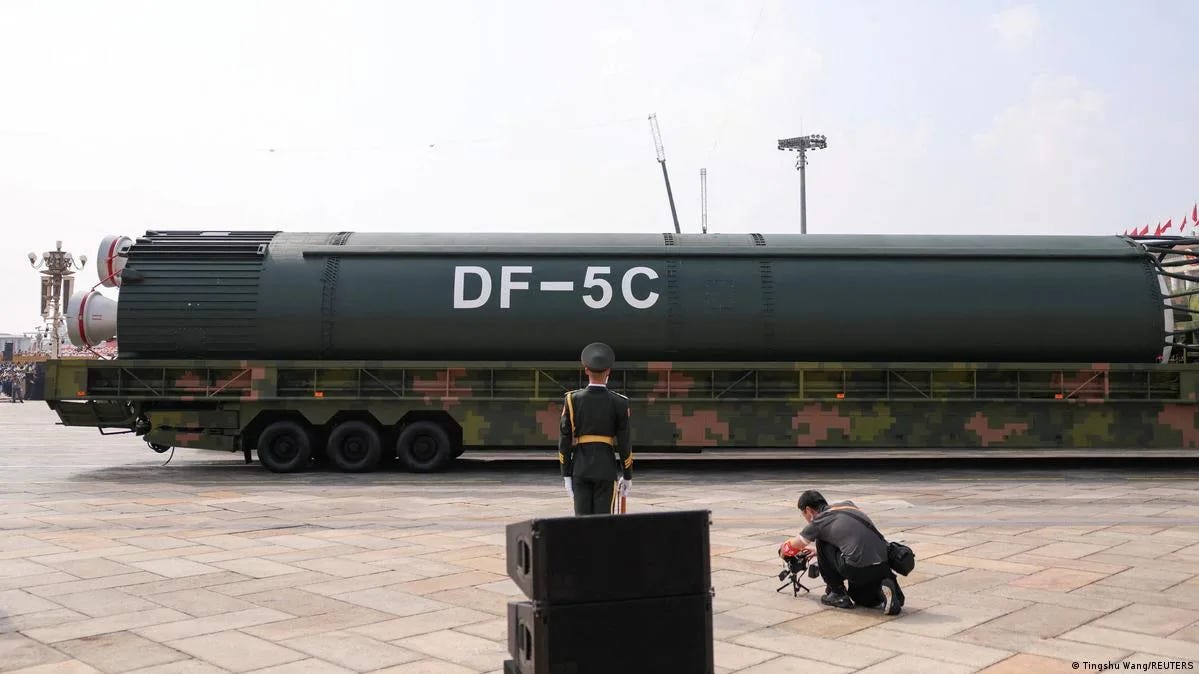
China is building what analysts say could become the world’s third-largest nuclear arsenal within a decade.
Russia has suspended participation in inspection talks due to the war in Ukraine.
France is preparing to expand its arsenal in partnership with European allies.
The United States is engaged in internal debate over resuming nuclear testing.
Thomas DiNanno, Assistant Secretary of State for Arms Control, told the Senate that the Trump administration is still evaluating how to implement the president’s directive to resume testing “on par with others,” without ruling out underground tests.
Arms control experts warn such a move could prompt Russia and China to follow suit, undermining the Comprehensive Nuclear-Test-Ban Treaty.
Meanwhile, Admiral Richard Correll, head of U.S. Strategic Command, has emphasized that existing reports confirm the safety of the U.S. arsenal and that no field testing is necessary highlighting internal divisions within the administration and broader concerns about the erosion of long-standing red lines.
European efforts to expand France’s nuclear deterrence raise another dilemma: will a broader European nuclear umbrella enhance stability, or weaken the global regime?
NATO notes that roughly 100 U.S. nuclear bombs remain deployed across Germany, Italy, Belgium, the Netherlands, and Turkey under nuclear-sharing arrangements, with ongoing modernization efforts.
However, countries such as the Netherlands and Sweden warn that increased emphasis on nuclear weapons could sideline investment in conventional capabilities and cast doubt on Europe’s commitment to disarmament.
In this context, the war appears less as a singular cause and more as a catalyst exposing accumulated pressures: declining trust in U.S. guarantees, renewed great-power competition, and the erosion of international institutions.