

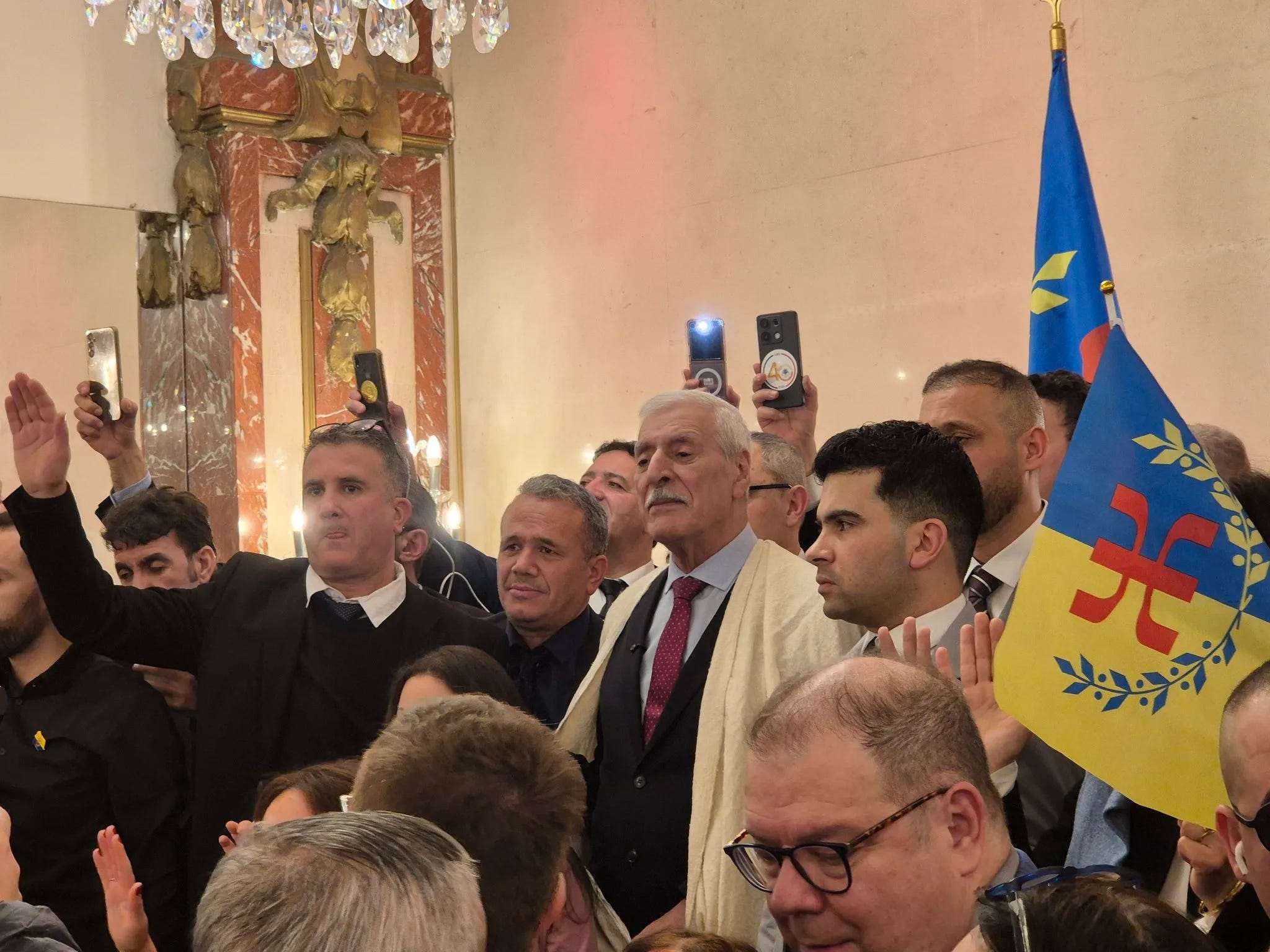
In a swift and controversial move, the separatist movement “MAK” (Movement for the Autonomy of Kabylia), which Algeria officially designated a terrorist organization on May 18, 2021, held a symbolic ceremony to declare the so-called independence of the Kabyle region and announce the founding of what it called the “Federal Republic of Kabylia.” But what is this movement? Who leads it? And what are its goals, reach, and influence within Algeria?
On December 14, at precisely 6:57 p.m., the leader of the MAK, Ferhat Mehenni, signed a document proclaiming the “independence of the Federal Republic of Kabylia” during a ceremony held in a private hall in Île-de-France.
The event was widely covered by various French media outlets, especially right-wing ones known for their hostility toward Algeria. Invitations were also extended to Israeli figures who support the secessionist move, such as academic Emmanuel Navon, who drew parallels between the Kabyle struggle and the founding of Israel.
The ceremony was attended by figures from Morocco, Canada, and France under the banner of defending human and minority rights. The “Kabyle national anthem” was played, with prominent leaders of the movement and members of the self-proclaimed “Kabyle Parliament” in attendance.
Standing before a specially designed flag, Ferhat Mehenni read what he called the “Declaration of Independence,” proclaiming the creation of the “Federal Republic of Kabylia,” outlining its geographic boundaries, and calling for “peaceful negotiations” with the Algerian state, referencing the Czech-Slovak model.
This report delves into the origins and objectives of the movement, the background of its founder, and the extent of its presence and influence within Algeria.
The Rise of Ferhat Mehenni
Ferhat Imazighen Imoula—known in the media as Ferhat Mehenni—made his first televised appearance in 1994 on the Algerian morning show Sabaḥiyyat, hosted by Afifa Maalem. During the interview, he recounted his musical journey that began in the late 1970s and his activism for a pluralistic Algeria.
One of his key statements during the interview was: “I am an Algerian citizen of Amazigh origin... I was born on this noble land… I am a son of Algeria, and I love my country and take pride in my Algerian identity.” However, it appears that over time, Mehenni’s beliefs and core principles shifted, and he adopted a separatist vision.
Initially, he was a leading figure in the Berber Cultural Movement (Mouvement Culturel Berbère) and the Sons of Martyrs Association a group comprising descendants of those who died during Algeria’s war of independence from French colonial rule.
He worked closely with figures like Saïd Sadi, Nordine Aït Hamouda, and the acclaimed francophone writer and intellectual Kateb Yacine (born Mohamed Khelouati). Known as a committed singer of Amazigh identity songs, Mehenni’s music became anthems echoed by crowds in football stadiums.
He was first imprisoned following the Amazigh Spring uprising of April 20, 1980, when Algerian authorities banned a lecture by writer Mouloud Mammeri at the University of Tizi Ouzou.
Mehenni was released on May 14 of the same year but was jailed again in the notorious Berrouaghia prison along with Nordine Aït Hamouda. On December 20, 1985, he was sentenced to three years in prison and fined 5,000 dinars. After 21 months in detention, he was released on April 27, 1987, under a presidential pardon.
The “Satchel Strike” and the Fractures Within
Following his release, Mehenni resumed his activism within the Rally for Culture and Democracy (RCD), alongside Aït Hamouda and Sadi. Their movement was rooted in firm ethical and intellectual values: truth, justice, respect for others, collective action, responsibility, and sacrifice for a shared goal building a united, diverse, and supportive Algeria.
In 1994, a deep rift emerged among Amazigh activists, marking the beginning of internal revolts in the Kabyle region. That year, a school boycott later dubbed the “Satchel Strike” was launched in Tizi Ouzou. The decision was put to a vote at the KATEB Yacine Regional Theater, and Nordine Aït Hamouda was the only figure to vote against it, believing that children should not be dragged into political conflicts.
This strike, which effectively shut down schools across the Kabyle region during the 1994–1995 academic year, became a pivotal moment in the region’s activism. It ultimately led to the creation of the High Commission for Amazigh Affairs on May 27, 1995, following a preliminary agreement between Amazigh associations and then-President Liamine Zéroual.
The institution was tasked with promoting and integrating Amazigh language and culture into Algeria’s social and developmental fabric. Among its accomplishments was the proposal to recognize Tamazight as an official language in the constitutional reform of 2016.
The Black Spring and the Shift Toward Secession
Later, Mehenni split from the RCD following escalating tensions with Saïd Sadi and redirected his focus to the Amazigh cultural movement. After the assassination of iconic singer Matoub Lounès on June 25, 1998, Mehenni took an unprecedented step, openly calling for the establishment of a separate Kabyle state a call that gained traction during the Black Spring protests.
The catalyst was the killing of 17-year-old student Massinissa Guermah on April 20, 2001, by gendarmes in the town of Beni Douala near Tizi Ouzou. The incident ignited massive protests that escalated into violent clashes with security forces, resulting in 126 deaths and over 5,000 injuries.
One outcome of the uprising was the withdrawal of most national gendarmerie units from the Kabyle region, largely due to pressure from the traditional tribal coalition known as the “Arch Movement,” which had emerged as a powerful grassroots force demanding recognition of Amazigh identity. Seizing the moment, Mehenni founded the Movement for the Self-Determination of Kabylia (MAK) following a small gathering in Makouda on August 24, 2001. Soon after, he left Algeria permanently for Paris.
He began appearing frequently at the UN Permanent Forum on Indigenous Issues, an advisory body under the UN Economic and Social Council. There, he condemned the Algerian regime and advocated for Kabyle secession. On June 1, 2010, he announced the formation of a Kabyle government-in-exile, appointing himself as president and naming nine ministers.
Controversial Ties with Israel
Around this period, Mehenni’s relationship with Israel began to solidify. In 2012, he visited Tel Aviv and met with the Deputy Speaker of the Knesset. He expressed solidarity with Israel and drew parallels between the Kabyle and Israeli experiences, saying: “We are in a hostile environment.
Both our peoples are on similar paths but Israel already exists, and that is the only difference.” He even promised to open an Israeli embassy in Kabylia if it became independent. The visit sparked a storm of condemnation across Algeria.
His former prison mate and longtime friend, Nordine Aït Hamouda, described this chapter as “a catastrophic betrayal” and “the worst kind of treachery,” pointing to Mehenni’s appearance waving the Israeli flag during protests in Paris.
Just a week earlier, Mehenni’s nephew, Ben Zohir Jaoud, published an open letter urging him to reconsider:
“I ask you to think again not to give me the right, but to prevent your name from being used by those who wish to weaken the homeland you once claimed to love… You always said you did it for Algeria. So how could you renounce it today after a lifetime of singing for it? You, more than anyone, know that our grandfather died a martyr for a united Algeria not for a divided one, not to see his descendants exploited by those seeking to tear the country apart.”
State Response and the Terrorism Designation
At the height of the 2019 Algerian protests, which saw millions pour into the streets demanding regime change and opposing former President Abdelaziz Bouteflika’s bid for a fifth term, the University of Tizi Ouzou allowed Ferhat Mehenni to deliver a remote lecture advocating the partition of Algeria.
The authorities responded swiftly, banning the Amazigh flag from protests and launching a sweeping crackdown on MAK activists in the Kabyle region.
In May 2021, the Algerian government officially classified MAK as a terrorist organization and issued an international arrest warrant for Ferhat Mehenni, labeling him a terrorist as well.