

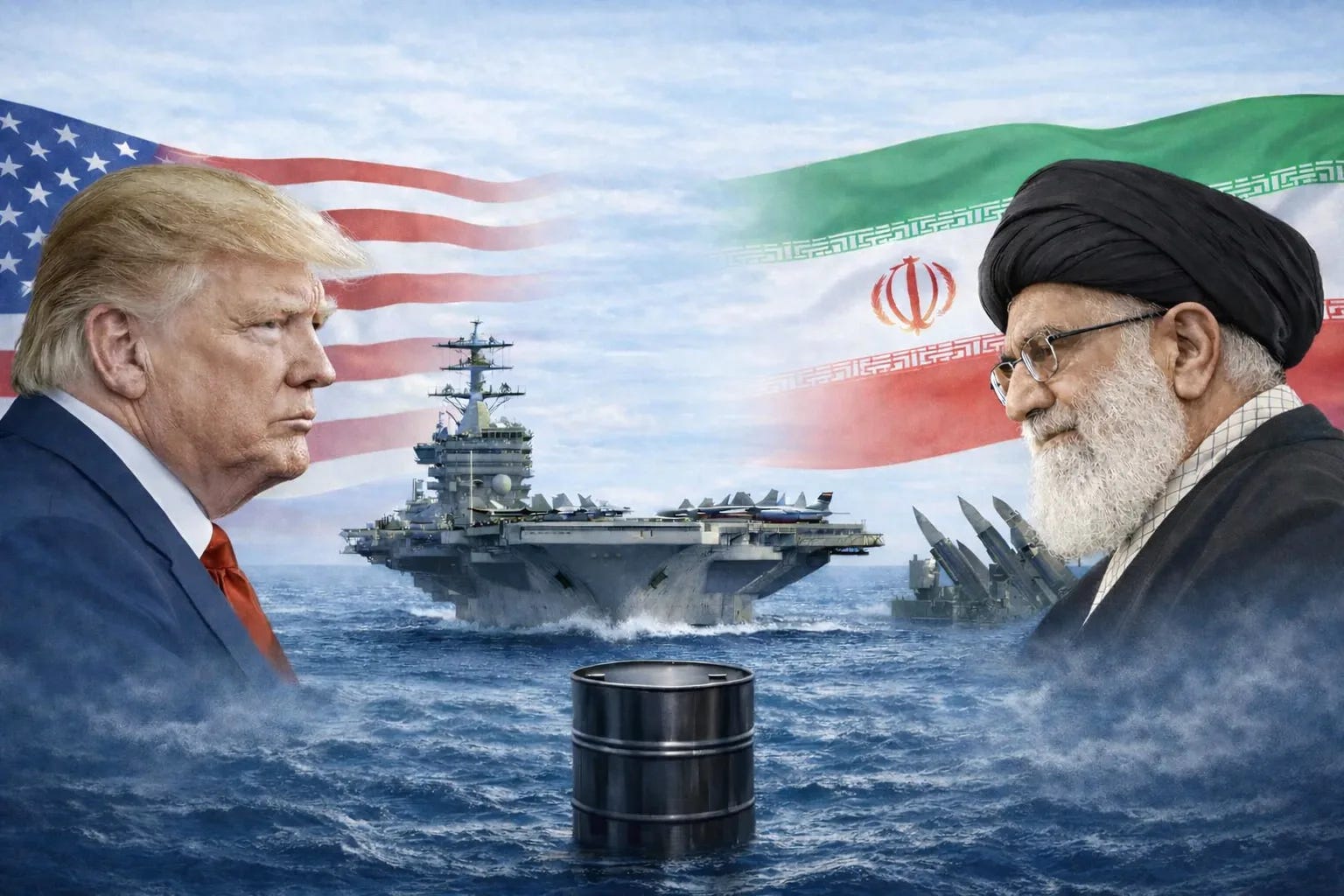
Despite the fluctuating pace of negotiations, indicators of escalation are mounting in ways that suggest an almost inevitable slide toward war particularly with the deployment of the U.S. aircraft carrier Abraham Lincoln to the Middle East, alongside Iran’s launch of large-scale military exercises in the Strait of Hormuz.
These developments have been accompanied by conflicting statements that keep the door to negotiations technically open from both Washington and Tehran, while simultaneously pairing diplomacy with explicit threats. U.S. President Donald Trump has warned of a “bad day” should no agreement be reached, while Iran’s Supreme Leader has responded that even the world’s most powerful armies could suffer painful blows. Iranian officials have gone further, threatening to send an American aircraft carrier “to the bottom of the sea.”
In reality, the prospects for successful negotiation rounds leading to a deal now appear increasingly remote. A wide gap separates Washington’s high-ceiling demands backed by Israeli pressure seeking a deal that amounts to total submission and Tehran’s limited flexibility, which centers on an agreement involving reasonable concessions that do not compromise Iran’s deterrent capabilities or its future capacity for confrontation. In practical terms, this means excluding the ballistic missile program and regional alliance files from the outset.
Accordingly, attention is shifting toward the form and limits of a potential military confrontation. No party possesses prior control over the pace of escalation once events begin to roll downhill. Any forthcoming clash would not resemble a brief, limited war; rather, available indicators suggest that the United States would lead the strike, with the principal objective being a qualitative change in the structure of the current regime perhaps even its eventual removal in one form or another.
This points to a war designed to be overwhelming and goal-oriented. For Iran’s leadership, that creates a zero-sum equation, compelling it to maximize the cost of confrontation and adopt protective measures aimed at frustrating anticipated U.S. objectives.
From Decisive Strike to War of Attrition
Although President Donald Trump’s administration has leaned toward an isolationist posture favoring the maintenance of dominance at minimal cost and avoiding long, expensive wars it prefers deal-making or coercive transformation under the doctrine of “peace through strength,” which Trump has presented as the organizing principle of his approach to peacemaking.
In this context, the Venezuela model where President Nicolás Maduro was removed in what was described as a swift, “clean” operation that led to a qualitative shift in Caracas’s posture toward U.S. demands has been viewed in the White House as a desirable template should threats alone fail to achieve objectives.
Trump’s national security strategy, which classified Latin America as part of America’s exclusive sphere of influence effectively reviving the Monroe Doctrine in updated form has likewise framed Iran as a persistent strategic threat and the principal source of regional instability.
According to 2025–2026 policy documents, the administration has adopted “peace through strength” as a means of weakening Iran economically and militarily, preventing it from acquiring nuclear weapons, and reinforcing allied security in ways that could eventually allow Washington to reduce its direct military footprint.
Over time, Washington’s position appears to have shifted from seeking a “satisfactory” nuclear agreement toward a greater inclination to alter the regime’s structure itself either through internal change supported by U.S. military intervention enabling a new ally to stage a coup, or through military action backing widespread protests that swept Iranian streets earlier this year. Both paths, however, seemed to recede after Tehran’s containment measures, even as the White House raised expectations expectations fueled by the swift outcome in Venezuela.
The ceiling set by President Trump has now become a constraint on both diplomatic and military tracks. The scene has narrowed to two stark choices: complete diplomatic submission or total military resolution. This binary framing complicates both avenues in the absence of any “magic plan” capable of delivering rapid, decisive results, particularly given Iran’s limited flexibility. It has also opened the door to more gradual, complex operational scenarios.
In that vein, two U.S. officials revealed that the military is preparing for the possibility of sustained operations lasting weeks against Iran should President Trump order an attack—potentially transforming the confrontation into a more dangerous conflict than previously seen between the two countries, according to Reuters.
They added that the Pentagon has dispatched an additional aircraft carrier to the Middle East, along with thousands of troops, fighter jets, guided missile destroyers, and other firepower capable of both offensive and defensive operations.
Officials emphasized that planning this time is more complex. The U.S. military could conduct a sustained campaign targeting Iranian government and security facilities not merely nuclear infrastructure with the expectation of direct Iranian retaliation leading to prolonged exchanges of strikes and reprisals.
Experts caution that U.S. forces would face far greater risks in such an operation against Iran, which possesses a vast missile arsenal. Iranian retaliatory strikes could also heighten the risk of a broader regional conflict.
White House spokesperson Anna Kelly, responding to questions about preparations for a potential long-term operation, stated that “Trump has all options on the table with respect to Iran,” adding that he listens to a range of views before making final decisions based on U.S. national security interests.
Tehran, for its part, has sought to cement the idea that any attack would trigger an immediate “regional war,” placing Israel at the forefront of potential targets alongside U.S. interests and bases in the Middle East.
Statements from Iran’s regional allies particularly in Yemen, Iraq, and Lebanon have aligned with that message, asserting that they would not remain neutral in such a confrontation. This steadily widens the risk of escalation into an open conflict difficult to contain geographically or predict in outcome a protracted war of attrition that could engulf the Middle East.
How Iran Thinks About a Long War
The central hesitation lies in the fact that force in the Iranian case does not automatically produce swift resolution. Speed is the political currency Trump values most. Should confrontation slide into a multi-front war of attrition following an initial U.S.–Israeli strike, Iran’s likely approach would not hinge on achieving direct military superiority, but rather on managing time transforming a rapid shock into a prolonged, high-cost conflict politically and economically for its adversaries.
Iranian researcher Arash Marzbanmehr argues that Tehran has spent decades preparing for a very different kind of conflict not to secure a lightning victory, but to ensure that any war with its adversaries would be long and costly.
Its strategy centers not on regional domination or spectacular triumphs, but on endurance and imposing high costs. Rather than delivering a knockout blow, Iran aims to draw opponents into wars of attrition that drain resources, erode political capital, and exhaust even the strongest armies over time.
This dynamic helps explain continued U.S. hesitation and Trump’s cautious posture. Though a risk-taker by instinct, he is not reckless; he gambles when odds favor swift, tangible returns. Iran presents a different scenario: high risk, limited gains, and a narrow path to decisive closure without the guarantee of a clean victory.
In practical terms, Iran’s response to an initial attack would likely focus first on absorbing the blow during the opening hours. Tehran would seek to establish a psychological deterrence equation before a purely military one, officially declaring that the strike “failed to achieve its objectives,” accompanied by images of intact facilities.
Simultaneously, it might carry out limited, carefully calibrated missile strikes against U.S. bases in the Gulf or Iraq—demonstrating capability without provoking immediate full-scale escalation. The goal would be to prevent the image of a decisive knockout and reintroduce uncertainty.
In subsequent days, Tehran would likely shift to gradual attrition: intermittent waves of missiles and drones, varying launch patterns and locations, relying on a dispersed underground infrastructure.
Iran could also progressively activate its allies: missile pressure from Lebanon, targeting U.S. interests in Iraq, threats to maritime navigation in the Red Sea or Gulf expanding tension incrementally to complicate risk management for Washington and Tel Aviv.
Economically, maritime routes and energy markets would serve as primary attrition tools. Even short of closing the Strait of Hormuz, raising shipping and insurance risks could significantly impact oil prices, transforming a bilateral military clash into a partial global economic crisis.
Politically, Iran’s leadership would frame the conflict as existential, bolstering domestic cohesion. Despite internal dissent, Iranian society retains a strong sense of national identity, and history shows that regimes facing direct external threats often benefit from a “rally around the flag” effect buying time to consolidate the home front.
If hostile strikes diminish, Tehran might seek to stabilize a new deterrence balance. If they intensify, larger fronts—especially Lebanon—could be activated, dramatically raising regional stakes.
Success would hinge on three factors: economic resilience at home, the degree of allied engagement across the Middle East, and the tolerance of public opinion in the United States and Israel for a prolonged multi-front war particularly if Iran succeeds in raising tangible costs.
The Limits of America’s Capacity for Attrition
America’s ability to manage a long, multi-front war of attrition cannot be measured solely by military might. It must account for political endurance, geographic spread, and the cumulative strategic cost over time.
The United States enjoys significant qualitative and technological superiority, enabling it to launch any confrontation with overwhelming force. Yet attrition wars test patience, economies, and alliances as much as firepower.
America’s strategic depth its homeland far from direct bombardment provides decision-makers with operational latitude absent existential pressure. Its network of bases across the Gulf, Eastern Mediterranean, and Europe offers flexibility but also multiple friction points vulnerable to missiles, drones, or indirect operations.
Economically, Washington can finance a long war more easily than its adversaries. Still, modern attrition extends beyond battlefield costs to energy markets, supply chains, and inflation. If regional escalation disrupts shipping or oil facilities, global economic strain could rebound politically on Washington especially absent clear, decisive results.
Domestically, Iraq and Afghanistan demonstrated that Americans may tolerate limited air campaigns but grow wary of open-ended conflicts, particularly if casualties mount. Multi-front engagements Lebanon, Iraq, the Gulf, perhaps the Red Sea would make message management as critical as battlefield management.
Washington would also need coalition backing while avoiding large-scale ground deployments. Yet international political support for a war of this scale remains limited, with notable reservations among several U.S. Middle Eastern allies—Israel excepted—about deep involvement.
Militarily, the United States can sustain long-term air and naval superiority, rely on long-range capabilities to minimize casualties, and leverage intelligence and space assets to track launch networks. But in attrition warfare, the adversary seeks not to defeat the U.S. fleet, but to sustain low-to-medium intensity bleeding accumulating costs and diverting American strategic attention from other theaters such as East Asia and Europe.
Should regional fronts expand, Washington would face a prioritization challenge. Each additional front whether through armed allies or maritime threats would require resource redistribution. Alliances become vital to share burdens, though expansion carries risks of unintended escalation.
In short, the United States materially can wage a long attritional conflict. It typically seeks to avoid such wars, however, because they consume political capital more than ammunition. Managing time, alliances, and strategic focus would become the real battlefield.
Israel Confronting Multi-Front Attrition
For Israel, in a gradually evolving war without decisive resolution against Iran, calculations differ fundamentally from Washington’s due to geography and the immediacy of threat.
Unlike the United States, Israel lacks strategic depth. Prolonged attrition would keep its home front under sustained missile or security pressure. While capable of short, high-intensity escalation waves, extended attrition poses a broader strategic challenge.
Israel retains strong long-range strike capabilities, regional air superiority, and multi-layered air defense systems. Yet in a prolonged conflict, the question shifts from the ability to strike to the capacity to absorb repeated retaliation. Active fronts such as Lebanon could impose sustained daily fire, creating economic and social strain.
Advanced missile defense systems, however effective, are not designed for indefinite high-intensity daily flows without significant economic and logistical costs. Repeated interceptions require expensive replenishment turning attrition into a logistical as much as a military issue.
A likely Iranian and allied approach could involve “missile saturation,” exhausting Israeli air defenses and creating openings for impactful strikes. Active participation from Lebanon or Yemen would multiply operational pressure.
If war drags on without decisive results, Israeli leadership would confront a central question: does continued operation enhance deterrence, or does unresolved attrition erode it?
Historically, Israel has sought swift resolution or recalibrated rules of engagement rather than managing prolonged low-intensity exchanges. Extended missile threats to the home front generate cumulative political and social pressure.
Prolonged conflict would also weigh on domestic politics, including Prime Minister Benjamin Netanyahu’s electoral prospects in a sensitive election year possibly pushing Israel toward either concentrated escalation to accelerate resolution or pressing Washington toward de-escalation arrangements.
Unlike the United States, Israel cannot distance the war geographically. It remains at its heart, narrowing its margin for temporal maneuver. Thus, absent decisive outcomes, it may pursue escalation to reshape rules or seek termination under conditions restoring deterrence.
The First Strike as the Decisive Variable
The trajectory of escalation will hinge largely on the nature of the first strike and how Washington translates the largest U.S. military buildup in the Middle East since the 2003 Iraq War into operational action.
Various scenarios have circulated among analysts and administration-linked sources. Yet none appears to fully meet the criteria set by President Trump’s cost-benefit mindset: he seeks clarity and decisiveness, but fears entanglement in an open-ended war.
Former Israeli Military Intelligence chief Tamir Hayman noted that the U.S. has assembled two naval strike groups far fewer than the six mobilized before Saddam Hussein’s removal in 2003 suggesting insufficient force for regime collapse, particularly given Iran’s greater complexity.
An alternative, he argues, may be a broad campaign to weaken rather than immediately topple the regime potentially targeting high-sensitivity figures, including even the Supreme Leader, alongside the Revolutionary Guard and security institutions. Israel might simultaneously be tasked with dismantling Iran’s missile infrastructure.
Israeli journalist Ronen Bergman, writing in Yedioth Ahronoth, posits a different objective: deliver a concentrated, punishing strike over several days to inflict maximum damage, then compel Tehran back to negotiations under harsher terms.
Yet Iran has repeatedly confounded adversaries’ expectations. Much will depend on Tehran’s capacity to absorb the initial blow and impose counter-costs on the United States and Israel.
If Iran weathers the first strike and effectively raises the stakes, all options become more complex. The region could enter a protracted confrontation with no clear victor reshaping regional balances beyond the battlefield.
As history has often shown, wars in the Middle East rarely end with the first strike. More often, they begin with it.
