

On the morning of December 5, 2023, the corridors of Egypt’s Ministry of Supply bore witness to an unprecedented event: a force from the Administrative Control Authority stormed the minister’s office to arrest his closest advisor, Ahmed Mahdy, following the exposure of an extensive corruption network.
The network had misappropriated hundreds of tons of subsidized foodstuffs intended to lower prices under a government initiative and resold them on the black market, reaping profits exceeding 1.5 billion Egyptian pounds.
Mahdy was the most powerful man inside the ministry. After reaching retirement age, he was appointed as “advisor to the minister,” and his secondment was renewed for seven consecutive years. A few months before his downfall, he even received an extraordinary promotion. The shocking irony: his official title was “Minister’s Advisor for Monitoring and Distribution,” making him the chief official responsible for ensuring the availability of goods, their fair distribution, and market‑price monitoring.
The case became publicly known as the “Supply Ministry Corruption.” But it was not the first. In 2018, three ministerial advisors and a then-deputy minister, Major General Alaa El-Din Fahmy, were arrested in a bribery scandal involving 2 million Egyptian pounds paid by a food-supply company. After 17 months of judicial investigations, Fahmy was sentenced to 10 years’ strict imprisonment and fined 7.5 million pounds.
Although the three advisors turned prosecution witnesses and were spared punishment after admitting to their intermediary roles, the case exposed a darker reality beyond a single incident: a system in which advisors get hefty salaries while the nature of their roles and actual influence within state institutions remains murky.
An Army of Advisors
Behind air-conditioned government offices and heavy wooden doors, a class of “advisors” gradually became a fixed layer in the state’s bureaucratic structure. While some may truly hold expertise and work quietly at stable salaries, the majority carry the title merely as of honor. They join a long queue of officials bearing titles such as “assistant,” “deputy,” and “expert.”
What began as mutual favors and personal benefit evolved over successive regimes into a deeply rooted phenomenon a “malignant disease,” as some analysts have put it spreading across wide sectors of the state apparatus.
During the government of Kamal el-Ganzouri appointed by the military council following the January 2011 revolution the first official disclosure was made: the government announced 1,490 advisors with an annual cost of 72 million pounds. Yet, later independent research centers estimated the actual number of advisors across ministries and governorates at around 73,000, collectively earning up to 1.5 billion pounds per month.
Day after day, the strain intensified. Today, the number of advisors in the civil service is estimated at about 83,000, according to the Egyptian Center for Economic Studies. They allegedly receive a quarter of the state’s wage bill, collecting no less than 2 billion pounds monthly not including additional bonuses and indirect perks placing a heavy burden on public finances.
Other reports go further, claiming the administrative apparatus includes up to 450,000 advisors, paid roughly 20 billion pounds annually out of a total 85 billion pounds allocated for salaries for some 5.7 million civil servants.
Over time, this layer evolved into a parallel network of senior positions within the government a “shadow government.” Its members draw large financial privileges while the state imposes austerity and streamlining on citizens. Yet for many, the real function of these posts remains unclear.
The presence of advisors varies across ministries. Both service ministries directly linked to citizens’ lives such as Health, Education, and Social Solidarity and strategic ones like Petroleum, Electricity, or Transport host large numbers of them. The same applies in economic agencies, the banking sector, some universities, and regional governorates.
This reality was described in a report by the pro‑establishment Egyptian newspaper Veto. The report spotlighted some ministries avoiding so-called “red line” institutions like Foreign Affairs, Interior, Defense, and Justice yet broke the taboo when it touched on the Ministry of Transport. The ministry is led by General Kamel El-Wazir, known to be close to President Abdel Fattah el‑Sisi.
According to the report, the Transport Ministry relies on a large number of advisors, most of them former military officers especially in sectors like roads, bridges, and maritime transport. For example, Major General Reda Ismail was appointed head of the maritime transport sector as a civilian, shortly after retiring from the armed forces.
In this ministry, the title “Advisor to the Minister of Transport” often serves as an honorary post assigned to dismissed or retired officials a practice known as the “seniority system.” This effectively turns advisory roles into a mechanism to keep former leadership figures in formal positions, adding financial burdens without real returns.
On paper they are “advisors,” but in practice they become “shadow ministers,” drawing up policies, overseeing billions of pounds in projects railways, subways, ports — while enjoying undisclosed privileges, all borne by a heavily indebted ministry struggling financially.
Phantom Roles with Sky‑High Salaries
The Ministry of Petroleum leads the pack when it comes to reliance on advisors and seconded personnel. According to a former Member of Parliament, Amira Abu Shaqqa, the ministry and its affiliated companies employ a huge number of advisors exceeding the number of actual staff estimated at more than 1,000.
The majority are concentrated in major companies such as ENPPI, Petrojet, and GASCO. Their monthly salaries are described as “astronomical,” ranging between 50,000 and 150,000 pounds, without requirements for daily attendance or fixed working hours.
The problem lies not only in their vast numbers but also in how they are appointed often based on favoritism and personal connections. Many are outsiders to the sector, and some have reached old age, raising serious questions about the value they add or their capability to contribute to state economic development.
Salaries for senior leadership and advisors in the petroleum sector aren’t capped by official pay scales. Instead, they are set directly by the heads of agencies and companies, along with generous allowances, bonuses, and travel stipends paid routinely.
The contrast with regular employees is stark. The system forces the ministry to borrow and halt new administrative and contract-based hires altogether which opens a wide door to corruption. According to global indices, on this basis Egypt ranks 130th out of 180 countries in corruption.
In the Ministry of Education, which is most directly tied to citizens’ daily lives, clearly defined roles are crucial not mere paper titles. Yet reality shows a deep dysfunction in how responsibilities are distributed among layers of advisors, deputies, and assistants.
One prominent example is Dr. Ahmed Daher, who spent five years shuffling between advisory and deputy roles in both Education and Communications ministries at one point holding both titles simultaneously. This reflects a pattern akin to that of Transport Minister El-Wazir, who once combined oversight of both Transport and Industry.
Despite such cases, however, they remain limited exceptions compared to the sway held by figures such as Major General Yousri Salem, Deputy Minister at the Authority for Educational Buildings. His secondment has been repeatedly renewed year after year since 2015, even though ministers changed many times, yet he remains untouched.
Recently, the ministry has brought in more advisors including Medhat Hilal as Advisor for Administrative Development, and Sherine Hamdy as Advisor for National Institutes continuing a trend of expanding the circle around the ministry regardless of whether the added positions serve real functions.
Creating Positions Without Functions
The inflation of positions becomes even more absurd within the Ministry of Higher Education, where the administrative structure is replete with roles that appear redundant or overlapping. There is a Deputy Minister for Innovation and Artificial Intelligence, an Assistant Minister for Smart Governance, alongside advisers for international organizations, cooperation, national projects, strategic planning, economic policy, technical affairs, student activities some of whom simultaneously run institutes for leadership preparation.
Other crucial responsibilities such as technological universities or the national knowledge bank are handled by teams of advisors whose impact on performance or efficiency remains invisible. Rather than enhancing competence, these positions have become additional financial and bureaucratic burdens on the state.
The same pattern repeats in the Ministry of Environment, where most advisors exist only on paper. Actual engagement is restricted to a very small number, while the rest remain virtually absent as if their posts were purely administrative formalities.
Similarly, in the Ministry of Local Development, the trend favors retired generals and police brass. The ministry relies on an extensive network of advisors rotated through various posts over many years with no real criteria for performance evaluation nor any meaningful impact.
For example, Major General Hamdi El-Gazzar who had served as head of security in the Red Sea governorate and briefly as governor of Sohag returned later as Advisor for Parliamentary Affairs. He also holds membership in the Administrative Development Agency and the central Local Affairs Secretariat of the ruling party, “Mostakbal Watan.”
Likewise, Khaled Qassem moved from his role as Assistant Minister for Knowledge, Education, and Science to become Assistant Minister for Environment and Community Development two fields with no logical connection apart from the continued phenomenon of distributing titles to advisors without objective criteria or functional necessity.
The Minister’s Inner Circle
In the Ministry of Labor, the scene takes a different shade of extravagance and favoritism. While the minister, Mohamed Gibran, initially pledged to reduce the number of advisors and thanked many for their previous service, he soon began recruiting new faces signaling that every minister prefers to bring along his “own clique.”
A similar pattern emerged in the Ministry of Electricity. Its minister, Mahmoud Asmat, issued a decision to halt new adviser contracts, review existing ones, and prevent retaining anyone over the age of 60 openly acknowledging the high monthly cost incurred by advisors. Yet, in under a year, new advisors were hired mostly former civil‑aviation officials raising widespread doubts about their relevance to the electricity sector.
The Ministry of Social Solidarity, despite its service-oriented role, is mired in overlapping positions and repeated redundancies. Instead of focusing on improving its services, the minister, Maya Morsi, appointed an Assistant for Social Protection, another for International Cooperation, a spokesperson (despite having a media advisor), along with multiple advisors for programs like “Moda,” disability affairs, economic empowerment, early childhood essentially creating new advisory posts for every conceivable issue, no matter how minor.
Likewise in the Ministry of Agriculture, the minister relies on a large number of advisors to follow up on crucial areas such as livestock production, agricultural research, and horizontal expansion in addition to far larger numbers in affiliated agencies such as the Fisheries Authority and the Land Reclamation Authority. Many of these advisors do nothing more than prepare and forward reports a duplication of roles otherwise handled by deputy ministers and sector heads.
In the Ministry of Culture too, the same pattern reemerged. The minister, Ahmed Fouad Henne, appointed seven new advisors with portfolios covering crucial areas such as investment, visual identity and design, cultural heritage, social development, external relations tasks that should ostensibly be handled by existing central departments.
The Supply Ministry remains plagued by the same issue. Its own employees rarely get real opportunities for advancement or substantial assignments, while external advisors and assistants are continuously appointed. Thus, it is unsurprising that corruption cases keep resurfacing especially among the advisor class and heads of subsidiary companies, who often ascend to their posts through personal connections and widespread favoritism.
The same structural corruption pattern appears in the Ministries of Finance and Health both heavily staffed with advisors appointed without clear criteria or performance assessments. The Finance Ministry tops the list with monumental salaries allocated to its advisors funds that, ironically, could have gone toward alleviating unemployment or reviving long‑dormant factories and companies.
Presidential Advisors
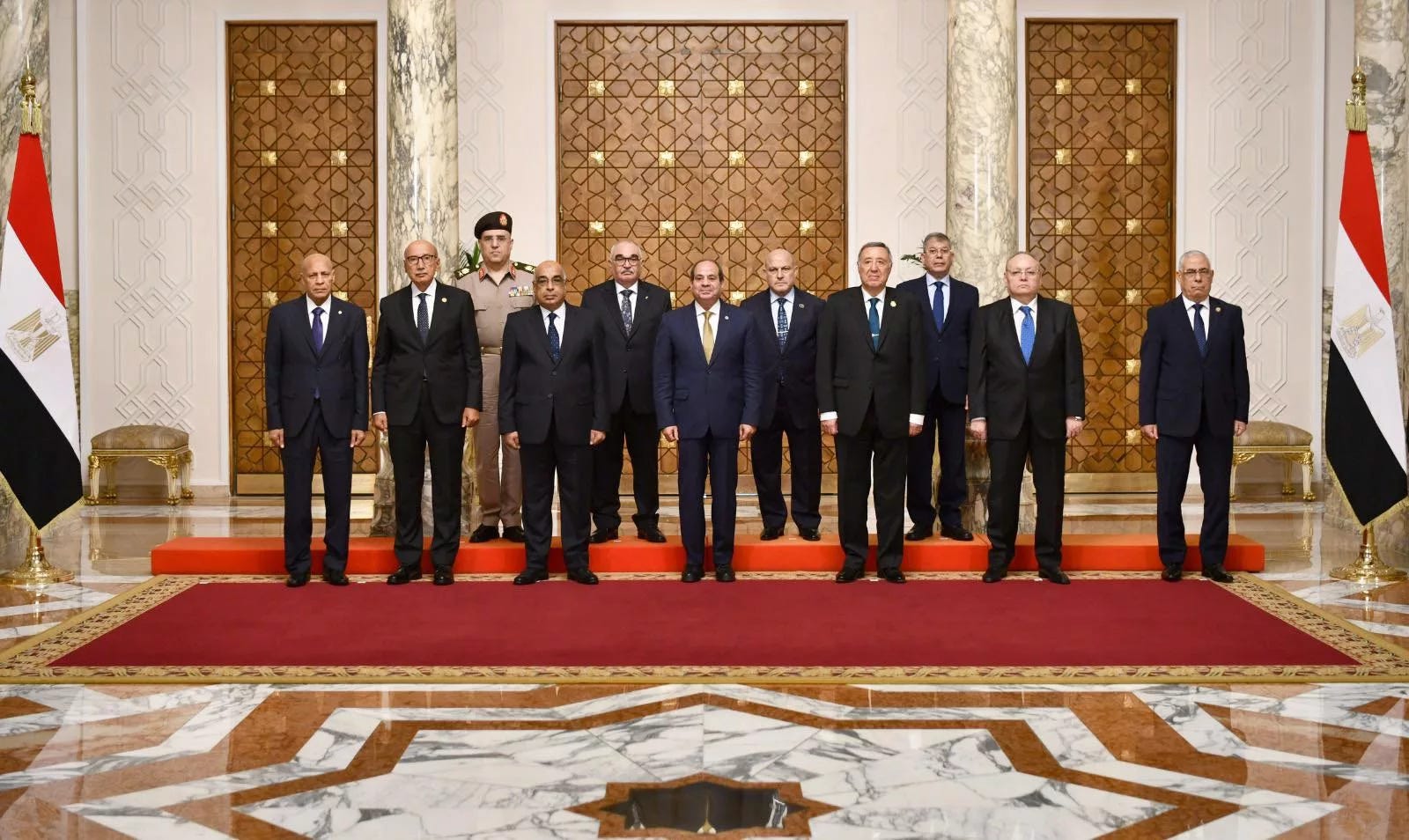
The phenomenon of the “Republic of Advisors” doesn’t end with ministries and governmental agencies. It extends into the presidency itself, where a number of unannounced advisors similar to those in strategic ministries occupy honorary positions given as political rewards to dismissed or retired officials. These posts grant their holders generous privileges, often with no clear job description or tangible function.
For instance, President el‑Sisi once relieved 11 advisors simultaneously among them former Interior Ministers Ahmed Gamal El-Din and Magdy Abdel Ghaffar (formerly Advisors on Security and Counter‑Terrorism), and the former Suez Canal Authority Chairman Mounir Mameesh (Advisor for the Suez Canal Axis and Maritime Ports). This was the first time such a large group of presidential advisors had been dismissed at once since el-Sisi came to power in 2014.
Yet this list does not encompass all who continue to occupy advisory posts. Prominent figures still prominent in the president’s inner circle include former International Cooperation Minister Fayza Abu El-Naga (Advisor on National Security), former South Sinai Governor Khaled Fawda (Advisor on Local Development), former Health Minister Mohamed Awad Tag El‑Din (Advisor on Health and Prevention), former Prime Minister Ibrahim Mahlab (Assistant to the President for National and Strategic Projects), former Chief of Staff of the Armed Forces Mohamed Farid Hegazy (Advisor for the “Decent Life” National Initiative), former Head of Military Intelligence Mahmoud Hegazy (Advisor for Strategic Planning and Crisis Management), among many others.
At the same time that a batch of advisors was relieved, the president appointed new ones — including former Defense Minister Mohamed Zaki (Assistant for Defense Affairs), former Chief of Staff Osama Askar (Advisor on Military Affairs), former Presidential Office Chief Major General Mohsen Abdel Nabi (Advisor on Media), former Planning and Economic Development Minister Hala El-Saeed (Economic Advisor to the President), and most recently former Head of the Armed Forces Financial Affairs Authority Major General Ahmed El‑Shazly as the President’s Financial Advisor.
In closing, the “Republic of Advisors” in Egypt stands as a mirror reflecting a deep dysfunction in the management of public funds. While many advisory posts across ministries and governmental bodies filled through favoritism and patronage — grant large salaries and privileges, the holders often offer no real contribution or visible effect. Meanwhile, ordinary citizens continue to struggle daily for access to basic services.