

Day after day, the claims of Sudanese government officials are being validated: ending the conflict now approaching its third year requires halting the growing flow of support from the United Arab Emirates to the Rapid Support Forces (RSF). Yet Abu Dhabi has continued to open new routes to sustain its backing without limits.
The supply network operating through shadow networks, armed groups, and state actors reveals the UAE’s apparent determination to prolong the conflict at any cost, disregarding Sudan’s sovereignty and the humanitarian catastrophe triggered by the war. This year alone, 33 million people are in need of assistance.
Since the outbreak of fighting, the UAE initially routed weapons to the RSF via Chad. It soon shifted to more complex pathways through Libya, Nyala Airport, and makeshift airstrips in Darfur, extending to the Central African Republic and Ethiopia while simultaneously consolidating the militia’s growing political influence across East Africa.
The UAE continues to furnish the RSF with military equipment, including air defense systems, despite a United Nations Security Council embargo prohibiting arms transfers to all entities in Darfur, western Sudan.
Under Pressure
Before the conflict erupted on April 15, 2023, the RSF functioned as a privileged arm of the Sudanese state, enjoying sweeping economic and political influence. But that standing quickly crumbled under sustained military strikes targeting its bases in the capital, Khartoum.
As these blows weakened the militia’s hard power, the UAE began constructing an air bridge to supply it with equipment. Early shipments included communications systems, guided munitions, mortar shells, and anti-tank missiles. UN experts tracked military cargo flights between June 2023 and May 2024 from Abu Dhabi International Airport to Amdjarass Airport in Chad.
These operations involved Ilyushin Il-76TD aircraft and similar planes previously linked to an Emirati air bridge supporting retired Libyan General Khalifa Haftar. At least three of these aircraft had prior records of arms trafficking, including one that departed Al Dhafra Air Base for Amdjarass on September 27, 2023.
Flight tracking data and documents reviewed by Reuters in late 2024 showed at least 86 flights from the UAE to Amdjarass since the war began. Three-quarters were operated by airlines previously accused by the UN of transporting Emirati weapons to a Libyan warlord.
Weapons are transported from Abu Dhabi International Airport and Al Dhafra Air Base—with stopovers in Uganda or Kenya to Amdjarass and N’Djamena in Chad. From there, supplies are moved overland into West Darfur via the Adré border crossing.
The RSF committed acts of genocide against the Masalit ethnic group in West Darfur as Emirati support began arriving. This assistance enabled it to seize the army base in Nyala in October 2023 and subsequently dominate South, East, and West Darfur before the end of the war’s first year.
Although the UAE has turned Chad into a zone of economic and military influence through major investments, N’Djamena has reportedly scaled back arms flows under mounting evidence of involvement and a Sudanese complaint filed with the African Union.
Still, supplies are unlikely to have ceased entirely. Amdjarass Airport’s proximity to West Darfur makes it a vital route, particularly in emergencies.
Chad’s role extends beyond facilitating arms transfers; it has also provided political backing to the RSF by engaging with it at border crossings such as Adré, Um Dukhn, and Foro Baranga despite their being outside Sudanese government control—and by allowing mercenaries to transit its territory.
The Backbone
Increased scrutiny of Amdjarass Airport forced the UAE to reroute shipments through eastern Libya, under the control of its ally Khalifa Haftar. This corridor has emerged as the most stable, given the desert terrain that allows ground transport away from surveillance and direct political pressure.
The UAE transports military supplies via Ilyushin Il-76 cargo aircraft to Kufra Airport, once a remote civilian airstrip but now transformed into an active military logistics hub, with expanded runways and cargo facilities.
A recent report indicates that at least 105 cargo planes landed at Kufra between April and November 2023. A more recent assessment suggests nearly 600 Emirati flights reached Kufra in 2025, with weapons shipments then forwarded to RSF strongholds in El Fasher and Nyala.
These flights originate from Emirati bases, sometimes stopping at African airports such as Uganda or Kenya, or taking filtered routes across East Africa to obscure their trajectories. Flight path analysis shows that some aircraft disable tracking signals mid-flight.
Weapons arriving in Kufra are smuggled into North Darfur via long-established routes through the tri-border area linking Sudan, Libya, and Egypt an area seized by the RSF in June 2025, paving the way for increased arms trafficking.
Beyond the tri-border zone, Emirati weapons enabled the RSF to capture El Fasher in North Darfur last October, where it also carried out acts of genocide after destroying dozens of surrounding villages.
How Are Supplies Moved from Libya?
Investigative reports indicate that arms shipments move from eastern Libya to Darfur via two routes: one by air to Nyala Airport or makeshift airstrips, where they are distributed to combat fronts.
The second route is overland. Weapons are transported from Kufra in armed vehicles to the tri-border area, then into the deserts of North Darfur where RSF bases are located and onward to El Fasher and Kordofan.
With these supplies, the RSF has extended its control over most of Darfur and expanded the conflict into West Kordofan, which fell fully under its control following its takeover of Babanusa and the Heglig oil fields after capturing El Fasher.
The supply lines from Kufra likely branch into remote agricultural tracks toward North Kordofan, allowing the militia to retake the city of Bara shortly after losing it to the army. Diversifying routes reduces vulnerability to increasingly frequent army strikes.
Geographic Proximity
Abu Dhabi has not limited itself to Chad and eastern Libya. Reports suggest it has converted Bangui Airport in the Central African Republic—bordering South Darfur—into a new hub for receiving military equipment before transferring it to the RSF.
This shift follows Emirati investments in the Central African Republic, including securing concessions for airstrips near the Sudanese border, facilitating the transformation of Bangui into a permanent supply platform.
Weapons are then transported from Bangui to Birao, a small border town, and onward into South Darfur via short, secured routes protected by the RSF and the Russian Defense Ministry’s “African Corps” (formerly Wagner).
Fighters from the corps are stationed in and around Birao, and it appears the UAE has mediated to improve relations between them and the RSF following a brief period of hostility.
Like the Chad route, this pathway strengthens the RSF due to geographic proximity, enabling rapid distribution to North Kordofan and northwestern North Darfur, where army forces and allies remain present in Al-Tina.
A New Frontline
By late 2024, the Sudanese army had secured a decisive victory in Jebel Moya in Sennar State, which it quickly leveraged to launch offensives in Sennar and Al Jazirah, reaching Khartoum by March 2025.
Pursuing retreating RSF forces into Blue Nile State, the army forced them into remote border areas controlled by their ally, the SPLM-N.
Subsequently, Ethiopia—reportedly funded by the UAE—established a training camp for these forces in the Benishangul-Gumuz region, reinforcing them with new fighters and mercenaries while additional weapons shipments arrived via Addis Ababa.
An investigation by Le Monde documented repeated flights of Emirati A300 cargo planes registered in the Central African Republic carrying military cargo to Ethiopia and onward to the Sudanese border.
The same newspaper also revealed a Burkina Faso-registered airline, Batoot Aviation, operating an air bridge for arms smuggling from the UAE via Ethiopia, transporting senior RSF commanders.
The company, owned by Sudanese businessman Mohamed Omar Suleiman Idris, was founded in August 2024 with capital of just €15,000, yet acquired three Ilyushin Il-76 aircraft worth millions by late 2025.
It reportedly conducted at least 36 flights between the UAE and Ethiopia, often disabling transponders over the Red Sea to evade detection before landing in Addis Ababa or at Bishoftu Air Base.
This route has enabled the RSF to open a new front in Blue Nile, capturing the strategic town of Kurmuk near the Ethiopian border this month, raising concerns about a potential advance toward Al-Damazin.
Direct Transport
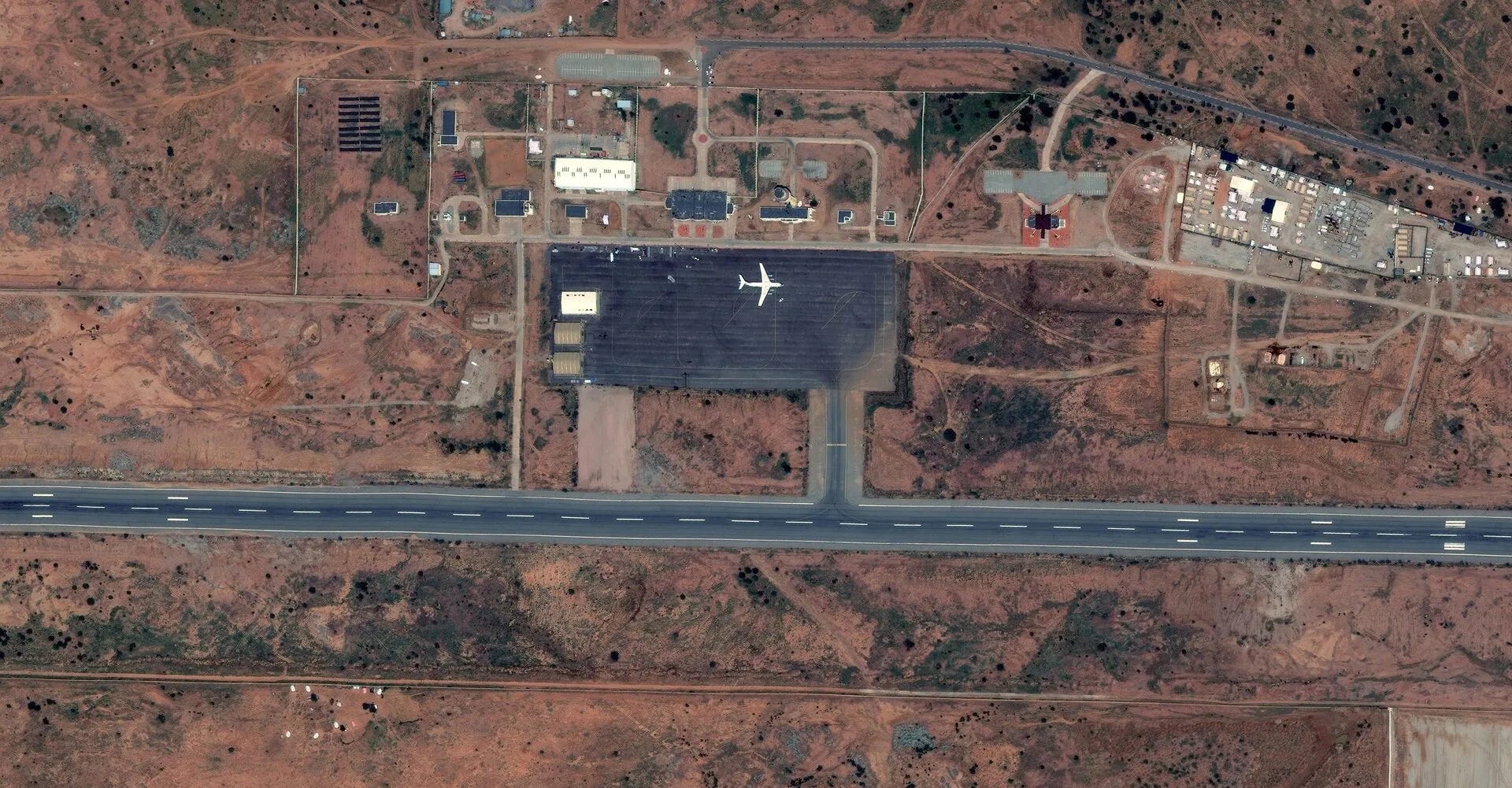
Beyond Chad, Libya, the Central African Republic, and Ethiopia, the UAE operates an air bridge from Bosaso in Somalia’s Puntland region to Nyala Airport and other airstrips in Darfur and Kordofan.
The RSF reopened Nyala Airport in September 2024, equipping it with air defenses and jamming systems though these have not prevented army strikes. The airport serves as a hub for receiving arms, smuggling gold, and evacuating the wounded.
Nyala also receives Colombian mercenaries who fight alongside RSF forces and train them in guerrilla warfare. Nearby are launch platforms for advanced drones.
While the RSF works to restore El Fasher Airport, it also relies on temporary dirt airstrips across Darfur and Kordofan to diversify supply points and evade aerial surveillance.
Among the most significant is the airstrip in Hamrat al-Sheikh in North Kordofan, strategically located at a crossroads linking Darfur to Khartoum, followed by Um Badr airstrip in the same state.
Additional airstrips exist near Zalingei in Central Darfur, in East Darfur, and in Um Dafuq near the Central African border, where helicopters have reportedly been observed.
From Food to Weapons
The UAE provides the RSF with a full spectrum of support from ready-to-eat meals to light weapons, artillery, drones, and air defense systems.
Amnesty International documented the RSF’s possession of Chinese-made AH-4 155mm howitzers, noting that the UAE is the only known buyer of this system. It also confirmed the militia’s use of Chinese GB50A guided bombs.
According to the organization, the UAE supplied these bombs, which can be deployed by Chinese drones such as the Wing Loong II and FH-95 both observed at Nyala Airport by Yale University’s Humanitarian Research Lab.
Reports also indicate that the UAE has provided additional Chinese weapons, including rifles, heavy machine guns, modified weapons, mortars, and ammunition, as well as Serbian Zastava M05 rifles via Emirati intermediaries.
The UAE has also delivered short-range air defense systems such as the Chinese FK-2000 and the ZSU-23-4 Shilka via Chad.
The RSF has acquired surveillance and targeting systems from Militec, reportedly approved for export by the UK despite knowledge of their use in Sudan, along with European munitions and thermobaric rockets.
The RSF’s confidence in the uninterrupted flow of weapons from the UAE even as it receives drones and missiles from Iran helps explain its disregard for the crimes committed by its fighters. Continued supply implies a prolonged war and diminished accountability.
By restructuring its supply network across multiple countries, the UAE has effectively integrated the Sudan conflict into its national security framework, exposing itself to growing risks as battlefield dynamics shift.
This sustained support driven by ambitions for resources, control of the Red Sea, and influence across the Horn of Africa can only be described as an organized crime.
In the end, a stark contradiction remains: while the international community condemns RSF atrocities and its parallel government, it remains silent on the sophisticated network of arms transfers and mercenary flows awaiting a reckoning that may yet restore balance.
