

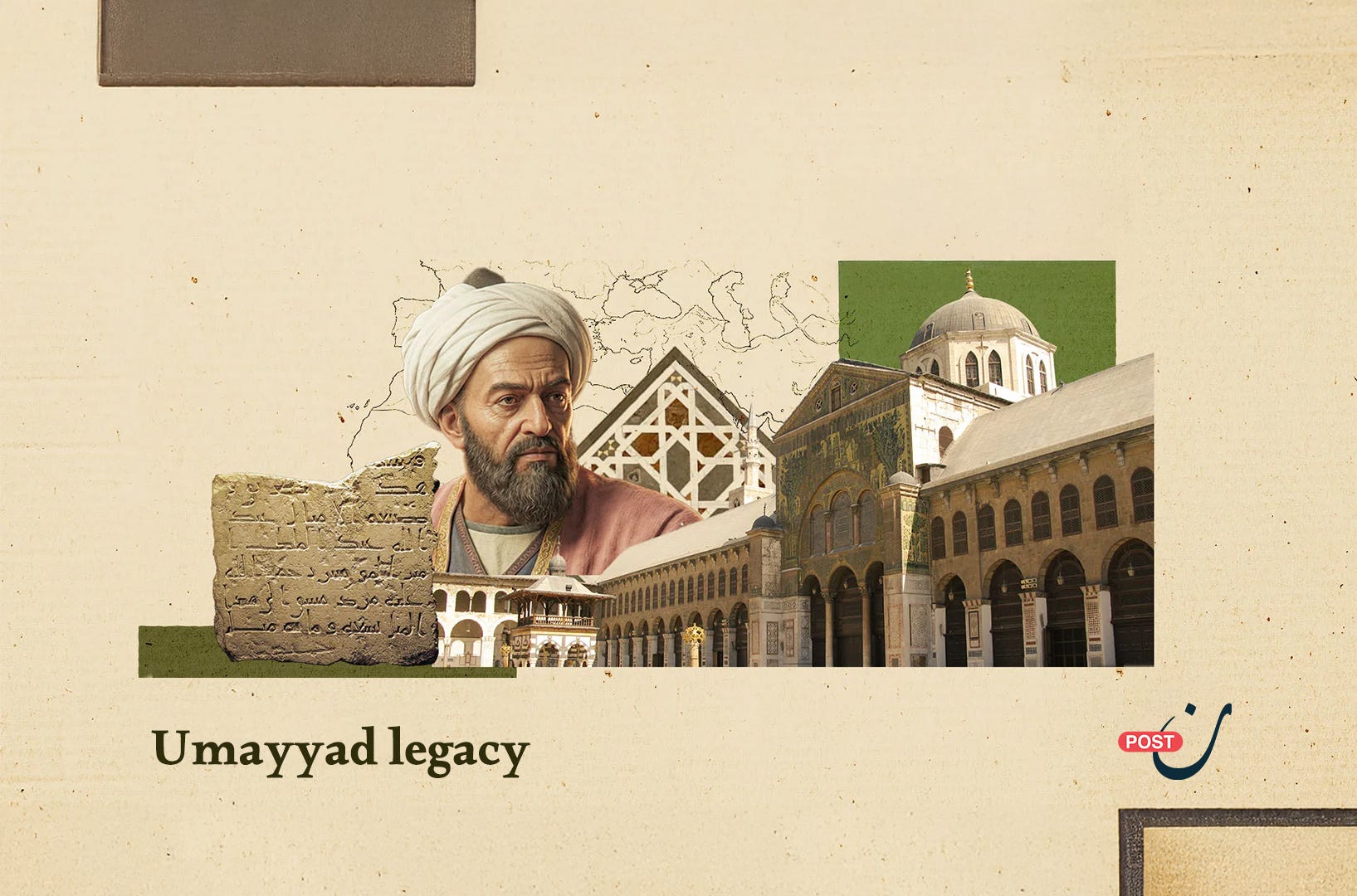
The Umayyads were thrust back into public debate following the liberation of Damascus from the Assad regime in late 2024 not as a relic of the past, but as an integral part of the Levant’s memory and identity, long marginalized and even derided by the Assad regime and its allies.
This report marks the first in a series under the file “The Umayyad Legacy,” through which Noon Post offers an in-depth reading of the Umayyad experience as the first Arab project of state-building and capital formation.
It was a pivotal moment in Islamic and global history between 661 and 750 CE, when a vast empire encompassing diverse peoples and cultures was administered from Damascus.
Rather than merely recounting events, “The Umayyad Legacy” interrogates meaning: How are capitals made? How does a place transform into a center of power? And how can historical roles be reclaimed without replicating the past?
It is a reading of history through the lens of the present, placing Damascus once again before fundamental questions of statehood, urban identity, and collective memory.
In the summer of 634 CE, Damascus opened its gates to a new political reality, closing the chapter of Byzantine rule and ushering in a new era in the history of the Levant. Yet this transformation did not fully take root until two years later, when the Battle of Yarmouk decisively shifted the balance of power, cementing Islamic rule and inaugurating a new historical phase for the region.
The city was first governed by Yazid ibn Abi Sufyan. Following his death in 639 CE, his brother Muawiya succeeded him. From the city’s alleys and walls, a new center of gravity began to take shape more structured governance and a Levant increasingly unified under a single leadership.
From Damascus, the foundations of a stable political authority emerged, providing Muawiya with the base from which he would later ascend to the caliphate.
In 661 CE (41 AH), after Hasan ibn Ali abdicated power, Muawiya entered Kufa and declared the “Year of Unity.” The Islamic provinces were consolidated under his authority, marking the beginning of the Umayyad state. With the transfer of the caliphate’s seat to Damascus, the city was transformed from a regional hub into a major political capital.
From there, the Umayyads governed a state that stretched from the borders of China in the east to the Atlantic Ocean in the west, encompassing peoples, religions, and languages never before unified under a single center. Within a single century, they built an empire that surpassed the Roman Empire in territorial extent. The Umayyad era was thus central to shaping both Islamic and world history.
More than thirteen centuries later, Syrians revived this legacy, bringing it back into focus with the liberation of Damascus in December 2024. The moment carried profound symbolic weight it was not merely the fall of the Assad regime, but a reopening of questions surrounding identity and memory, invoking the Umayyad legacy as a living reservoir of dignity and pride.
Damascus and the Invention of the Center: A Capital Governing Three Continents
Damascus was no ordinary city in the ancient world. Its location along the land bridge between Asia and Africa, and its connection to the Mediterranean basin, granted it a central role in overland trade networks. It became a key station for caravans traveling between the Arabian Peninsula, the Levant, Egypt, and Mesopotamia.
From this strategic position, the city acquired both economic weight and military significance. It passed through the hands of successive great empires from the Assyrians and Babylonians to the Persians, and later the Romans and Byzantines.
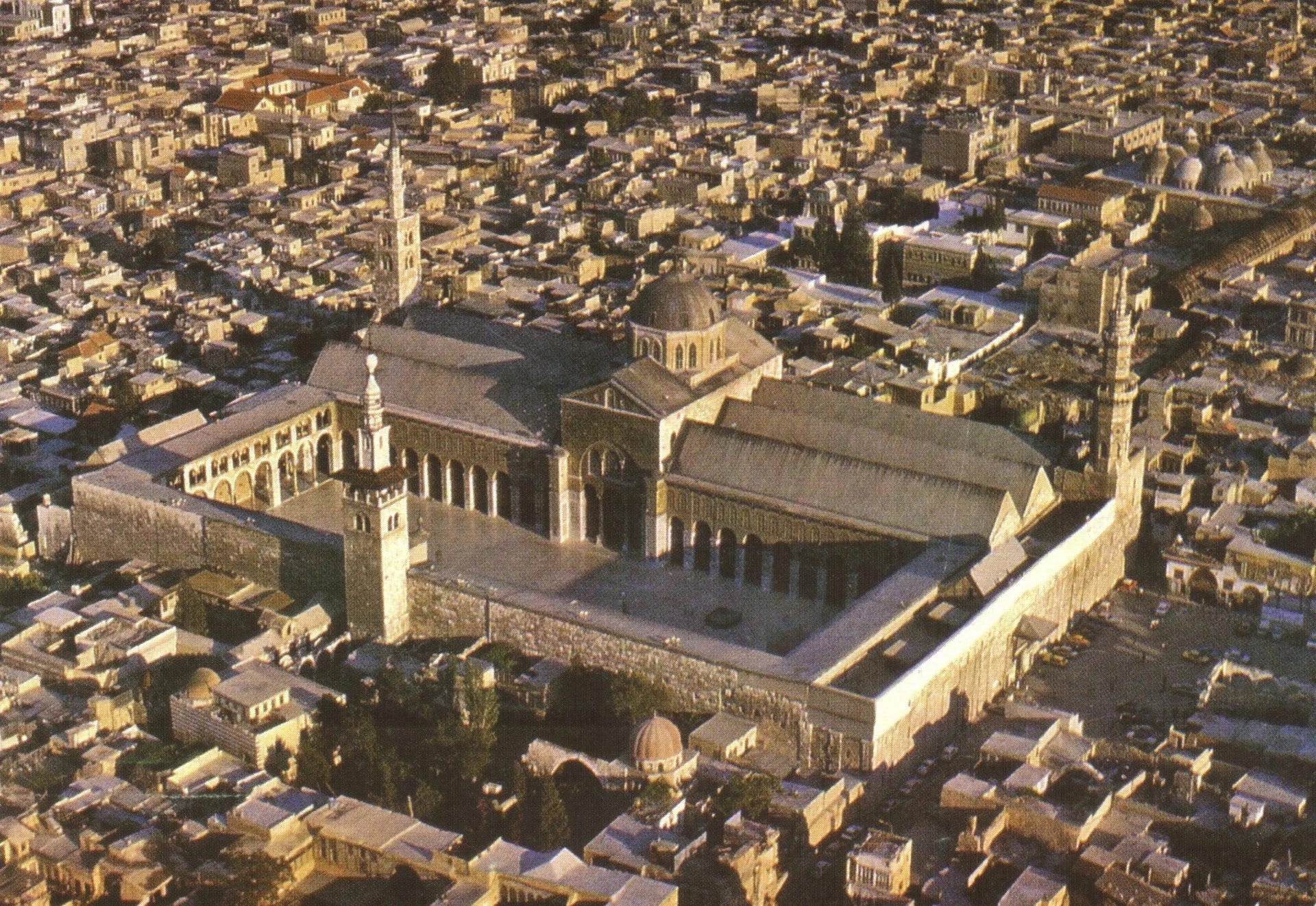
Despite its demographic and economic prosperity under Roman and Byzantine rule, Damascus remained a regional administrative center within a broader imperial system, while ultimate political authority resided in Rome and later Constantinople.
This reality changed fundamentally in 661 CE with the establishment of the Umayyad state and the designation of Damascus as the capital of the caliphate. The decision was not merely administrative but foundational and deliberate, grounded in the city’s relative security, proximity to the Byzantine frontier, administrative experience, and trade networks.
From that point onward, Damascus became a political and administrative center leading a vast state, and an early model of an Arab capital managing significant human and cultural diversity.
The centralization that emerged during the Umayyad period was not created from scratch. It extended a trajectory that began under Caliph Umar ibn al-Khattab, who laid the institutional foundations of governance through provincial divisions, the appointment of governors, the regulation of taxation, the establishment of administrative registers (diwans), and the principle of accountability before the caliph.
Following the declaration of Damascus as the capital, Muawiya ibn Abi Sufyan further developed and consolidated this framework. The caliphate became firmly established as the apex of political, military, and religious authority. The state was divided into provinces governed by appointed emirs responsible for tax collection, remittance to the treasury (Bayt al-Mal), maintaining security, defending borders, managing troops, and supporting expansion.
These governors did not command large independent armies; rather, they relied on social standing, influence over tribal dynamics, and the ability to navigate inter-tribal divisions.
The Umayyad caliph stood at the head of the state as supreme leader, commander-in-chief, and religious and judicial authority. He directly appointed governors, judges, and military commanders, all accountable to him. In major cities such as Kufa, Basra, and Fustat, responsibilities were distributed among the governor, the tax administrator, the judge, and the chief of police.
Syria and Upper Mesopotamia fell under the caliph’s direct authority, while other provinces included Egypt; Iraq, with its centers in Kufa and Basra; Persia and Khurasan; Armenia and Azerbaijan; Bahrain and Oman; the Hijaz and Yemen, among others. At times, multiple regions were placed under a single governor.
Yet the vast geographic scope and diverse political and military conditions particularly in North Africa posed unique challenges. The distance and complexity of tribal and military dynamics necessitated administrative restructuring.
Ifriqiya, once governed from Egypt, became an independent province in 705 CE and was further divided into administrative units such as Ifriqiya, Tripoli, al-Zab, and al-Sus, each overseen by deputies with authority over smaller districts.
At the same time, new urban centers with military and administrative functions were established, including Kairouan in Ifriqiya, Wasit in Iraq, and Ramla in Palestine, alongside the preservation and development of existing administrative infrastructures.
Thus, the state expanded rapidly: eastward through Persia and Khurasan into Transoxiana and Sindh; northward to Armenia and the Caucasus; westward to Ifriqiya and then al-Andalus in 711 CE. The Red Sea became a vital commercial artery linking Egypt to the Arabian Peninsula, East Africa, and South Asia, while campaigns against Constantinople marked the peak of confrontation with Byzantium in the early eighth century.
By 750 CE, the Umayyad state had reached its maximum extent from al-Andalus in the west to the borders of Central Asia in the east, from the Caucasus in the north to deep Africa in the south. Damascus remained at the heart of this expanse, transformed from a crossroads of trade into an imperial capital that established the first Arab model for governing vast, diverse territories.
Institutions of Umayyad Rule: How Was a Vast Empire Governed from Damascus?
Administration and Communications
Muawiya ibn Abi Sufyan expanded administrative frameworks by establishing the Diwan al-Rasa’il (Chancellery), responsible for correspondence between the caliph and his governors and commanders. Its head was chosen from the caliph’s inner circle due to the sensitive nature of the information handled. Over time, the diwan evolved into a full-fledged institution with specialized scribes, archival systems, and document preservation.
To ensure document authenticity and prevent forgery, Muawiya established the Diwan al-Khatam (Seal Office), which stamped official correspondence with an engraved seal. As the empire expanded, the need for rapid communication led to the creation of the Diwan al-Barid (Postal Service), a network of relay stations equipped with horses and couriers to transmit messages, directives, and even personnel.
Under Abd al-Malik ibn Marwan, the postal system was further enhanced, becoming an integrated infrastructure that combined administrative coordination with oversight of provincial conditions solidifying Damascus as a powerful administrative hub.
Law and Judiciary
In the early Islamic period, caliphs personally adjudicated disputes. Umar ibn al-Khattab institutionalized this function by appointing specialized judges across provinces.
As the Umayyad state expanded and Arab and non-Arab populations mixed, the need for further organization grew. Judges such as Sulaym ibn Anaz in Egypt began documenting judicial rulings. Under Abd al-Malik, the Mazalim courts were established to handle complex cases, particularly those involving elites.
Judicial administration developed gradually, with judges appointed by caliphs and governors and held accountable to them. The state also issued judicial decrees to standardize procedures.
The Umayyads also established the Hisba system to oversee public order and prevent violations in markets and public spaces. Market inspectors (muhtasibs) monitored weights, measures, roads, and public infrastructure.
In jurisprudence, independent reasoning (ijtihad) flourished before the crystallization of the four Sunni schools. Prominent scholars included Abd al-Rahman al-Awza‘i, while Abu Hanifa and Malik ibn Anas later founders of major legal schools emerged toward the end of the Umayyad era.
Security and the Military
Military organization began under Umar ibn al-Khattab with the establishment of the Diwan al-Jund in 641 CE. As the Umayyad state expanded, Muawiya introduced specialized security institutions: the hajib (chamberlain), the royal guard, and the police.
Initially linked to the judiciary, the police gradually became an independent institution responsible for criminal investigation and enforcement. Notable figures included Nusair, father of Musa ibn Nusair, the conqueror of al-Andalus.
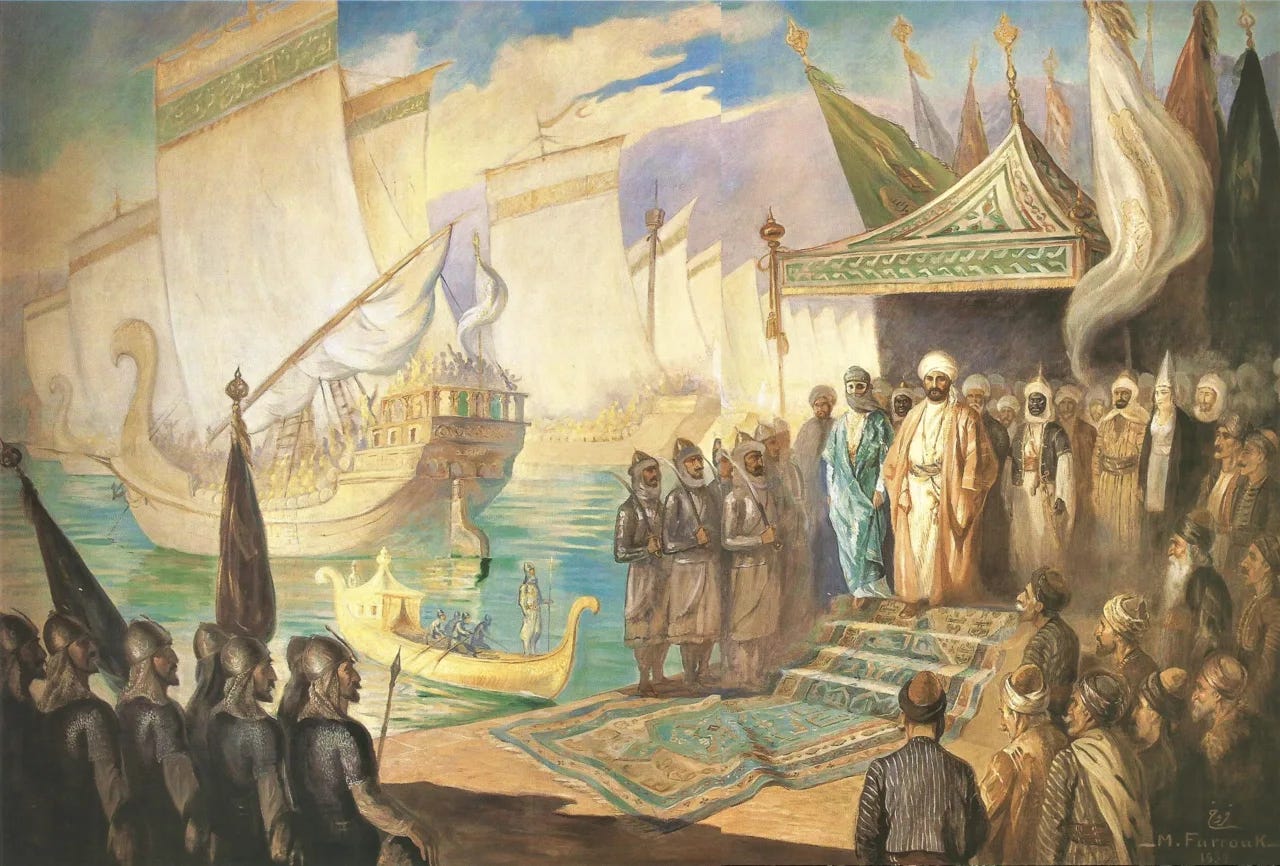
The Umayyads also strengthened the army, initially recruiting Arabs, then incorporating Berbers following expansions into North Africa and al-Andalus. Military centralization increased during the Marwanid period, reducing tribal dependence and creating a more cohesive and mobile force.
Naval power was also developed, with Muawiya credited for establishing the first Islamic fleet, capturing Mediterranean islands such as Arwad and Rhodes, and fortifying coastal cities like Acre and Tyre. Maritime activity extended into the Red Sea, enhancing trade and pilgrimage routes.
Revenue and Finance
Financial administration began under Umar ibn al-Khattab with the creation of the Diwan al-Kharaj, drawing on Persian administrative models. It oversaw taxation, revenues, and military salaries, with each province operating in its administrative language.
Under Muawiya, this system expanded, becoming the backbone of state financing, including revenues from zakat, jizya, and kharaj.
The most significant transformation came under Abd al-Malik ibn Marwan, whose reforms included restructuring taxation, restricting military salaries to active soldiers, minting an independent Islamic currency, and Arabizing administrative registers.
Taxation was broadened to include all landowners, Muslim and non-Muslim alike. Population surveys conducted in Syria (697–698 CE), and in al-Jazira and Egypt (706–711 CE), ensured efficient revenue collection. Provincial tax officials reported directly to Damascus.
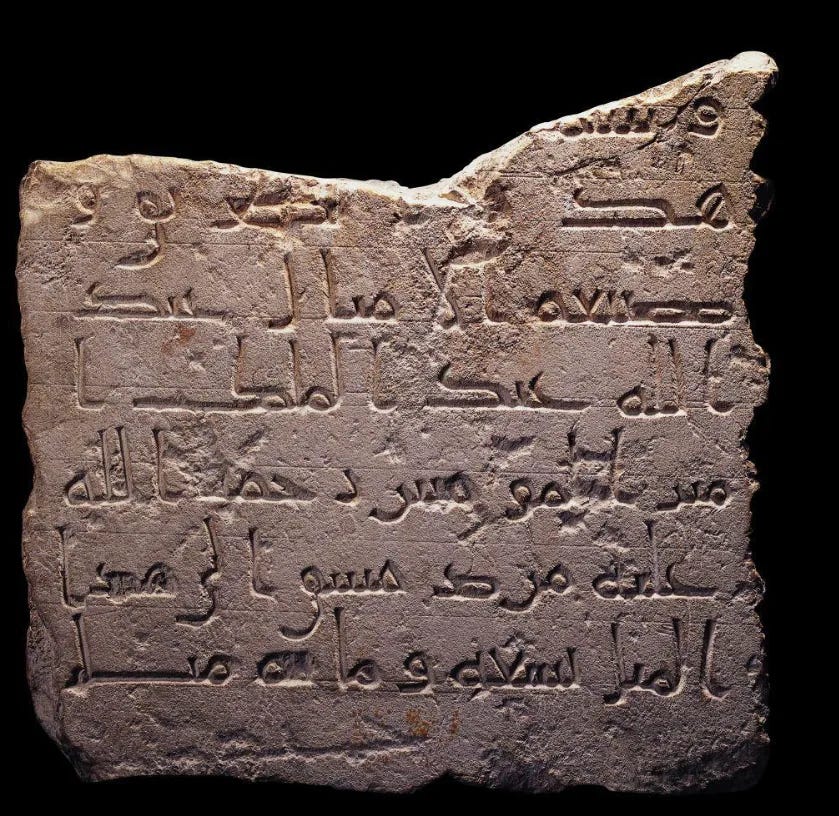
Public spending included irrigation projects along the Tigris and Euphrates, agricultural development, and provisions for prisoners and war captives.
The Umayyad experience demonstrates that what made Damascus an exceptional imperial capital was not only its symbolism and geography, but its ability to govern from a clear center of decision-making, connect distant peripheries, and build effective institutions.
The lesson history offers Syria today is clear: restoring political and cultural influence begins with constructing a well-defined central authority capable of forging a unifying identity, while maintaining administrative flexibility to manage social and cultural diversity.
Revitalizing markets, strengthening trade infrastructure, and reactivating regional and international networks can restore Damascus not merely as a crossroads between East and West, but as a civilizational and political heart of the region.
