

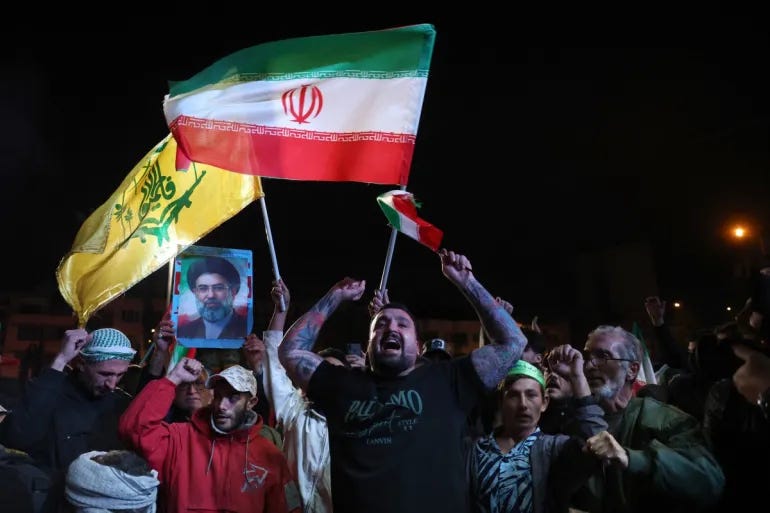
At a moment when tensions had reached their peak, the world watched closely as the final hours ticked down on the deadline set by U.S. President Donald Trump ahead of a sweeping joint American-Israeli attack targeting Iran’s energy facilities and critical infrastructure. Tehran, for its part, had threatened a reciprocal response aimed at Israeli energy installations and U.S.-linked interests across the Middle East.
All parties understood that escalation to such a level of strikes would open a trajectory difficult to contain, pushing the region into a profoundly unstable phase whose repercussions would extend well beyond its borders particularly as energy had become a lever of pressure with direct implications for global markets and vital supply routes.
At this critical juncture, the two-week window emerged as an opportunity to contain the escalation, with proposals for a ceasefire and the reopening of the Strait of Hormuz serving as an entry point to recalibrate the situation. These signals helped slow the slide toward a broader confrontation, within the context of a war the United States—alongside Israel—had steered forward as part of calculations tied to reshaping regional balances.
Against a backdrop of political declarations that allow each side to frame the outcome as an achievement, competing narratives quickly surfaced. Pakistan’s role in announcing the understanding stood out, while U.S. and Iranian statements offered contrasting indications of success. Israel, meanwhile, adopted a more cautious tone, as a temporary negotiation track was launched its ultimate trajectory still open to multiple possibilities.
What happened?
Just before the deadline, President Donald Trump announced that a ceasefire understanding had been reached with Iran, involving a two-week suspension of mutual military operations as a prelude to continued negotiations aimed at securing a longer-term agreement.
He noted that Washington had received a 10-point Iranian proposal that could serve as a negotiable framework, indicating that most points of contention had been overcome and that U.S. military objectives had been achieved. In parallel, U.S. sources confirmed the halt in military operations, linking the agreement’s implementation to the reopening of the Strait of Hormuz.
Tehran, for its part, declared through its Supreme National Security Council and Foreign Minister Abbas Araghchi that final negotiations would be held in the Pakistani capital, Islamabad. It presented a framework that included sanctions relief, the release of frozen assets, the continuation of uranium enrichment, and specific arrangements for the Strait of Hormuz to allow safe passage for two weeks in coordination with Iranian forces.
Iran also tied its cessation of operations to a halt in attacks against it, framing the outcome as progress in imposing its negotiating terms.
Regionally, Pakistani Prime Minister Shehbaz Sharif announced an agreement encompassing a ceasefire “everywhere,” including Lebanon, with Pakistan set to host direct talks between the parties within days. By contrast, Israeli Prime Minister Benjamin Netanyahu’s office stated that the truce did not extend to Lebanon, while supporting a two-week pause in attacks.
At the same time, U.S. leaks suggested Israel had agreed to suspend its airstrikes in parallel with negotiations, committing to the agreement in coordination with Washington.
This divergence in Israel’s position reflects a degree of duality: a formal commitment to a temporary truce alongside a more cautious political and security discourse. The gap between the negotiation track and Israel’s vision of how the war should end suggests that Tel Aviv seeks to preserve room for maneuver keeping escalation options on the table while tactically engaging in de-escalation.
Who stepped back?
Negotiations in conflicts of relative parity tend to take on a reciprocal character, with each side seeking to leverage its available cards within the limits of maneuver in order to reach an outcome closer to its interests and constraints.
Within this framework, mediation led by Pakistan and Egypt created a tangible channel of communication, helping establish a preliminary basis for discussion as the region approached a critical moment that could have triggered a wide-scale confrontation amid threats to target Iran’s energy facilities and vital infrastructure, and the prospect of a far-reaching Iranian response.
At the same time, President Donald Trump appeared to be searching for an exit from an escalating trajectory that had begun to exceed initial assumptions built on the premise of a swift resolution.
Those assumptions rested on the belief that military force and firepower alongside Israel could produce a breakthrough within Iran’s political structure, whether by fueling internal unrest or prompting shifts from within the system itself.
Yet the course of the confrontation revealed a gap between prior estimates and battlefield realities, reinforced by leaks tied to assessments by U.S. Defense Secretary Pete Hegseth, as well as Israeli evaluations that had banked on internal Iranian dynamics that ultimately failed to materialize as expected.
Within this context, Iran demonstrated an ability to absorb the initial blow and rapidly adapt to the trajectory of the confrontation transitioning toward a more prepared mode of war management. Its capacity to influence global energy markets also raised the cost of confrontation at both regional and international levels, contributing to a shift in U.S. debate toward more flexible approaches.
In light of this, the move toward a ceasefire based on Iran’s 10-point proposal represents a significant step in establishing that framework as a reference point for negotiations particularly as its contents imply a redefinition of the equation in ways that run counter to U.S.-Israeli war objectives. Still, these points remain an open negotiating framework, likely to be subject to reciprocal trade-offs during the anticipated talks in Islamabad.
At the same time, Iran’s acceptance of a temporary truce marks a shift from its earlier insistence on a comprehensive and extended ceasefire with clear guarantees. This adjustment reflects a pragmatic engagement in a phased negotiation process, coupled with an effort to preserve and manage the gains achieved thus far within an open-ended diplomatic track.
What does reopening the Strait of Hormuz mean?
Throughout the war, Iran’s position linked reopening the Strait of Hormuz to a comprehensive halt in military operations, viewing pressure on energy markets as a cumulative tool requiring sustained disruption to become a decisive factor in the balance of power.
In this context, U.S. insistence on reopening the strait became a direct pressure point, which Pakistani mediation helped translate into a compromise formula as the confrontation edged toward a more dangerous phase.
Iran’s acceptance of reopening the strait thus marks a shift in how it deploys this leverage while maintaining conditions governing transit. These include coordination with Iranian armed forces and adherence to what were described as “technical considerations,” suggesting a gradual and regulated reopening that preserves Tehran’s influence over movement through one of the world’s most critical energy corridors.
The real test of this arrangement will lie in Iran’s ability to translate initial understandings including those linked to a joint protocol with Oman into a stable and implementable framework for maritime traffic.
The strait has, in effect, become a central arena of confrontation and competition over control: Iran seeks to entrench it as a strategic lever reinforcing its economic and political position, while the United States explores mechanisms to constrain that influence whether by internationalizing its management or ensuring a direct role in regulating its operations.
Temporary calm or a path to ending the war?
From a cautious perspective, the current calm appears more transitional than a definitive end to the war, particularly given ongoing disagreements over the scope of de-escalation especially regarding the Lebanese front and its linkage to the confrontation with Iran.
This remains one of the most sensitive issues, tied to a core objective of the war: reshaping Iran’s relationship with its regional allies.
In this light, the lull may be used to reorganize the military landscape, addressing deficiencies exposed during the fighting whether in munitions, air defense systems, or damage to strategic radar infrastructure. Some assessments also point to U.S. efforts to rebuild operational readiness in preparation for a potentially more escalatory phase, possibly targeting higher-value objectives.
Beyond the military dimension, Iran’s internal dynamics also factor into the equation. Some analyses suggest the current phase could be used to reignite internal pressure following the cohesion displayed during the conflict. Meanwhile, a projected improvement in energy markets may offer greater room to recalibrate economic costs before any renewed escalation.
Accordingly, the current calm remains governed by fragile considerations, in the absence of firm guarantees and amid overlapping military and political calculations rendering it closer to a truce atop volatile ground, shaped by delicate balances that could shift with any change in the parties’ assessments or priorities.
The Gulf position and the limits of its influence
Amid the escalation, Gulf states emerged as among the most exposed to the fallout of the confrontation, given their position at the heart of regional balances and their direct linkage to global energy markets and economic stability.
These developments have put the relative stability that has prevailed since the end of the Gulf War to a real test, particularly in light of risks to the investment climate and the Gulf’s image as a comparatively safe environment.
The Gulf position has been marked by clear divergences: some approaches viewed the war as an opportunity to curb Iranian influence and weaken its regional presence, while others favored preserving a level of tacit understanding that had governed relations with Tehran in recent years.
As strikes expanded to include U.S. bases and economic and commercial facilities within some Gulf states, sensitivities deepened, shifting these countries from indirect stakeholders to direct recipients of battlefield repercussions.
In this context, Gulf concerns have centered on the risk of targeting energy infrastructure especially amid threats of expanding strikes to oil and water facilities posing an open strategic challenge to their stability.
These considerations have driven efforts to intensify pressure toward containing escalation and advancing a de-escalation formula that reduces the pace of reciprocal strikes within their geographic sphere.
Accordingly, the Gulf role can be seen as a contributing factor in pushing toward de-escalation, particularly in light of challenges exposed by the confrontation regarding defense system effectiveness and vulnerability to attacks.
These developments may also prompt broader reviews of defense strategies, the nature of ties with the United States, and approaches to Iran especially in light of shifts within its decision-making structure during the war.
Two weeks of brinkmanship
After roughly forty days of the region’s most expansive confrontation, the Middle East and the world enters a phase of partial calm, even as Israeli military operations continue in Lebanon and the Palestinian territories. Attention now turns to what may be among the most complex rounds of negotiations, amid a widening gap between the U.S. objectives that launched the war and Iran’s 10-point proposal that underpins the temporary truce.
Iran’s demands at this stage set a higher negotiating ceiling than those on the table before the war, placing U.S. decision-makers before difficult choices: pursuing a political settlement under new terms or re-entering a cycle of escalation.
Any Iranian success in securing parts of these demands would consolidate its negotiating position and bolster its regional standing, with significant implications for power balances and the war’s original objectives.
Within this framework, the negotiation track reflects a state of cautious anticipation, where calculations of gain and loss intersect for all parties amid a rapidly shifting regional environment.
The developments of this phase suggest that what follows this war will differ markedly from what preceded it both in terms of Middle Eastern power equations and the dynamics shaping the international system.
