
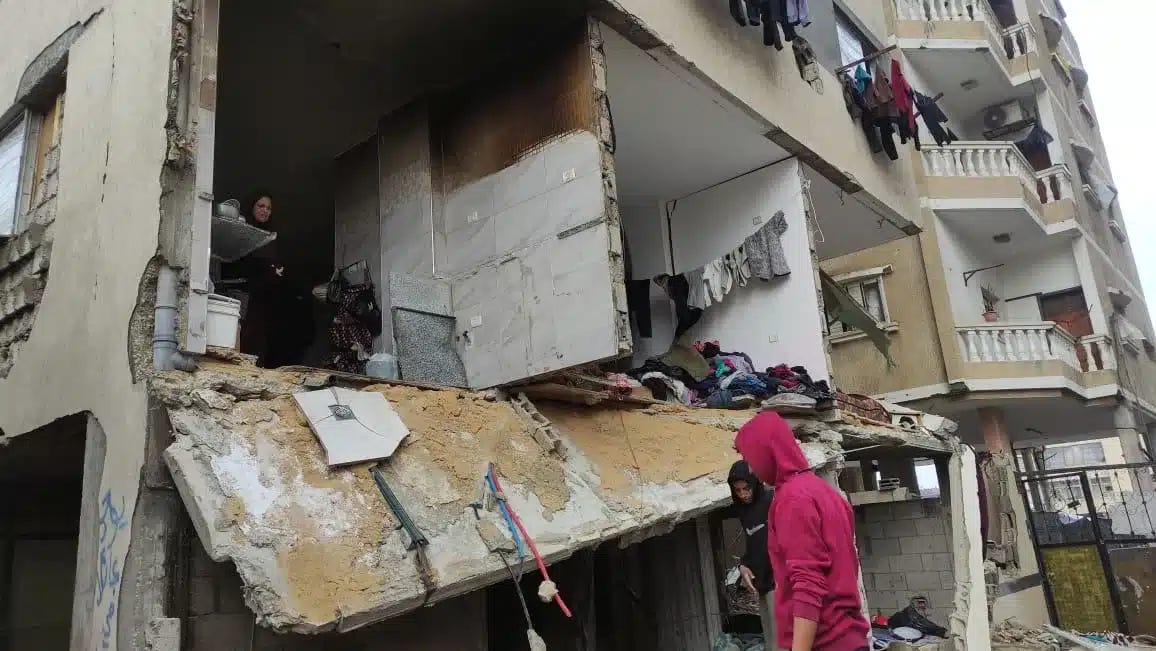
“A building collapses on its residents” such a headline would be rare under normal circumstances, but in Gaza, it’s become expected. The sheer frequency of these tragedies, especially with the arrival of winter, is staggering. Following the massive destruction wrought by Israeli bombardment, many Palestinians have been forced to take shelter amid the wreckage of their former homes.
They do so fully aware of the risks, but see concrete walls and roofs no matter how damaged as a better shield against the elements than a tent ever could be.
For those who’ve lost their homes, the options are few and grim: tents that offer neither dignity nor protection, overpriced rental apartments unaffordable to families whose resources were depleted by the war, or staying with relatives a choice not available to everyone and often rejected due to the constraints it imposes on both hosts and displaced guests.
In this bleak landscape, another option has emerged: returning to the remnants of destroyed buildings whether homes, schools, or institutions. Many embrace the chance, even paying to rent heavily damaged properties.
Those living in structurally compromised buildings endure a nightmare. They accept the danger and do what they can to mitigate it, even as they know deep down that their precautions may prove useless.
Sleepless Nights
“How can I sleep knowing a single small wall is what’s holding the building together?” asks Ihab al-Helou, his face etched with worry. “The building I lived in was bombed during the early days of the war. I moved between relatives’ homes and tents until the ceasefire was agreed upon at the end of 2024, and the occupation forces withdrew. When I came back, I considered myself incredibly lucky.”
His apartment, on the ground floor, still had part of its ceiling intact though it lay beneath the rubble of four upper floors. Al-Helou salvaged the remaining space, sealed it with tarps, and lived there until the most recent wave of displacement.
In September, he fled to central Gaza. When he returned, he found missile remnants embedded in what was left of his home. The livable space had shrunk further, and the remaining ceiling now threatened to collapse. Experts confirmed his fears: “This place is uninhabitable. If a single stone from that wall falls, the entire ceiling could come down.” Ironically, it was a wall he had considered removing to create more space.
“The alternative is a tent,” he says. “My wife and daughters refused to go back to that. A tent means living on the street. We’ve already been through that twice. I know the danger is real but what choice do we have?” He adds, “Since the day I returned to this home in its current condition, I’ve lived in constant fear of it collapsing. That fear turned into terror during the first winter storm, when parts of the structure started to give way.”
“There are nights I can’t close my eyes,” he says. “Sometimes I’m outside and panic at the thought that the house may have collapsed on my family. My wife and daughters feel the same. I feel helpless and heartbroken that I can’t give them a safe place to live.”
For weeks now, water has streamed into al-Helou’s home from every angle during rainstorms. After the rain stops, large amounts of water collected in the debris above seep through the ceiling’s cracks, which seem to multiply with every storm.
With each storm, the winds rip apart the tarps he uses as walls. While he struggles to reattach them, his family races to dry the floodwater. Parts of the home are now unusable, soaked through from persistent leaks. He places buckets beneath the cracks, but the spaces are too damp for sleeping, sitting, or even storing clothes or bedding.
The risk isn’t limited to collapse. A single falling stone from the rubble could kill. That almost happened to his daughter, who had been cooking over a fire behind the house. She had just stepped away to fetch spices when part of a column fell precisely where she had been sitting.
When fixing the tarps, al-Helou is torn: secure them tightly and risk increasing pressure on the fragile structure? Or use small nails and risk them being torn away by the wind?
He notes that each storm creates new cracks and dislodges more debris above. As news of further collapses spreads, al-Helou once again raised the idea of returning to a tent but his family refused.
“Homes are collapsing and so are our spirits,” he says. “With each collapse, our hearts fall too. Fear is growing, and solutions are nowhere in sight.”
He’s issued instructions to his family: avoid certain parts of the house and surrounding area, don’t touch the rubble. “But I know these precautions aren’t enough especially with kids. My youngest daughter saw her toy peeking out from the debris and tried to pull it free. She wasn’t strong enough, but one small shift in the rubble could’ve brought everything down. Only God’s mercy saved us.”
Buried—Then Returned
Just seconds stood between Ibtisam Mahdi and death. She experienced a partial collapse of her home while she was inside. And yet, with no other options, she returned to live in what was left.
She was in the kitchen preparing food when sunlight broke through the clouds. She stepped outside to activate the solar power system. Before she could press the switch, she turned to see the kitchen where she had been standing moments earlier collapse.
“My apartment was originally a high-ceilinged storage room,” she explains. “The contractor split it horizontally, and now I live in the upper half, which stands on external pillars that differ from the rest of the building’s structure.”
After her most recent displacement in September, she returned to find a tank had destroyed one of those crucial outer pillars. A structural engineer assured her the floor was sound but warned that specific walls could collapse if nearby bombing caused major tremors.
Taking his advice, she moved back in cautiously. She warned her two children not to play near the threatened walls. From her window, she even warned neighbors and passersby not to linger beneath them.
Then came the first winter storm and with it, the unimaginable. The very floor the engineer had deemed stable collapsed along with the walls.
As she exited the kitchen, she saw her daughter heading out to meet a friend. But when the collapse began, she panicked, thinking her daughter was still inside. She frantically searched the rubble until she heard her daughter, Mayar, shout: “Mama, I’m here.”
Neighbors assumed the house had been hit by an airstrike. Ibtisam knew otherwise: it had collapsed—and far worse than she ever imagined. As neighbors rushed to check on her family, she worried that debris from her building might have injured someone outside—her long-standing fear.
Amid the chaos, her nine-year-old son Youssef screamed, “Mayar’s gone!” He saw his mother was safe and knew his father wasn’t home but panic blinded him to the fact that Mayar was right in front of him. Ibtisam hugged him and kept repeating, “Mayar is here, right in front of you,” until his fear began to subside.
After the collapse, a man offered her family a room in his home. But three days later, he asked for 500 shekels (around $160) in rent. Two weeks after that, he said the rent would double the following month. That’s when Ibtisam decided to use the money to repair her own home instead.
“The house is still unsafe. The cracks in the walls are obvious. I’m terrified it could collapse again but I have no choice,” she says. “I consulted engineers and followed their instructions. I spent a lot of money on repairs. Anything to avoid going back to a tent.”
It was not an easy decision for her or her family. But after living in a tent for 22 days during their last displacement, they preferred the risk of collapse to the indignity and hardship of tent life. Her children were afraid at first but quickly adapted. Thankfully, neither witnessed the moment of the collapse, which helped lessen the trauma.
Even her extended family urged her not to return. They call every day to check on the house, and only her strict adherence to engineers’ advice has calmed their fears.
The psychological scars are deep. Every gust of wind or drop of rain rekindles the terror. For Ibtisam, who saw the collapse with her own eyes, the trauma was intense. For two weeks, she had nightmares of being trapped in the kitchen as it came crashing down. She eventually sought help from a therapist.
“I’ve lived through horrific moments displacement, nearby strikes, flying shrapnel and debris but nothing compares to what I experienced that day.”
Her family survived but the financial loss is immense. Half her apartment, including the children’s room, their belongings, a brand-new wardrobe, much of the food supply, and the entire kitchen all gone. On top of that, she spent a fortune trying to make the remaining space livable.
Some losses are harder to explain. Like the heartbreak of Youssef and Mayar over two bowls one pink, one blue that their mother had bought when they were toddlers. They used them every day until the collapse.
A Difficult Road Ahead
Maha Bessal, spokesperson for Gaza’s Civil Defense, says structurally unsound buildings are one of the most pressing and complex challenges facing the enclave, with thousands of buildings at risk of collapse and tens of thousands of people still living in them.
“A building deemed unsafe typically has compromised foundations or major structural damage,” Bessal tells Noon Post. “These structures can collapse at any moment, posing a serious threat not just to residents but to anyone nearby.”
Most of these buildings are located near cities or in areas previously entered by Israeli ground forces. Even empty buildings are dangerous especially with tents now set up everywhere around them.
People are returning to unstable buildings because they have no alternatives, Bessal explains. Tents offer no protection from the cold or heat. While most residents know they need to leave these buildings, they simply have nowhere else to go.
“We’ve urged people to evacuate,” he says. “Some listened and in several cases, their buildings collapsed days after they left. Others escaped only minutes before their homes gave way.”
He stresses that even partially damaged homes those that appear livable can be extremely dangerous. Debris can fall at any time, and further collapses are possible.
“Just because a building is still standing doesn’t mean it’s safe,” Bessal warns. “The volume of explosives dropped on Gaza has caused structural weaknesses in nearly every building. We need a comprehensive assessment. The risk of collapse remains very high.”
Since the ceasefire began in October, 50 buildings have collapsed entirely 22 during winter storms. More than 150 have partially collapsed. At least 27 people have died due to cold weather and structural failures. That number doesn’t include casualties from the most recent storm, which claimed three lives on its first day alone.