

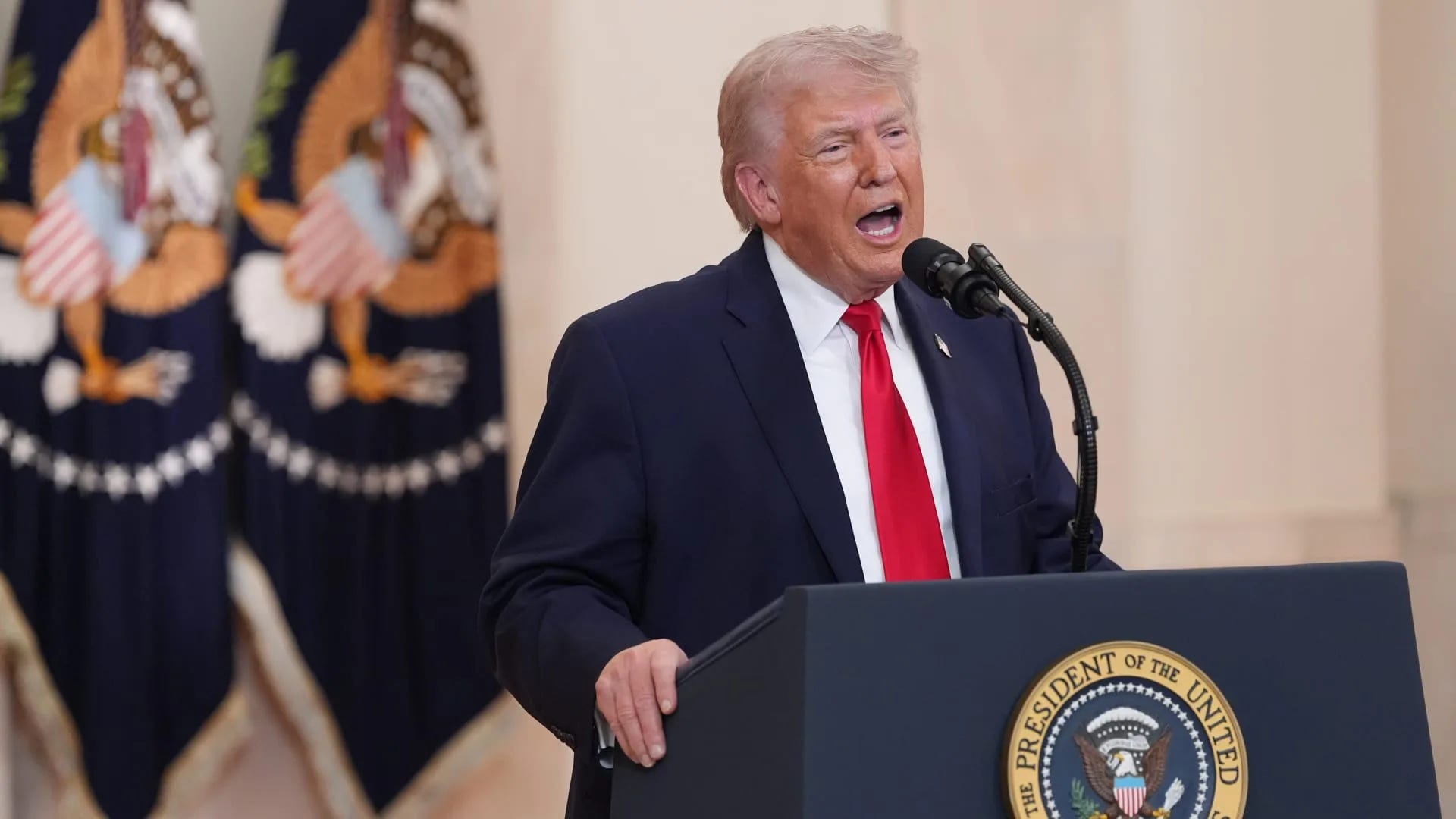
At a moment when many had been waiting the long-anticipated address by U.S. President Donald Trump delivered after 32 days of war with Iran hoping it would offer a clear explanation of the trajectory of the confrontation and its possible outcomes, the speech did precisely the opposite.
Rather than dispelling ambiguity, it deepened it; rather than closing the door on speculation, it flung it wide open. Instead of presenting domestic and international audiences with a defined path forward or at most two Trump appeared to layer additional confusion onto an already highly complex scene.
Many observers had expected Trump to deliver a speech outlining the details of the confrontation and offering a vision for de-escalation, particularly amid mounting domestic and international criticism over the war’s costs and repercussions.
These effects had begun to reach the American public directly through market instability and rising energy prices. Yet such expectations quickly evaporated.
What many had anticipated as a moment of political clarity instead became another occasion for reproducing the same ambiguity this time in a sharper form.
Over the course of 19 minutes, Trump failed to provide what had been expected of him: no clear outline for ending the war, no decisive timeline, and not even a coherent political framework for managing or containing the escalation.
It was therefore unsurprising that this ambiguity quickly reverberated across markets, with oil prices surging anew and noticeable turbulence in currency and stock markets. The speech did not reassure the world; it heightened its anxiety. It was as though the American president had launched a war he knew how to ignite, but for which he still lacked a compass to exit.
Yet despite the dense ambiguity cast by the speech over the war’s trajectory, it carried a series of clear political messages directed at the American inside, at allies, at the broader international community, and at Iran’s new leadership.
These messages may appear contradictory on the surface, but such apparent inconsistency aligns with a tactic of “strategic ambiguity” that Trump seems to have deliberately employed since the outset of the war less as a pathway to genuine resolution than as a tool for pressure, maneuvering, and reshuffling the deck.
A Message to the American Public: Justification and Reassurance
Among the most prominent messages Trump sought to convey were those aimed primarily at the domestic audience, framed in a dual register of justification and reassurance. On one hand, he attempted to justify the war as necessary and preemptive imposed, according to his narrative, by the threats posed by Iran’s missile and nuclear capabilities.
He emphasized what he described as military “achievements,” speaking of weakening Iran’s naval and air forces and constraining its missile and nuclear capacities. This framing sought to reinforce a narrative that the war had achieved its central strategic objective: preventing Iran from evolving into a greater nuclear threat.
On the other hand, Trump addressed American citizens who had begun to feel the economic repercussions of the war firsthand, particularly through rising fuel prices and volatile energy markets. Here, he struck a reassuring tone, suggesting that these effects would not last long though he offered no clear timeline or concrete plan for containing them.
At the same time, Trump attempted to distance himself from the war’s economic and political costs by placing the blame on Tehran for disruptions to navigation and energy markets, portraying Washington as responding to a crisis imposed by Iran rather than one it had ignited.
The speech also appeared to be a clear attempt to calm domestic sentiment amid declining public support for both the war and Trump’s handling of it. A CNN poll indicated that roughly two-thirds of Americans oppose the decision to launch military action against Iran, while 63% believe the war is likely to become a prolonged conflict.
Nearly seven in ten Americans oppose sending ground troops to Iran reflecting growing public concern about being drawn into an open-ended and costly confrontation.
In the same vein, Trump’s approval ratings on economic issues have dropped significantly, with support falling to 31% the lowest level recorded for him on this front—at a time of mounting cost-of-living pressures and increasing sensitivity to fuel prices and broader economic sentiment.
To the International Community: The War Is Nearing Its End
Amid rising international criticism over the war’s unintended consequences for energy markets and supply chains, Trump sought through his speech to ease the pressure, signaling that the war had entered its final phase and could end within two to three weeks.
He stressed that most U.S. military objectives had already been achieved, highlighting what he described as the extensive destruction of Iran’s military and defense infrastructure—ensuring, in his telling, that Iran would no longer pose a future threat to the United States or global stability.
Yet the irony was stark. A speech intended as reassurance produced the opposite effect. Rather than alleviating fears, it amplified them. Trump offered no clear plan for ending the war, no precise timetable, and no political vision for how such an end would take shape or under what conditions.
Unsurprisingly, markets reacted swiftly: oil prices surged again, reflecting a widespread perception that Washington remains committed to escalation rather than moving toward a near-term settlement.
Thus, while Trump sought to project reassurance, he effectively fueled further anxiety. His claims of an imminent end failed to convince markets or wary capitals, as they were not accompanied by a clear roadmap or decisive political signals pointing toward de-escalation. Economic dynamics moved in the opposite direction of his intended message.
A Pressure Message to Allies
One of the most striking contradictions in Trump’s speech lay in his dual message toward European allies. Even as he continued to question NATO’s effectiveness and the capabilities of its members hinting at diminishing the alliance’s value he simultaneously exerted direct pressure on Europe to engage in securing the Strait of Hormuz and ensuring full maritime access.
From this perspective, Trump delivered a clear message: the United States would not bear the burden of protecting the strait alone. According to his logic, the waterway is far more vital to European economies dependent on Gulf oil than it is to the United States.
He thus reframed the issue as a security bill that should be more heavily borne by those who benefit most politically and perhaps militarily.
This rhetoric aligns with already rising tensions across the Atlantic, following the refusal of several European countries to directly engage in the war against Iran. European leaders increasingly view the conflict as not primarily their war and fear that expanding it militarily would impose security and economic costs they are unwilling to shoulder.
This stance has angered Trump, who escalated his criticism of NATO and even floated the possibility of withdrawing from the alliance highlighting a deepening political rift between Washington and its traditional European partners.
To Iran: Surrender or Escalation
The speech carried a direct and explicit threat to Iran: compliance with U.S. demands or an expansion of the war. Trump deliberately linked Tehran’s acceptance of American conditions chief among them abandoning its nuclear ambitions and addressing its stockpile of enriched uranium to avoiding a harsher phase of strikes that could extend to remaining strategic infrastructure, including energy and oil facilities.
In this sense, the speech was less an offer of a viable political settlement as some close to U.S. decision-making circles have suggested and more a restatement of coercion through force. Washington, it implied, is not presenting Iran with multiple options but rather a single equation: comply or face destruction.
The weight of this threat is magnified by developments on the ground, including an escalating U.S. military buildup in the region and political rhetoric emphasizing continued strikes over the coming weeks rather than signaling a genuine path toward de-escalation.
The reality on the ground thus appears more aligned with continued military escalation than with any meaningful diplomatic approach, regardless of Trump’s attempts to frame the situation as nearing a swift conclusion.
The Tactic of Strategic Ambiguity
The speech further deepened the sense of uncertainty overshadowing the situation, suggesting that Trump is deliberately employing strategic ambiguity as a cornerstone of his foreign policy since returning to power. While this approach may at times provide greater room for maneuver and pressure, it also reveals a fundamental weakness in understanding U.S. direction at the international level.
It renders Washington’s trajectory harder to interpret and less predictable, thereby heightening doubts among both adversaries and allies.
Trump appears to favor this approach not only to unsettle his opponents but also to keep allies in a constant state of anticipation, reinforcing the image of a leader who monopolizes information and unilaterally determines the direction and timing of decisions. However, this style of governance has not come without cost, contributing to a widening gap with European allies.
On the broader international stage, this ambiguity has cast a heavy shadow over global markets, quickly translating into volatility in energy markets, fluctuations in currency exchange, and declining risk appetite across equities and metals. Investors have interpreted the speech not as a roadmap for de-escalation but as another dose of uncertainty.
A Populist Speech with Contradictory Messages
From its opening moments, it was clear that Trump’s address was delivered in a distinctly populist tone closer to mobilizing rhetoric than to the kind of speech expected to provide concrete information or clarity about the war’s trajectory and potential outcomes.
Rather than revealing data or clarifying strategy, the speech focused on boosting morale, projecting strength, and reinforcing a narrative of victory. Yet the reality that unfolded immediately afterward suggested that ambiguity still dominated.
Even as Trump asserted that Iran’s missile capabilities had been neutralized, Iranian ballistic and cluster munitions lit up the skies over Tel Aviv and Amman.
The speech was therefore laden with notable contradictions. While Trump emphasized achieving U.S. war objectives, he offered no structured plan for ending the conflict nor a coherent vision for the day after assuming those objectives had indeed been met.
A similar contradiction emerged regarding the Strait of Hormuz: he downplayed its direct importance to the United States while simultaneously pressuring European allies to intervene and secure it.
A comparable inconsistency appeared in his treatment of enriched uranium. While he signaled that it was not central and could be easily monitored via satellite, he simultaneously invoked escalation should Tehran fail to meet U.S. demands tied to its nuclear file.
Perhaps the most pressing question raised by these contradictions is this: if Trump has indeed achieved his military objectives in Iran, as he claims and if he does not consider the Strait of Hormuz or the recovery of enriched uranium stockpiles to be critical why does he simultaneously speak of continuing the war for another two or three weeks?
And why does the U.S. military buildup in the region continue at this pace if the conflict is, as he suggests, nearing its end?
This divergence between declaring military success and insisting on continued escalation opens the door wide to speculation about Washington’s next moves in the coming days. It leaves the regional landscape volatile and open to all possibilities, with no clear horizon for de-escalation or a final settlement.
