

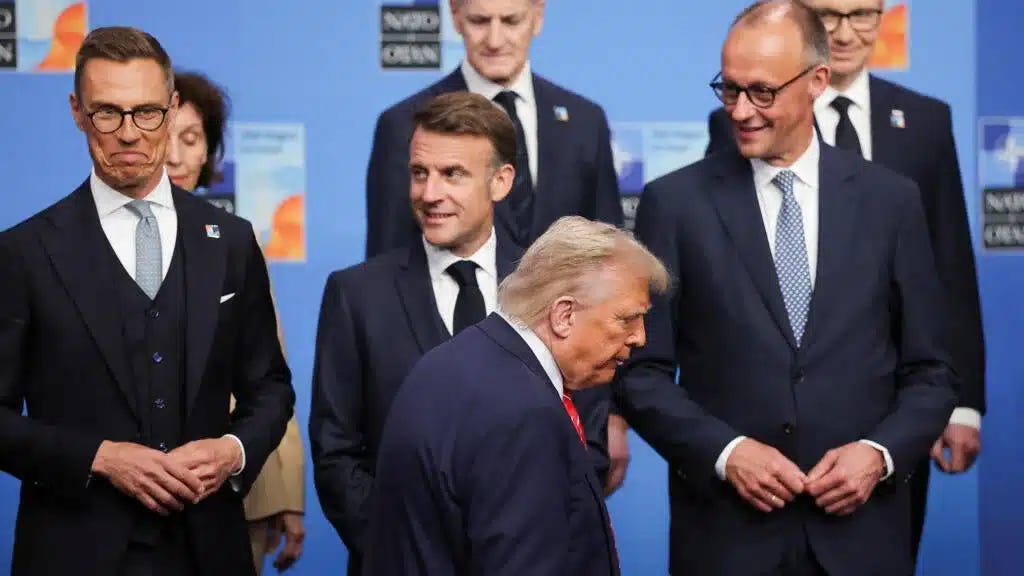
U.S. President Donald Trump has issued new threats to his European allies, warning of what he described as a “very bad future” that may await the North Atlantic Treaty Organization (NATO) if it does not move to provide practical support in securing the Strait of Hormuz, which is facing growing disruption and partial closure due to the fallout from the war against Iran.
In an interview with the Financial Times, Trump argued that European countries now owe Washington politically and strategically, particularly after the extensive support the United States has provided to Europe and Ukraine in recent years. He called on several European states—most notably Britain and France—to deploy naval forces, minesweepers, and special units to help reopen the strait, alongside other international actors such as China, Japan, and South Korea.
The American president added in a tone that carried both skepticism and pressure: “We’ll see now if they help us. I’ve always said we’ll be there for them, but they won’t be there for us, and I’m not sure they will.” The remark once again underscores Trump’s approach to redefining obligations within Western alliances according to a logic of mutual interest and equal burden-sharing an approach that has fueled tensions between the United States and its European partners in recent months.
In light of this warning far from the first of its kind NATO now finds itself facing a deeply complex dilemma: balancing fears of sliding into a broader confrontation with Iran against concerns about provoking Trump’s anger and the possibility of harsher American positions toward the alliance. What strategy, then, can NATO adopt to escape this predicament without paying a heavy strategic price on either side?
War Deepens Europe’s Internal Divisions
The U.S.-Israeli war against Iran has exposed the fragility of European cohesion, contributing to deeper divisions across the continent and revealing growing fractures within the NATO structure between Europe and the United States, according to Britain’s The Telegraph.
The newspaper argues that one of the war’s most significant indirect consequences has been the widening rift between Europe and Washington. The Atlantic alliance which has served as one of the pillars of American dominance since 1945 appears at this moment like a “hollow shell,” amid a decline in the sense of mutual obligation and a growing tendency to prioritize narrow national interests over the demands of strategic partnership.
The paper traced the signs of this divergence back to the earliest moments of the conflict, noting that Trump launched the war without meaningful coordination with European allies. Meanwhile, the ultimate objective of the military operation remained ambiguous whether the aim was to undermine Iran’s military capabilities, push for regime change, or impose a form of total capitulation on Tehran.
The newspaper also cited the positions of several European capitals particularly Madrid, London, and Rome as clear indicators of tensions with Washington. In Spain, Foreign Minister José Manuel Albares accused the United States and Israel of violating international law in Iran and called on Europe to condemn the ongoing airstrikes. Madrid subsequently moved to permanently withdraw its ambassador to Israel amid escalating diplomatic tensions over its opposition to the American and Israeli attacks.
In Britain, relations with Washington also appeared strained after the war exposed differences in the two countries’ approaches. According to the newspaper, Trump voiced objections to London’s refusal to participate in the initial strikes. British Prime Minister Keir Starmer also faced a degree of mockery from the American president after Britain considered sending an aircraft carrier to West Asia, only to later abandon the move and cancel emergency plans related to the deployment.
NATO’s Strategic Calculations
NATO’s approach to the ongoing war is shaped by five key determinants guiding its political and military behavior.
First: Avoid turning the alliance into a direct party to the war
NATO is keen to distance itself from direct involvement in a confrontation with Iran, recognizing the dangers of sliding into an open-ended war that goes beyond the alliance’s traditional defensive framework. This approach is rooted in clear precedents. During the 2019 Strait of Hormuz crisis, former NATO Secretary General Jens Stoltenberg stressed that the presence of some member states in the region did not mean NATO itself was present as an alliance.
The same logic reappeared during the first Iranian war in June 2025, when the alliance’s official response was limited to daily consultations and managing developments without announcing a new combat mission under NATO’s umbrella.
Second: Protecting existing forces and missions rather than opening new fronts
One of NATO’s top priorities is safeguarding its forces already deployed in the Middle East, particularly in Iraq, where the alliance carries out logistical and training missions within existing international frameworks. From this perspective, NATO prefers strengthening its current presence and preventing the war’s spillover from threatening its assets and personnel in the region, rather than becoming entangled in new fronts for which it is neither politically nor militarily prepared especially given the significant operational and financial burdens such involvement would entail.
Third: Preserving limited military capabilities and avoiding exhaustion
Considerations of capacity and readiness play a significant role in the alliance’s calculations, particularly in light of chronic imbalances in defense spending and armament levels among several of its members an issue that Trump has repeatedly used to criticize NATO and its European partners.
As a result, NATO has little strategic interest in becoming involved in another war that could further deplete its remaining military capabilities, especially after the heavy strain that the war in Ukraine has already placed on member states’ weapons stockpiles and defense resources.
Fourth: Managing regional balances and protecting strategic interests
NATO countries recognize that they maintain a broad network of economic, logistical, and strategic interests across the Middle East. Entering the war as a direct party could expose those interests to Iranian retaliation, as occurred with American assets during previous escalations.
For this reason, European states have shown considerable caution regarding any direct involvement, preferring to maintain a delicate balance between safeguarding their regional interests and avoiding a wider confrontation that could undermine their influence and presence in the region.
Fifth: Concerns over the war’s economic and political repercussions
NATO and European capitals more broadly are increasingly worried about the indirect repercussions of the war, particularly on the economic and social levels within Europe. Since the first day of the conflict, its effects have quickly begun to reverberate across the continent through rising gas and fuel prices and growing discussions about possible austerity measures to contain the anticipated costs of the crisis.
Should European countries become directly involved in the war, these repercussions could intensify significantly, increasing pressure on European governments. This factor is especially sensitive at a time when public opinion in Europe is becoming more cautious about automatically aligning with American foreign policy approaches particularly when their economic and political costs are high and when their benefits for Europe’s direct interests remain uncertain.
Possible Paths of Involvement
At the same time, European policymakers are acutely aware of the sensitivity of relations with the Trump administration, especially given the tone of warning and pressure adopted by the American president. Even as European capitals emphasize sovereignty and strategic autonomy, they understand that the United States still shoulders the largest share of NATO’s defense burden and maintains the alliance’s most extensive military presence, in addition to serving as its primary security umbrella.
As a result, while NATO is reluctant to enter the war directly as an institutional actor, it is equally unwilling to trigger another cycle of tensions with Washington. The alliance is therefore likely to pursue a middle-ground approach, offering partial or limited forms of support that ease American pressure without sliding into full-scale involvement.
This scenario appears even more realistic given that Trump’s request was directed at specific countries rather than at NATO as a unified entity. That distinction provides European states with greater room for maneuver while reducing the institutional embarrassment facing the alliance itself.
Any European or NATO support for the United States is therefore likely to come through contributions from individual member states rather than through a formal NATO operation. Such cooperation could take the form of maritime security arrangements outside the alliance’s institutional framework, similar to the initiatives led by the United States or individual European states during the 2019 crisis.
European participation—if it occurs—is expected to focus on defensive or technical roles such as mine clearance, escorting vessels, and providing aircraft or drones for surveillance and protection rather than engaging in an open war against Iran.
Through this pragmatic balancing act, NATO appears intent on managing the complex equation by protecting strategic interests, ensuring maritime security, and avoiding becoming a direct participant in the war. Consequently, any response by individual alliance members will likely remain limited, national in scope, and outside NATO’s formal umbrella.
A direct NATO operation against Iran therefore remains politically unlikely at least for the time being unless developments on the ground or shifts in European strategic calculations force a reassessment in the future.
