

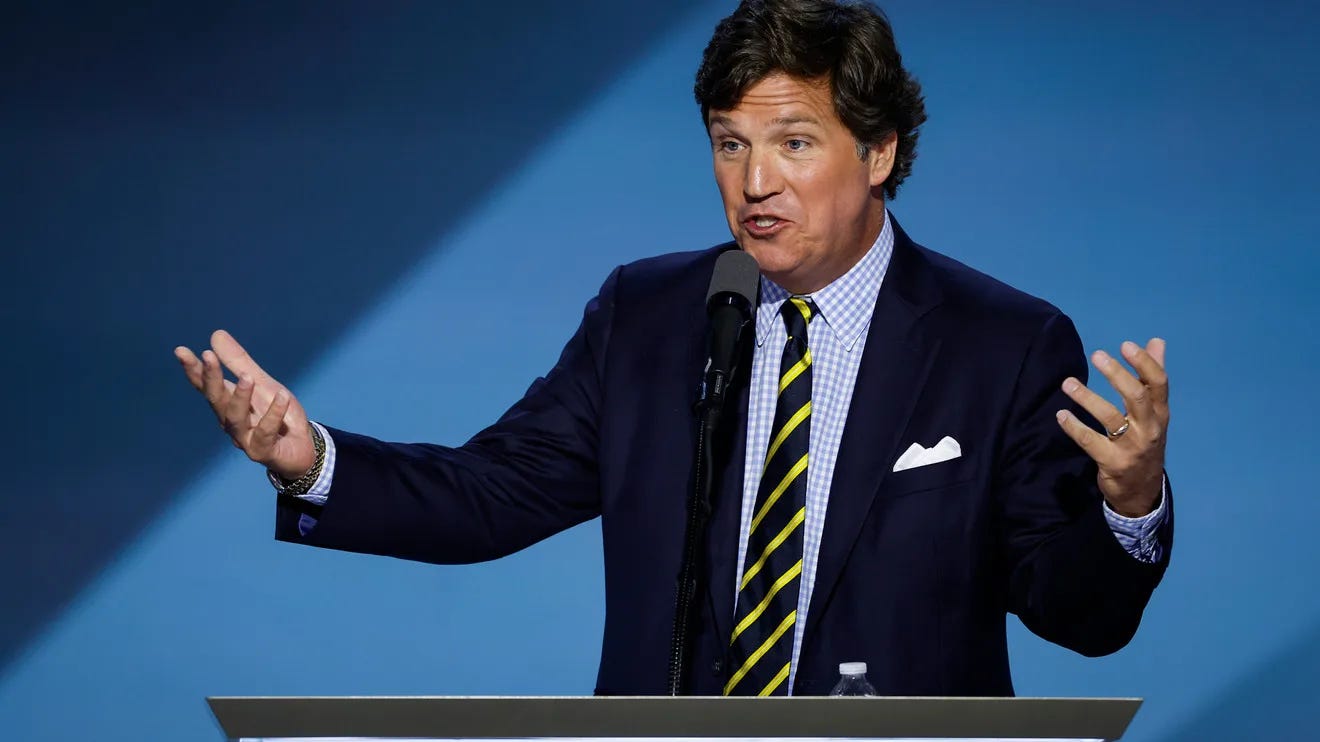
His interview with the US ambassador to Israel, Mike Huckabee, was the latest episode to thrust Tucker Carlson’s name back into Arab discourse. The exchange featured remarks by the ambassador touching on the sovereignty of states in the region, a heated clash between interviewer and guest, Carlson’s reported detention at Ben Gurion Airport for questioning, and his subsequent broadside against Israel.
The uproar has become a recurring feature in recent months. Carlson has faced accusations of antisemitism, even as he has sharpened his criticism of Israel to an extraordinary degree at one point likening Benjamin Netanyahu’s policies to Nazism. “Netanyahu says he is defending Western civilization.
No—he is its enemy, literally its main enemy… Why were the Nazis bad? Because they said we are fighting these people based on their identity… and Netanyahu believes the same thing,” Carlson said.
Many observers interpret this shift in a leading figure of the “Make America Great Again” camp—once a hawk of the American political right—as evidence that October 7, 2023, upended global political balances, particularly in the United States. Alliances once thought immovable appear shaken; positions long considered axiomatic in the 80-year history of the Arab-Israeli conflict seem newly open to rupture.
Yet can a right-wing broadcaster wield such influence as to become a barometer of political transformation? Or is the Tucker Carlson story little more than sound and fury—an expression of wishful Arab thinking, eager to believe that the brutal devastation in Gaza has yielded some long-term gain for the Palestinian cause?
Sometimes, answering a question about a single name can illuminate an entire phenomenon. In his book Who Is Charlie?, the French writer Emmanuel Todd analyzed what he termed the sociology of a religious crisis in the aftermath of the Charlie Hebdo attacks. Borrowing that formulation, we might ask: Who is Tucker Carlson?
The aim is not to recount his biography or ideological evolution, but to examine his current influence particularly within the American right and whether it signals a meaningful, even gradual, shift in US policy attitudes toward Israel.
A Voice for Other Victims
Religious pluralism, LGBTQ rights, and democracy these three principles function, for Israel, much as the ideals of the French Revolution did for Europe: civilizational touchstones. Or so Israel presents itself as the Middle East’s lone oasis safeguarding these values in a desert of autocracy and backwardness.
Through international public diplomacy campaigns such as “Brand Israel,” the country has foregrounded these themes in Western audiences. In the din of that messaging, however, the voices of those Israel claims to protect have often been sidelined. Chief among these are Palestinian Christians.
Carlson’s contribution to the Palestinian cause—intentional or otherwise—lies in stripping it of the Islamic-jihadist framing that Israel has long used to position itself as the West’s civilizational partner in a sacred war against Islamist terror. Amid internal battles within the American right, Carlson elevated the issue of Palestinian Christians, challenging the reduction of the conflict to Israel versus Hamas militants. Israel, he argued, continues to harm Christian communities who share the West’s religious heritage.
From a media perspective, Carlson’s platform has allowed the Palestinian narrative to reach audiences historically indifferent to Middle Eastern or Arab issues. Whether Carlson’s engagement is ideological or opportunistic matters less than the practical effect: his feuds within the right have opened a new lane for Palestinian voices.
This dynamic became especially visible over the past six months as Israel’s longstanding narrative about safeguarding Christianity in the Holy Land came under scrutiny. In the wake of Carlson’s clashes with Republican Senators Ted Cruz and Mike Johnson who portrayed Israel as uniquely protective of religious freedom Palestinian voices gained traction.
Carlson hosted the American Orthodox nun Mother Agapia Stephanopoulos in a YouTube episode titled “This Is What Life Is Really Like for Christians in the Holy Land,” which garnered two million views. She detailed the daily hardships facing Palestinian Christians, including those holding US citizenship.
The “Ben Gurion Battle”
Carlson’s involvement did not stop there. Two weeks ago, he aired another episode “The Shocking Reality of How American-Funded Israel Treats Christians” featuring Palestinian pastor Rev. Dr. Hosam Naoum. The episode generated significant engagement, amassing 1.8 million views on X within ten hours and 1.5 million on YouTube.
It was this episode and its aftermath that set the stage for Carlson’s later confrontation with Ambassador Huckabee. A dispute between the two on X culminated in a three-hour broadcast exchange, triggering regional responses including a joint statement by several Middle Eastern states after the ambassador defended Israel’s sovereignty from the Nile to the Euphrates on theological grounds.
The British newspaper The Guardian dubbed the encounter the “Ben Gurion Battle,” describing it as a generational clash within American Christian conservatism. Carlson accused Huckabee of championing Israeli interests over American ones, reflecting a widening fissure within the US Christian right.
Samuel Goldman, author of God’s Country: Christian Zionism in America, told The Guardian: “I think we are approaching the end of an era that peaked under George W. Bush, when it was taken for granted that Republican and conservative spokespeople would be pro-Israel.”
Goldman emphasized a clear generational divide. Huckabee, 70, belongs to a cohort that saw Israel as a pillar of Judeo-Christian civilization and a religious obligation for Protestant Christians. Carlson, 56, represents a rising strain of MAGA isolationism and Christian nationalism.
“He reflects and exploits the doubts among younger conservative Christians about whether their parents’ or grandparents’ enthusiasm for Israel makes political or theological sense,” Goldman said.
Carlson: The Godfather of a New Generation
In a mid-February study published on the Times of Israel platform, political psychologist Erwin Mansdorf examined what he termed the “Tucker Carlson effect.” Surveying 561 US Republicans, he found that younger Republicans were markedly more enthusiastic about Carlson as a political figure.
Among respondents under 44, more than 55 percent viewed Carlson as a potential candidate, and 58 percent said they would likely vote for him. Among those 45 and older, only 38 percent believed he would run, and 41 percent expressed willingness to support him.
Mansdorf concluded that Carlson’s appeal is far stronger among younger Republicans, echoing similar findings by the Manhattan Institute. While support for Carlson does not automatically translate into hostility toward Israel, 55 percent of younger Republicans reported being less invested in Israel than their older counterparts. For them, Israel is one foreign policy issue among many—not a uniquely defining cause.
More striking were generational differences regarding perceived threats to the American way of life. While majorities in both age groups expressed at least moderate concern about immigrants and Muslims, the gap widened on Jews: 45 percent of Republicans under 44 expressed moderate or greater concern, compared with 23 percent among those over 45.
“Although Jews remain viewed as less threatening than other groups,” Mansdorf warned, “the fact that nearly half of young Republicans expressed this level of concern suggests increasing exposure to narratives portraying Jews as a societal problem even among voters who do not consider themselves antisemitic.”
The Right’s “Zohran Mamdani”: Bad News for Israel
Mansdorf ultimately poses a troubling question: how can strong nominal support for Israel coexist with readiness to back a figure associated with anti-Israel rhetoric?
Political psychology, he argues, offers an answer. Voters often prioritize tone, identity, and broader messaging over specific policy positions. Mechanisms such as motivated reasoning and the halo effect allow individuals to downplay or rationalize troubling aspects of a candidate.
For some voters—especially younger ones—Israel may become politically irrelevant, no longer a litmus test in Republican primaries. The danger, Mansdorf cautions, is not an abrupt collapse in Republican support but a gradual erosion of Israel’s status as a defining political issue.
“If Israel becomes a non-disqualifying concern something voters are willing to overlook then candidates with hostile or extreme positions will be able to advance without paying a political price,” he writes.
Invoking the case of Zohran Mamdani as an example of shifting political red lines, Mansdorf warns that once-exclusionary views can fade amid populist rhetoric. For Israel and American Jewish communities, the implication is clear: it is no longer enough to ask whether Republicans support Israel in principle.
The real question is whether that support is strong enough to influence voter behavior when confronted with a charismatic populist offering a cultural-war agenda at home and indifference or hostility toward Israel abroad.
In conclusion, Mansdorf seeks reassurance for his readers, but the glass appears half full of murky water. “Our data suggest good news: Republican support for Israel has not collapsed, and not all young Republicans are anti-Israel or antisemitic.
But there is also bad news. The psychological mechanisms that allow voters to ignore controversial positions are already at work and appear stronger among the rising generation. The decisive question is not whether Israel still matters in principle, but whether it will matter enough when the moment of decision arrives.”