

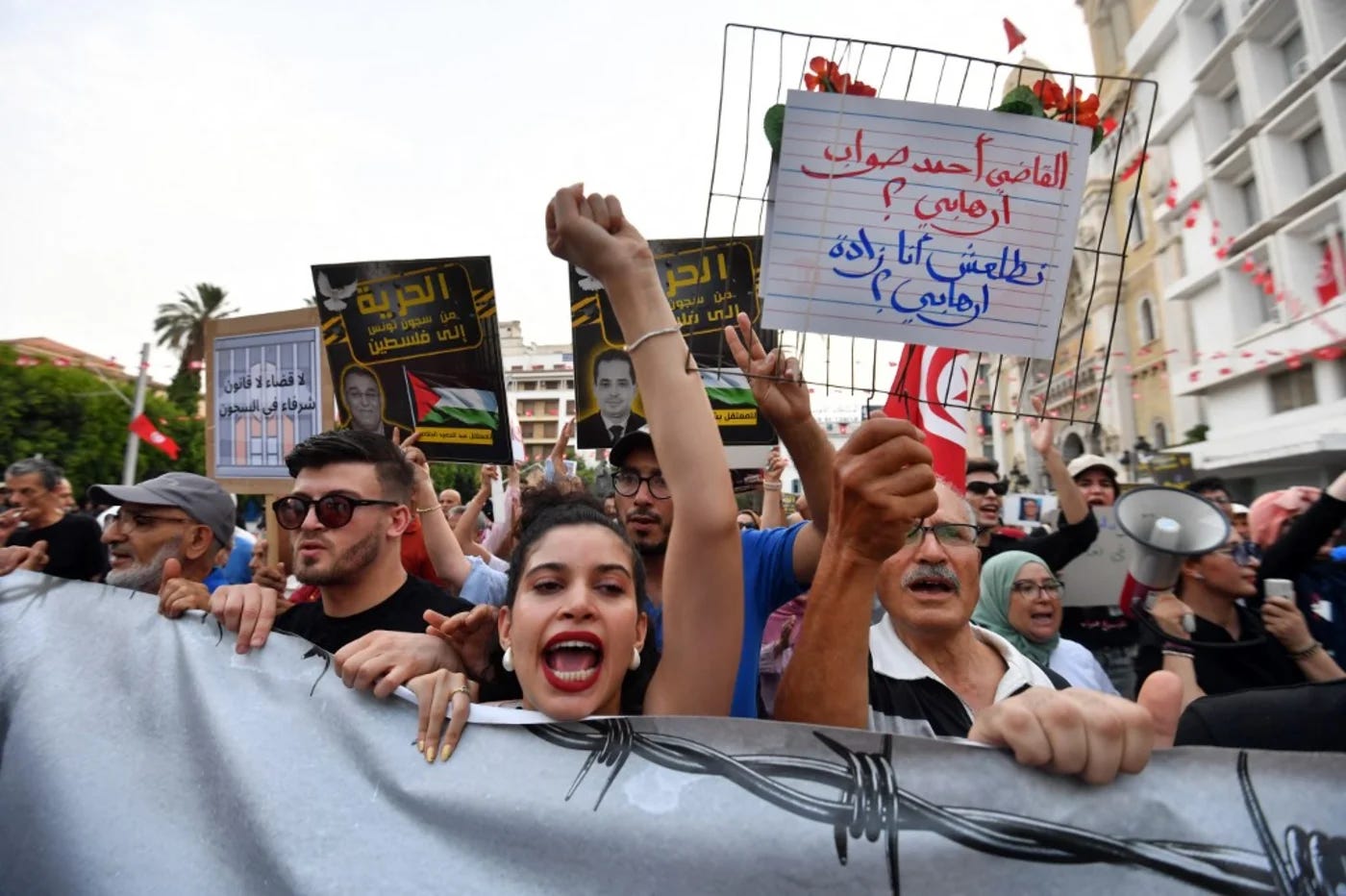
Under the banner “Opposition Is Not a Crime,” the Tunisian capital and several other cities have witnessed a fourth consecutive week of protests against the ruling regime, bringing together activists, human rights organizations, and political figures from across the ideological spectrum.
The protests have recently widened in scope, with renewed calls for a “unified movement” comprising Islamist, leftist, and liberal factions. But what has fueled this latest escalation? What are the protesters demanding? And how are the authorities responding?
Causes of Escalation
1. Political and Judicial Repression
The protest movement surged following a Court of Appeals ruling that sentenced dozens of opposition leaders, lawyers, and businessmen to prison terms of up to 45 years on charges of “conspiring against state security.”
Another court sentenced Abir Moussi, head of the Free Destourian Party, to 12 years in prison.
Prominent figures such as politician Nejib Chebbi, lawyer Chaima Issa, and human rights advocate Ayachi Hammami have also been arrested.
These measures have rattled even regime supporters, with one protester saying that “the machinery of dictatorship spares no one.”
2. Economic Crisis
Soaring prices and shortages of basic goods have made the economic crisis a central trigger of public anger. Tunisians are grappling with a severe downturn: GDP growth stands at just 1%, public debt has reached 81% of GDP, and inflation hit 7.4% in 2024.
The government has increasingly relied on domestic borrowing to cover budget deficits, with plans to borrow $3.7 billion from the Central Bank in 2026 after taking $2.3 billion in 2025.
Experts warn this policy amounts to “deficit financing through money printing,” which will worsen inflation and further weaken the dinar. Economic reports also indicate that the 2025 Finance Law hinges on new taxes to cover spending an approach that could widen the deficit and accelerate inflation if fiscal projections fail.
In response, the powerful Tunisian General Labor Union (UGTT) has called for a nationwide strike on January 21, 2026, demanding wage increases and denouncing what it calls “an attempt to entrench autocratic rule.”
3. Social Pressures
These protests are not isolated. Marginalized interior regions like Kef, Kasserine, and Gafsa have seen marches demanding jobs and improved services.
Environmental demonstrations have also erupted, particularly in Gabès, where protesters are calling for the shutdown of a phosphate complex accused of severe pollution.
All of these movements are united by a sense of social injustice, widespread poverty, and unemployment factors fueling the broader push for a unified opposition.
Who Is Leading the Protest Movement?
Tunisia’s opposition landscape is composed of several major players, including the National Salvation Front led by jailed politician Nejib Chebbi, the Islamist Ennahda Movement led by the imprisoned Rached Ghannouchi, and the Free Destourian Party led by the detained Abir Moussi.
The coalition also includes various leftist and liberal parties as well as civil society groups such as the Tunisian League for Human Rights and the “Family Coordination for Political Prisoners.”
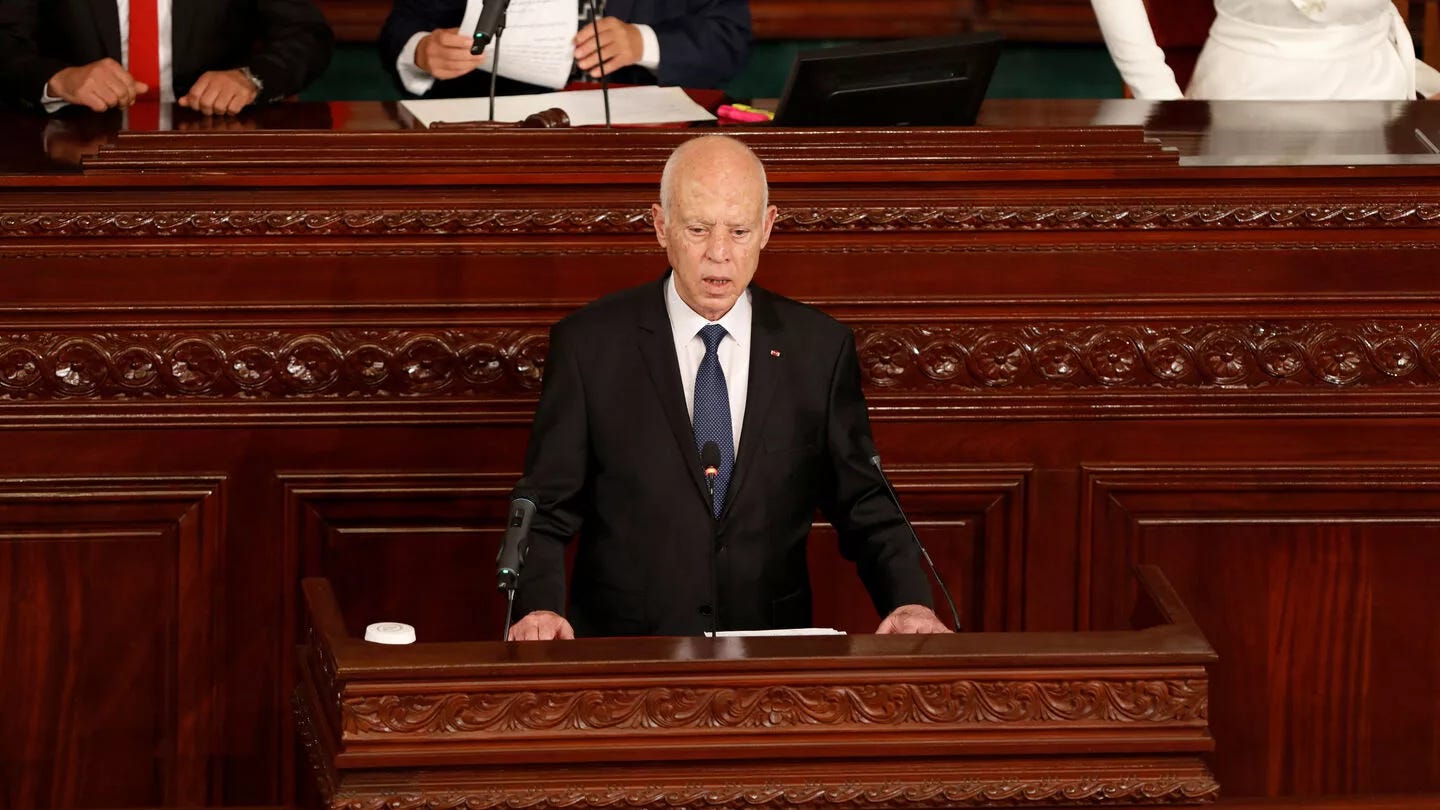
The UGTT has also emerged as a key actor, not only by calling for a general strike but also through its visible presence in recent demonstrations.
These groups have historically been fragmented and tensions remain. The Tunisian Network for Rights and Freedoms, for example, refused to demonstrate alongside the National Salvation Front on July 25, 2025, leading to the cancellation of a planned joint protest.
However, the wave of arrests and increasingly harsh sentences has prompted many to reconsider their alignments, reviving discussions around the need to unite against President Kais Saied’s regime.
Still, the movement remains leaderless in structure. No single figure currently embodies the entire opposition front, and leadership appears collective for now.
Key Demands of the Protest Movement
Restoration of Constitutional Legitimacy: The National Salvation Front and its allies are calling for the reversal of President Saied’s July 2021 exceptional measures and a return to the 2014 constitution, along with early parliamentary and presidential elections.
Release of Detainees: All opposition groups are demanding the immediate release of dozens of detained politicians, lawyers, and journalists including Abir Moussi, Chaima Issa, Ayachi Hammami, and Nejib Chebbi.
Judicial and Media Reforms: Protesters want enhanced judicial independence and the repeal of restrictive decrees like Decree 54 on “fake news,” widely seen as a tool to muzzle dissent.
Socioeconomic Program: Leftist parties and labor unions are pressing for the restoration of subsidies for vulnerable groups, the implementation of a progressive tax policy, and a serious crackdown on entrenched corruption within state institutions.
What Lies Ahead?
President Kais Saied’s administration claims these judicial actions are part of a broader campaign to “fight corruption and purge traitors.” But human rights groups have increasingly described Tunisia as an “open-air prison,” warning that the protests could spiral into widespread unrest if the economic and social crises deepen.
Authorities have responded to the protests with arrests and use of force most notably in Kairouan, where clashes broke out following the death of a young man during a police chase. In response, angry youths burned tires and confronted security forces.
Events in Gabès and Kairouan suggest that unrest may spread further into Tunisia’s impoverished interior, in addition to the capital and other cities protesting political repression.
According to Middle East Eye, the protest movement’s success hinges on the opposition’s ability to maintain unity and exert sustained pressure on President Saied to implement reforms or hold elections.
Should internal divisions persist, however, the regime may continue exploiting the fragmentation to prolong its rule and intensify its crackdown.