

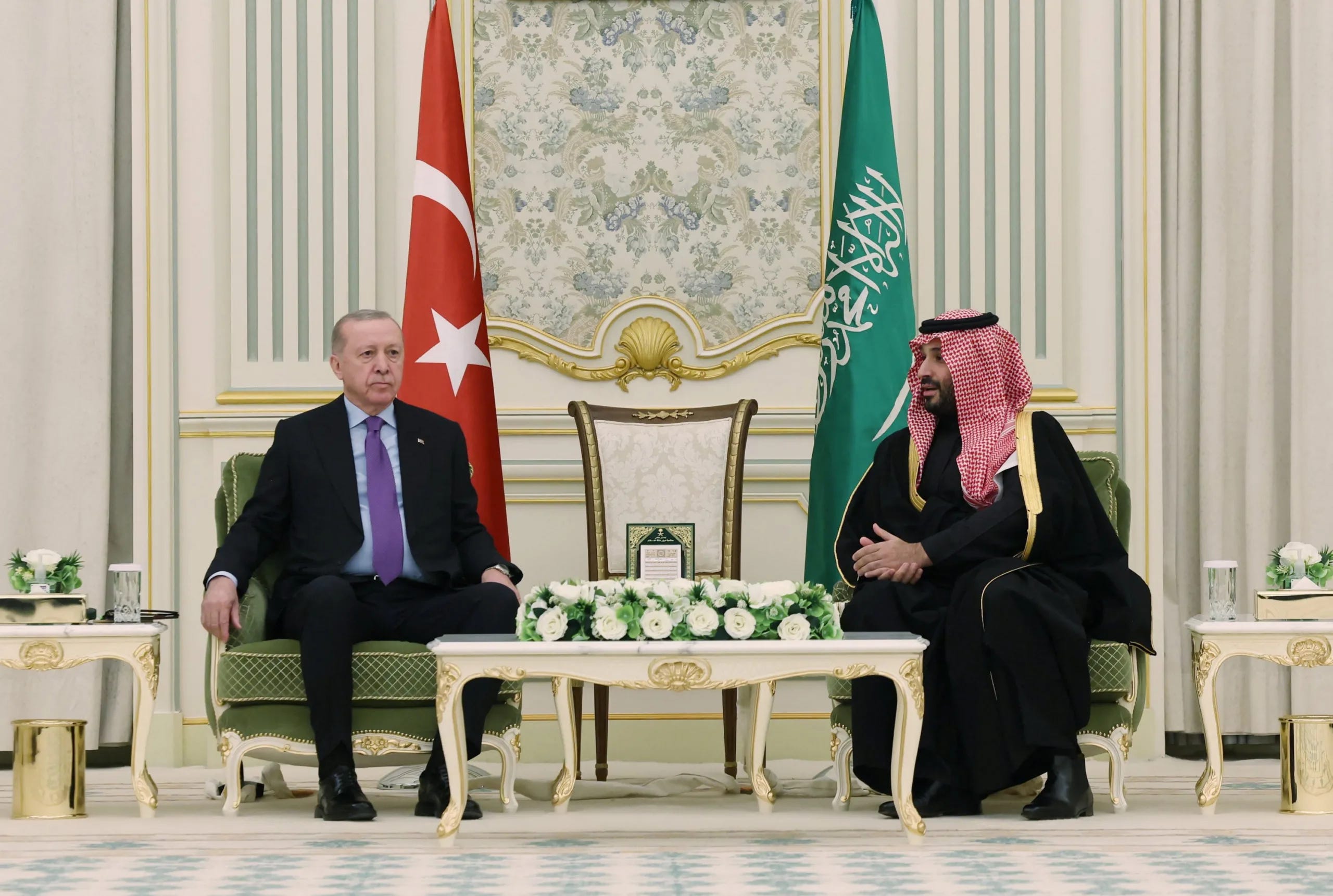
In early February 2026, a high-profile meeting in Riyadh between Turkish President Recep Tayyip Erdoğan and Saudi Crown Prince Mohammed bin Salman sent a clear message across the Middle East: Turkish-Saudi ties are deepening fast.
This encounter was more than a ceremonial exchange; it underscored a rapidly expanding strategic partnership that is beginning to unsettle Israel’s regional designs.
This rapprochement, which culminated in sweeping agreements across energy, defense, and economic sectors, marks a significant shift in regional alliances. For Israel, however, it signals a complex challenge.
Tel Aviv no longer sees the Ankara-Riyadh dynamic as a bilateral development it is increasingly viewed as part of a larger, emergent network that could restrict Israel’s political, economic, and strategic maneuverability.
The Roots and Drivers of Reconciliation
Just a few years ago, a warm Erdoğan welcome in Riyadh would have been unthinkable. Relations soured dramatically after the 2018 killing of journalist Jamal Khashoggi, compounded by opposing stances on issues such as Egypt and Libya.
But shifting regional priorities have redrawn the landscape. According to The Jerusalem Post, the growing threat from Iran and subtle tensions between Riyadh and Abu Dhabi prompted Saudi Arabia to re-engage with Turkey, once a bitter rival.
Riyadh’s disillusionment with the UAE over Yemen and Sudan, and its reassessment of Israel as a competitor rather than a partner—especially after the 2025 war on Gaza—accelerated this pivot. Israeli analysts believe Saudi Arabia has cooled on normalization with Israel due to its destabilizing policies in Syria and a controversial 2025 airstrike in Doha.
Within this recalibrated context, Riyadh views Ankara as a strategic alternative to restore regional balance.
Turkey, meanwhile, has pursued a sweeping policy of regional reconciliation, mending ties with Egypt and the UAE in 2023–2024 and even briefly engaging Israel before relations soured again over Gaza.
More consequential, however, is Turkey’s shift toward unconventional defense alliances. A 2026 Bloomberg report revealed Ankara is in advanced talks to join a mutual defense pact with Saudi Arabia and Pakistan the Islamic world’s sole nuclear-armed state.
The alliance, announced in September 2025, includes a mutual defense clause and could place Turkey under Pakistan’s nuclear umbrella a development Israeli media described as a “game-changer” in the regional power equation.
Turkey’s Expanding Influence
Israeli strategists are increasingly uneasy about Turkey’s rapid rise as a regional power. The 2024 fall of Bashar al-Assad’s regime opened the door for Ankara to become a central player in post-war Syria.
Saudi Arabia implicitly backed this transformation, particularly in supporting the integration of the Syrian Democratic Forces (SDF) into the new Syrian state a position aligned with Turkish goals.
Turkey capitalized on the new landscape, expanding security coordination with Syria’s Arab neighbors Jordan, Iraq, and Lebanon. In March 2025, Amman hosted a groundbreaking security summit that included officials from Turkey, Jordan, Iraq, and the new Syrian government to bolster counterterrorism and border security efforts.
With Saudi support, Ankara’s role as a regional security guarantor deepened. It is now involved in post-ISIS reconstruction, urging the transfer of detained ISIS fighters from Kurdish custody to its Syrian allies.
Erdoğan also reached out to Lebanon, pledging support for the country’s stability in a call with President Joseph Aoun. In Iraq, despite longstanding tensions over Turkish incursions and PKK presence, Israel-based assessments suggest Ankara has solidified both security and economic ties with Baghdad to counter Iranian influence.
This Turkish footprint from the Levant to Mesopotamia is complemented by a successful diplomatic outreach to Cairo and Abu Dhabi. Turkey restored ambassadors to both capitals in 2024, pivoting to a pragmatic, interest-based relationship. Its ties with Qatar have remained robust.
With Saudi Arabia now joining this network, Turkey is positioned at the center of a web connecting nearly every major Arab power from the Gulf to North Africa.
Backed by Saudi capital, Pakistani military weight, and balanced diplomacy with Washington and Moscow, Ankara is transforming into a regional linchpin bridging the Maghreb, the Mashreq, and the Horn of Africa.
A Defense and Economic Alliance with Strategic Weight
The Turkish-Saudi alliance isn’t limited to diplomacy. It is rooted in substantial defense and economic cooperation developments with strategic implications for Israel.
Newly signed agreements during Erdoğan’s recent visit reflect major foreign investment flows into Turkey’s energy sector, a sign of Saudi confidence in the Turkish economy. A proposed regional megaproject to link the Turkish and Saudi electricity grids could transform regional energy flows.
The two nations also aligned their long-term visions Saudi Vision 2030 and Turkey’s “Century Vision”—to synchronize infrastructure development, non-oil trade, and manufacturing.
On the defense front, Saudi Arabia has emerged as the largest buyer of Turkish defense products, diversifying its arms sources and bolstering indigenous capacity. For Turkey, this translates into critical foreign currency inflows and expanded defense clout.
Israeli analysts warn that Turkey’s role as a security provider could undercut Israel’s defense exports across Islamic regions in Africa and Asia, closing off key markets.
This growing Turkish role also threatens Israel’s infrastructure and energy ambitions, especially the India-Middle East-Europe Corridor (IMEC), announced in 2023, and its gas and electricity export plans via Cyprus and Greece.
If Riyadh favors routes through Turkey and Syria, Israel’s geopolitical value as an energy hub could diminish. A Hebrew-language study notes that sidelining Israel in energy logistics would undermine IMEC and erode the economic benefits of the Abraham Accords.
Continued Saudi investment in Turkey and surrounding states further reduces prospects for future Israeli-Saudi tech-defense collaborations once envisioned in Tel Aviv.
Israel’s Rising Alarm
Across Israeli policy circles, the Turkish-Saudi rapprochement is seen as a direct challenge requiring countermeasures.
In January 2026, Maariv reported growing unease in Israel over the deepening Ankara-Riyadh defense ties and Turkey’s warming relations with Washington.
Israel is concerned that Turkey’s expanding influence stretching from Syria to Jordan, Lebanon, and Iraq could culminate in a new strategic bloc linking the Middle East, North Africa, and the Red Sea, with Saudi Arabia at its core.
This potential axis, particularly with Pakistan’s implicit nuclear backing, could severely restrict Israeli freedom of movement in Gaza, Iran, Syria, and energy policy.
Maariv described Erdoğan’s regional strategy as “realist and pragmatic,” aimed at forging joint security and economic interests with Saudi Arabia. Tel Aviv views this alignment, supported by Islamabad, as a geopolitical squeeze on Israeli influence especially as all three states have condemned Israel’s 2025 war on Gaza.
This condemnation was visible at the late 2025 Organization of Islamic Cooperation (OIC) summit and the Erdoğan–MBS joint statement denouncing Israel’s assault and blockade, while calling for a ceasefire and a two-state solution.
Israeli observers say this signals a shift in Riyadh’s traditionally moderate stance toward Israel, adding regional legitimacy to anti-Israeli positions.
Prime Minister Benjamin Netanyahu subtly expressed frustration with this axis on January 27, 2026, stating, “We expect those who seek peace with us not to join efforts led by ideologies that reject peace and seek to delegitimize the State of Israel.”
Israel is now reassessing its alliances, deepening military cooperation with Greece and Cyprus and exploring alternative trade and energy routes via Egypt, Jordan, and the Red Sea, aiming for greater flexibility in an evolving region.
Israeli circles are also troubled by Washington’s tacit approval of this shift. According to Bloomberg, US allies like Saudi Arabia and Turkey increasingly doubt the reliability of American support and are building independent security frameworks.
Ankara’s rapport with former President Trump allowed it to pursue its regional agenda with a green light. Trump even hinted at re-admitting Turkey into the F-35 fighter jet program—despite Israeli opposition—offering Erdoğan the latitude to coordinate closely with Riyadh in reshaping the region.