

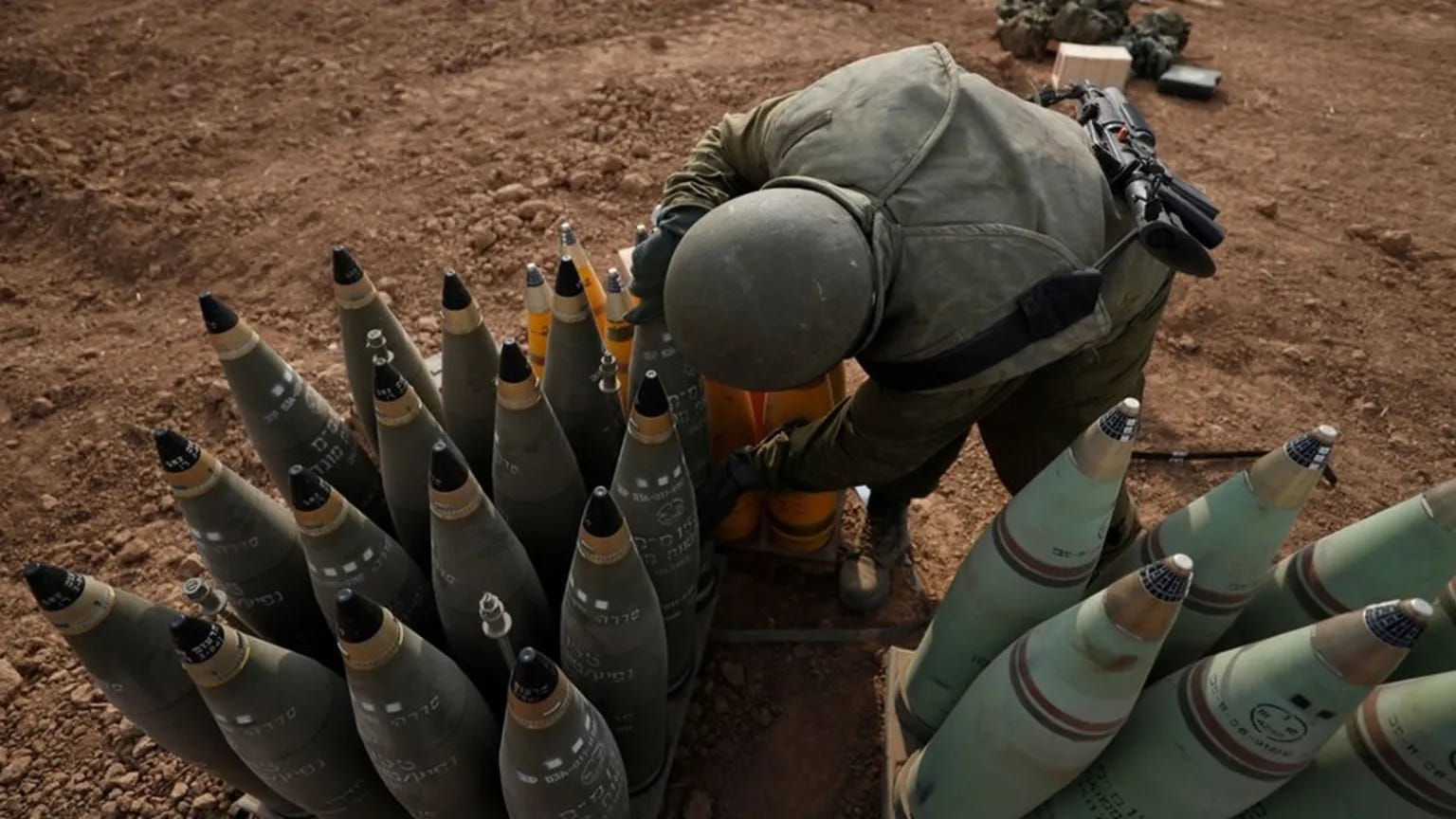
Bloomberg, citing an official in Israel’s Ministry of Finance, revealed that the government of Prime Minister Benjamin Netanyahu is moving to increase its defense budget by roughly $13 billion to finance the war with Iran. The increase will be included in a revised draft of the 2026 budget. Israel’s cabinet is expected to discuss and vote on the amendments before sending them to the Knesset for final approval before the end of the month.
According to the plan reviewed by the agency, the defense budget will rise by about $9 billion, in addition to allocating $3.2 billion as a reserve to cover potential military needs. Israel’s total defense spending is expected to reach approximately $45 billion an increase of around 115 percent compared with its level in 2023, before the outbreak of the war in Gaza.
This historic surge in Israel’s defense budget coming amid a multi-front war fought by the occupying state reflects a range of intertwined signals and implications, whether at the military, political, or economic level. It also carries clear messages to both the Israeli public and the broader regional environment.
Militarily: The Expansion of a Multi-Front War
The first thing this massive budget reveals is the profound shift now dominating Israel’s military doctrine: the consolidation of a state of continuous war within a multi-front combat environment. Until recently, this approach had been the subject of debate within Israeli society. However, recent developments, along with the nature of the challenges confronting Netanyahu, have pushed this trajectory closer to becoming a fixed strategic choice rather than a temporary response.
Regardless of the repercussions that may follow from this approach, Netanyahu and his far-right coalition appear inclined according to their political and security outlook to expand the scope of confrontation and manage simultaneous fighting across multiple fronts, stretching from Gaza and the West Bank to Lebanon, Syria, Yemen, Iraq, and ultimately Iran.
From this perspective, the attempt to pass a defense budget of this magnitude appears to reflect a political and military conviction that the coming phase will remain governed by the logic of open war and its heavy costs.
Strategically: An Admission of the Scale of Losses
The move to amend the 2026 budget—despite its prior approval—and raise defense allocations effectively amounts to an implicit acknowledgment of the scale of attrition suffered by Israel’s military in recent months, beginning with the war in Gaza and extending to the current confrontation with Iran.
These successive developments have imposed heavy burdens on Israel’s military establishment, revealing battlefield and operational costs far higher than earlier estimates and exhausting a significant portion of its combat and armament capabilities.
Despite the climate of ambiguity and secrecy that Israeli authorities seek to maintain in order to conceal the true extent of their losses, the push to raise the defense budget by roughly $13 billion signals a clear shortage in military capabilities and readiness.
This additional funding is primarily aimed at replenishing depleted military stockpiles whether weapons, sensing systems, or intelligence capabilities while also covering the escalating costs of military operations, including operational expenses, soldiers’ salaries, mobilization and reserve call-ups, and other burdens associated with managing prolonged, multi-front wars.
Economically: Deficits and Mounting Strain
Since late 2023, Netanyahu’s government has continued to allocate enormous financial resources to fund its multi-front war. In 2024 alone, more than $31 billion was spent on military operations in Gaza and Lebanon. Then, last December, the cabinet approved a draft state budget for 2026 that included roughly $35 billion for the defense sector—significantly higher than allocations in the previous draft.
This upward trajectory in military spending reflects the extent of the Israeli government’s reliance on the security and military option. At the same time, it imposes growing economic and financial burdens on the structure of Israel’s economy.
According to Bloomberg, this dramatic increase in spending could push the budget deficit beyond the previously set ceiling of 3.9 percent of GDP, at a time when public debt stands at around 69 percent of the national output.
Estimates also indicate that Israel’s government borrowing needs have surged sharply since the outbreak of the Gaza war in October 2023. Borrowing reached approximately $90 billion in 2024 before declining to around $64 billion last year, with expectations that it may rise again during the current year.
The consequences do not stop at direct borrowing. They also extend to debt servicing and interest payments, which are estimated at about $3.2 billion annually, according to Israel’s Ministry of Finance. Because the increase in spending cannot be covered entirely through borrowing, the government may find itself forced to cut spending in other civilian sectors or impose new taxes even though it has already announced austerity measures worth roughly $9.6 billion to finance military operations in Gaza, Lebanon, and Iran.
Politically: Closing the Door on Internal Opposition
Amid growing security-related criticism directed at the Israeli government over the ongoing war, Benjamin Netanyahu and his far-right coalition are seeking to recalibrate the domestic front and contain the erosion of public confidence.
They aim to do so by expanding defense spending and presenting it as proof that security and the protection of the state are the government’s top priorities at this sensitive moment.
At the same time, by increasing defense allocations and attempting to repair the losses and attrition suffered by the military over the past two years, Netanyahu seeks to present himself as a decisive leader capable of managing confrontation firmly in the face of his domestic rivals.
This approach is also used as a political and military deterrent tool, aimed at preventing opposition forces from exploiting the current situation to question the government’s competence or push for its removal at the earliest opportunity.
Regionally: Messages to the Region
Netanyahu’s insistence on expanding defense spending and addressing the military shortages resulting from the attrition experienced by Israel’s armed forces in recent months despite clear economic strain does not merely reflect a temporary response to battlefield needs.
Rather, it reveals a growing desire to prolong confrontation and continue fighting, potentially entrenching a broader transformation that places Israel’s economy on a war footing as the governing priority of this phase.
This approach may also be interpreted as a multi-layered strategic deterrence message directed first at resistance factions and Tel Aviv’s regional adversaries from Gaza, Lebanon, and Syria to Yemen, Iraq, and ultimately Iran.
The core message is that Israel seeks to rebuild the capabilities and equipment it has lost over the past two years, enabling it to restore part of its military arsenal and raise its level of readiness once again.
More broadly, the policy conveys a deeper and clearer signal: Israel no longer views the current confrontations as limited military rounds. Instead, it appears to be preparing for the possibility of a prolonged war and perhaps a wider regional conflict.
Ultimately, the move to increase defense spending reveals what appears to be a deliberate intention by the occupying state to keep the region in a continuous state of tension and confrontation, whether through maintaining a single front or expanding the conflict across multiple arenas, aided by what it sees as unlimited support from the Trump administration.
At the same time, this Israeli momentum is also rooted in a regional environment characterized by imbalance and declining power dynamics, conditions that have encouraged Israel’s government to press ahead with escalation policies while benefiting from a turbulent regional climate that has allowed it to expand its maneuvering space and impose new realities on the ground.