

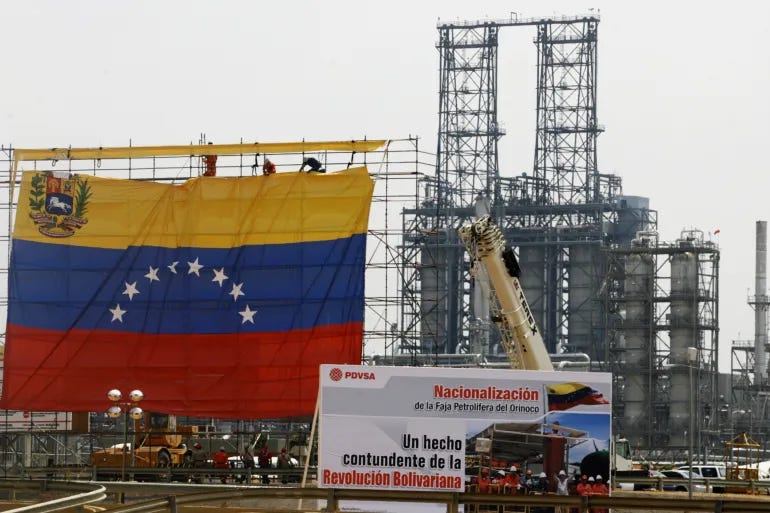
The recent developments in Venezuela carry complex ramifications for Arab oil-producing countries, following former US President Donald Trump’s pledge to impose a “temporary” American administration as a political cover to seize control of the oil-rich nation.
Venezuela experienced a dramatic turn of events at the start of 2026, as the United States launched a military operation that resulted in the abduction of President Nicolás Maduro, who was then transported to New York. Trump marketed the operation as an effort to “reform the oil sector” and “restore production to its former levels.”
As a founding member of OPEC and a partner to Arab nations in global energy markets, Venezuela’s shifting oil status is likely to reverberate across the Middle East and impact global markets as well.
Massive Reserves, Struggling Output
Venezuela holds the world’s largest proven oil reserves, estimated at around 303 billion barrels roughly 17% of global reserves surpassing even Saudi Arabia. Yet despite this vast resource, the country’s oil production has sharply declined over the years.
After peaking at around 3.5 million barrels per day (bpd) in the 1970s accounting for over 7% of global output at the time Venezuela’s production has steadily fallen. During the 2010s, output slipped below the 2 million bpd mark, averaging around 1.1 million bpd in 2025, or just 1% of global supply.
Currently, estimates suggest Venezuela is producing only about 800,000 bpd a strikingly low figure given its immense reserves and potential.
This sharp decline is attributed to a combination of chronic mismanagement and years of crippling US and Western sanctions that have throttled the country’s oil sector.
Venezuela’s oil exports have also shrunk dramatically, with over 80% now flowing to China via clandestine channels due to the US embargo leaving the country’s oil revenues far below what its reserves would suggest.
US Plans to Tap Oil Wealth
Following the abduction operation, Trump announced plans to bring in major US oil companies to invest in Venezuela, promising billions in spending to revive the sector in a manner that would serve American interests and redirect revenue flows. His remarks fueled longstanding accusations that oil was the true motive behind Washington’s intervention.
Despite Trump’s optimistic rhetoric, energy experts caution that reviving Venezuela’s oil sector will be an arduous task, requiring immense time and investment.
Analysts at Goldman Sachs warn that any recovery in production will be slow and contingent on massive capital outlays to restart wells, repair refineries, and rehabilitate fields that have suffered from years of underinvestment.
Venezuela’s aging infrastructure presents another obstacle. Many of the country’s idle wells require full-scale maintenance or even re-drilling, not just a simple restart. Storage facilities, blending units, and upgrading plants are also running far below capacity due to neglect and sanctions that restrict access to key materials like diluents.
Still, projections by JPMorgan suggest that if a political transition is secured in Caracas and sanctions are eased, Venezuela’s output could rise to 1.3–1.4 million bpd within two years, and possibly reach 2.5 million bpd within a decade.
Other experts argue that production could hit the 2.5 million bpd mark within 3–5 years if sanctions are swiftly lifted and foreign investment flows in though this scenario is highly optimistic and depends on political stability and the new administration’s ability to attract investors and rebuild trust.
Prices and OPEC+ Dynamics
News of Maduro’s ousting initially jolted global oil markets, yet prices did not rise in fact, they dipped slightly.
On January 5, 2026, Brent crude fell below $61 per barrel, giving up earlier gains. This decline reflected market confidence that global supply remains sufficient and that any disruption in Venezuelan exports would be short-lived.
Simultaneously, the OPEC+ alliance which includes Venezuela, Russia, and Gulf states held an emergency session the day after the events and opted to maintain current production levels for the first quarter of 2026.
The decision signaled OPEC+’s intent to contain market jitters and prevent panic, particularly since Venezuela was already producing well below its quota due to sanctions. As such, the temporary loss of its limited output was not seen as significantly disruptive.
Analysts believe Venezuela’s impact on prices will remain limited in the short term. Even if exports are halted for several weeks due to political turmoil, ample global supply and compensatory output from other producers should avert major price spikes.
UBS analysts noted that any meaningful recovery in Venezuela’s production is unlikely before the end of the decade.
Still, long-term investors remain watchful. If Washington enforces a roadmap that channels Venezuelan oil back into the market and ramps up output by hundreds of thousands of barrels daily, this could increase the global oil surplus in coming years.
Goldman Sachs estimates that Venezuelan output reaching 2 million bpd in the future could lower oil prices by around $4 per barrel from current 2030 forecasts.
Middle Eastern Oil Anxiety
The US intervention in Venezuela has been met with cautious attention in Arab oil-producing capitals, which maintain ties with Caracas through OPEC. Publicly, many Gulf governments including Saudi Arabia and the UAE refrained from issuing strong statements, given their strategic alliance with Washington.
Qatar, however, positioned itself as a mediator. Its Foreign Ministry expressed “deep concern over recent developments” and called for restraint and dialogue — a stance consistent with Doha’s traditional role as a regional broker and reflective of underlying fears about oil market instability.
Iran, by contrast, strongly condemned the US intervention. Tehran had been Maduro’s closest ally in the Middle East and viewed his ousting as a blow to an anti-American axis and the loss of a strategic partner.
From an oil perspective, Iran has additional reasons to be concerned. Like Venezuela, it faces Western sanctions and sells oil to China through informal routes. A formal and robust return of Venezuelan oil to global markets could crowd out Iranian exports and weaken Tehran’s bargaining position.
Saudi Arabia, though not an ally of Maduro, is also wary of the implications of a US-dominated Venezuelan oil sector. A surge in supply could undercut the price gains Riyadh has fought to secure through major production cuts in recent years.
In the future, the Kingdom may be forced to implement further cuts to balance the market if Venezuelan output floods global supply potentially weakening Saudi leadership over global oil pricing.
There is also a political dimension within OPEC that cannot be ignored. If Venezuela effectively falls under direct American influence, Washington would gain a foothold in the organization it never had before a prospect that could unsettle Arab OPEC members concerned about preserving the group’s independence.
Some unease was evident when OPEC’s official statement after the latest meeting made no mention of Venezuela’s crisis, perhaps to avoid sparking internal discord.
What Lies Ahead?
In the near term, Venezuela’s oil industry remains hamstrung by political instability and ongoing US sanctions. Analysts expect output to hover around 900,000 bpd in 2026, with no major increases on the horizon.
Oil prices are also likely to remain relatively stable as long as global supply stays ample to cover any temporary shortfalls. But medium- and long-term scenarios depend on how events unfold: if the US imposes a transition in Caracas and the new government cooperates, we could see a gradual rise in Venezuelan production by several hundred thousand barrels in the coming years.
In that case, OPEC+ would need to absorb the additional output within its quota framework, potentially requiring successive meetings to reallocate shares and avoid a supply glut that could hurt all producers.
Energy analysts believe Venezuela’s impact will remain manageable as long as production increases are gradual and predictable. But if the situation spirals, it could inject fresh uncertainty into the market.
Arab oil producers will face a delicate balancing act between economic interests and political alliances regarding the Venezuelan file. Stability and a structured return of Venezuelan oil could benefit the global economy by slightly easing prices, but if uncoordinated, it could erode other producers’ market share.
Gulf capitals are thus expected to pursue open channels of dialogue with any new leadership in Caracas, aiming to reintegrate Venezuela into coordinated oil policy rather than leave it as a disruptive wildcard.
Ultimately, behind Venezuela’s vast reserves lies a crucial question: Can Washington harness its oil wealth to serve its own agenda without triggering a supply shock that destabilizes markets and undercuts fellow producers?
The answer will unfold over the coming months and years and will be closely watched not just in the Middle East, but around the world.