

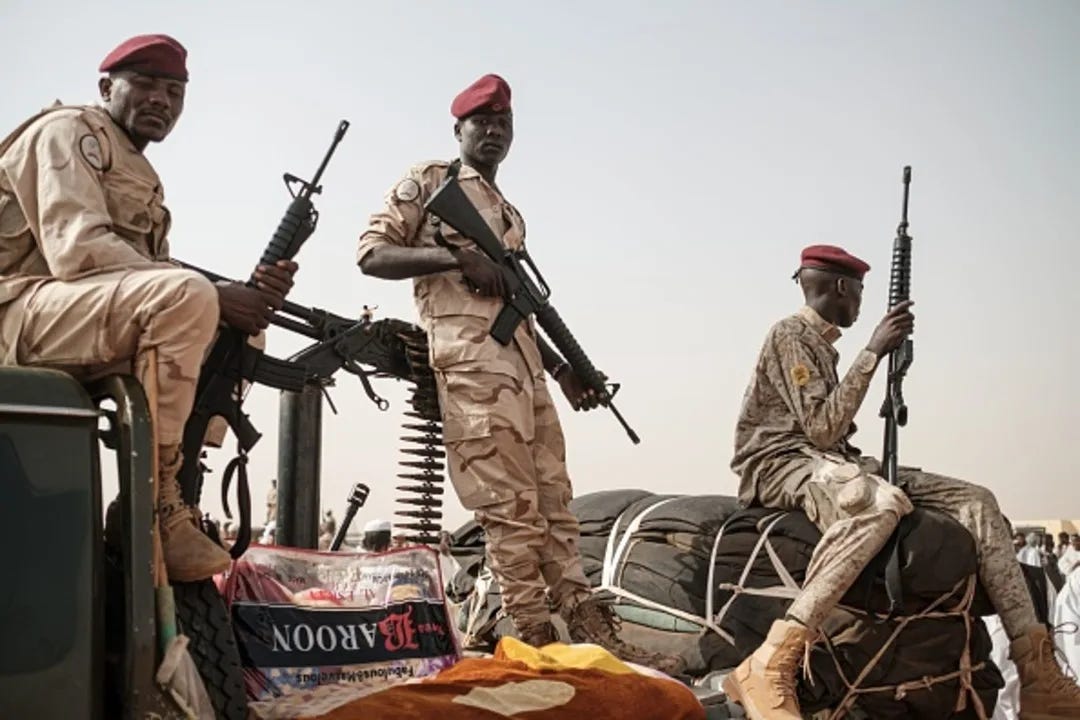
A recent investigative report by Agence France-Presse has uncovered the intricate recruitment network funneling Colombian mercenaries to fight alongside the Rapid Support Forces (RSF) in Sudan. The network stretches from the Andes Mountains in South America to war-torn Darfur in western Sudan, with critical stopovers in the UAE, Somalia, and Libya.
The investigation is based on interviews with mercenaries and their families, company records, and geolocation analysis of combat footage from Darfur. It focuses particularly on the role played by these foreign fighters in the RSF’s documented abuses and their decisive contribution to the fall of El Fasher into the hands of Mohamed Hamdan Dagalo—widely known as Hemedti—and his militias.
The findings align closely with a statement issued by the Sudanese army on August 4, asserting it possessed “documents and evidence proving the involvement of Colombian mercenaries” fighting with RSF forces in El Fasher. At the time, the Sudanese government said it had presented this evidence to the UN Security Council, warning that the conflict was evolving into a “cross-border terrorist war waged by proxy.”
Investigations like this continue to strip away the veneer from Abu Dhabi’s denials, gradually exposing its role in fueling Sudan’s conflict. The UAE has increasingly relied on mercenaries not only as a pillar of its security doctrine but also as a key instrument of its regional foreign policy, in a broader strategy by the Al Nahyan rulers to consolidate military and political influence.
Exploiting Economic Desperation
The French agency’s investigation reveals how Abu Dhabi has capitalized on Colombia’s economic struggles to recruit retired fighters using financial incentives to exploit their urgent need for income.
Every year, thousands of Colombian soldiers retire young with meager pensions, making offers from the Gulf particularly those with generous pay and benefits hard to resist.
The oil-rich Gulf state has thus turned Colombia’s economic crisis into a recruitment opportunity, enlisting trained fighters for deployment in conflict zones under the guise of security or special operations.
Colombian officials involved in military recruitment networks confirmed that prospective recruits are offered positions in the UAE guarding critical infrastructure such as oil pipelines, or participating in overseas operations like those in Yemen or Sudan.
Despite warnings from some recruits about the dangers and the murky nature of their final destination some ended up in Sudan and were reportedly killed there the allure of high pay often proved decisive.
Colombia’s selection is no coincidence. It offers a fertile ground for sourcing highly experienced fighters at low cost. The country’s military has fought insurgencies and criminal groups for decades, producing battle-hardened soldiers. Compared to their Western counterparts, Colombian mercenaries come cheap making them an economically attractive alternative.
Recruitment via WhatsApp
One of the most striking aspects of the investigation is the simplicity and secrecy of the recruitment process. It wasn’t conducted through official channels or well-known security firms. Instead, it played out through WhatsApp messages, with each soldier approached individually.
A retired Colombian soldier recounted receiving a WhatsApp message just a year after leaving the army: “Are there any former warriors interested in work? We’re looking for reservists from any force... details in a private message.”
Upon replying, the sender introduced himself as a former air force officer and offered a job in a Gulf city. Despite not knowing the full nature of the mission or the final destination, the soldier accepted tempted by the generous pay amid harsh economic conditions.
Testimonies reveal monthly salaries ranging from $2,500 to $4,000 around six times the average pension for a Colombian army officer. The wide pay gap underscores how financial incentives are leveraged to recruit mercenaries into serving foreign agendas.
A Brutal and Obedient Force
The investigation raises questions about why the UAE would favor Colombian mercenaries over recruits from the Middle East or Africa, where costs might be even lower. The answer, according to multiple accounts, lies not in budgetary concerns but in the nature of the soldiers themselves. Colombians are seen as tougher, more resilient, and more willing to carry out orders without hesitation or moral scruples.
This mix of military discipline and hardened brutality, shaped by years of internal conflict, makes them ideal for violent, high-stakes battlefields requiring aggression and swift results.
Most of the Colombian recruits brought in were infantrymen with limited technical skills, but hardened by years in violent, chaotic environments. One video clip shows a group of them driving through the ruins of the Zamzam IDP camp in North Darfur, with reggaeton music blaring in the background.
One soldier, in a Colombian accent, is heard saying: “Destroy everything.” The scene encapsulates the mercenaries’ ruthless approach and lack of humanitarian concern.
The evidence suggests that the financiers—namely the UAE—aren’t merely seeking trained fighters, but rather individuals willing to carry out “dirty work” without questioning orders. The excessive, often gratuitous violence of many Colombian recruits appears to be a feature, not a bug a deliberate strategy to expand military and political influence through fully controlled proxies, regardless of human cost.
Smuggling Routes
The report outlines two primary, UAE-organized pathways used to transport Colombian mercenaries to Darfur:
The first runs through eastern Libya, under the control of Field Marshal Khalifa Haftar. Since Sudan’s war began, this region has become a critical artery for delivering weapons, fuel, and fighters to Hemedti’s forces. UAE-funded training camps, run by Libyan officers, operate in the area. After completing training, the mercenaries are moved across the border into Sudan.
The second, larger route runs through Somalia, specifically from Bosaso in the semi-autonomous Puntland region. The city serves as a key transit hub, with mercenaries flown from there aboard cargo planes to Darfur via Chad and Niger.
This route aligns with a massive leak of Somalia’s electronic visa database, which listed tens of thousands of names including Colombians on their way to Sudan. Satellite imagery and flight-tracking analysis also confirm frequent landings of Ilyushin IL-76D cargo planes in Bosaso the same model used at UAE and Libyan air bases.
This supports a July 1, 2025, Africa Intelligence report revealing that Bosaso airport run by a company linked to the Abu Dhabi Fund for Development, chaired by Tahnoun bin Zayed has become a central node in an airbridge funneling weapons and mercenaries to Darfur via Libya, all beyond the reach of international oversight.
2,500 Colombian Mercenaries Deployed in Sudan’s War
The investigation found that A4SI (Coquiano International Services) a firm owned by retired Colonel Álvaro Coquiano and specializing in recruiting ex-Colombian military personnel played a central role in deploying fighters to Sudan.
According to testimonies from former mercenaries, the agency facilitated the transfer of some 2,500 Colombian fighters to the UAE in recent months. From there, they were sent to eastern Libya, and finally deployed in combat units aligned with the RSF in Sudan.
In response, the United States imposed sanctions on Coquiano and his wife, Claudia Oliveros, citing their involvement in a vast recruitment network training Colombian ex-soldiers—including minors—for combat roles with the RSF.
The US Treasury Department described these activities as a flagrant violation of international law and regulations against terrorism and proxy warfare. Since September 2024, it said, hundreds of former Colombian soldiers have traveled to Sudan to fight for Hemedti’s forces.
Accelerating the Fall of El Fasher
Colombian mercenaries played a pivotal role in tipping the balance of power in Sudan’s civil war, contributing directly to the RSF’s seizure of El Fasher. Multiple US and international reports indicate the city’s collapse was driven in part by the arrival of these foreign fighters, specifically brought in to bolster Hemedti’s campaign.
Verified videos analyzed by AFP showed Colombian forces operating on the outskirts of El Fasher prior to the takeover. One pro-army militia said roughly 80 Colombian fighters participated in the siege since August suggesting that foreign support was instrumental in the RSF’s advance, rather than purely internal supremacy.
This foreign intervention combined with advanced weapons supplied by the UAE, including combat drones explains the rapid and unexpected fall of the city, especially given recent Sudanese army gains in Khartoum and elsewhere.
The deployment of Colombian fighters appears to have been a strategic turning point that decisively shifted momentum in Hemedti’s favor at a critical moment.
UAE Faces Renewed Scrutiny
This is not the first time the UAE has faced accusations of fueling Sudan’s conflict by deploying Colombian mercenaries to support the RSF. It is now increasingly evident that the recruitment of Colombian fighters was not ad hoc, but part of an institutionalized effort involving private security firms and formal contracts.
An August 3, 2025, report by Colombian journalist Santiago Rodríguez on La Silla Vacía revealed that the operation is jointly run by the UAE’s Global Security Services Group (GSSG) owned by Emirati businessman Mohamed Hamdan Al-Zaabi and a Colombian firm headed by Álvaro Coquiano, who has been living in the UAE for years.
Al-Zaabi plays a central role in managing contracts with mercenary providers under the guise of private security operations, while A4SI acts as the main conduit for recruitment and logistics an arrangement that blurs the line between commercial interests and military operations.
Inside Sudan, a Colombian mercenary identifying himself as “César” told AFP he had helped train RSF fighters including children as young as 10 at UAE-funded camps near Nyala. His duties also included securing Nyala Airport, a critical hub for weapons and supplies, where cargo planes regularly landed from Bosaso under UAE control. He also assisted in operating drones used to strike Sudanese cities.