

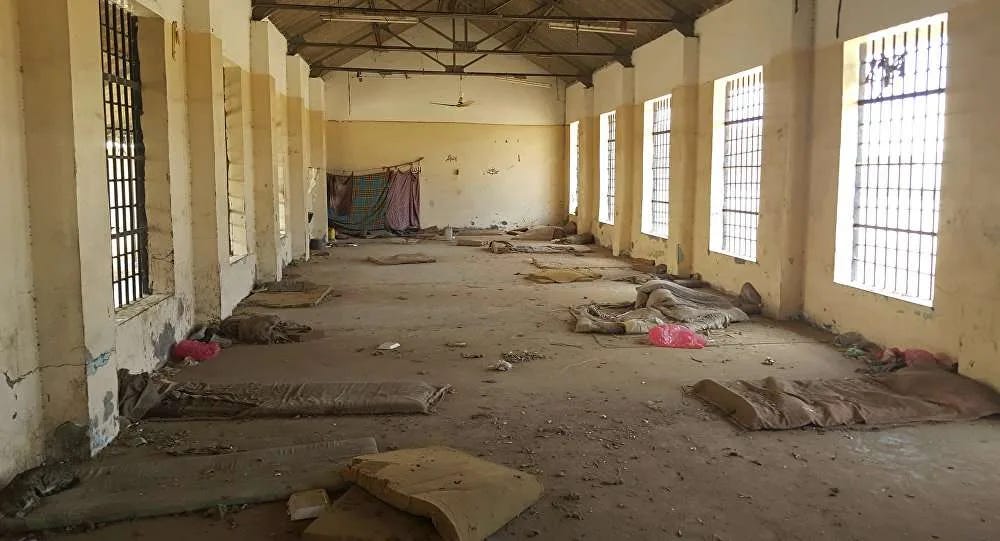
The issue of unofficial prisons in Yemen’s eastern Hadramaut governorate has once again come under the spotlight, following unprecedented official accusations against the United Arab Emirates of operating secret detention centers in the area most notably, suspected sites within the Riyan Airport military base in the city of Mukalla.
These allegations, made by Yemen’s official authorities, have reopened one of the country’s most sensitive and complex files. For years, there was official denial, media silence, and fear among victims, despite persistent reports from rights organizations about detention sites operating outside state authority.
On January 19, 2026, Salem Al-Khanbashi, a member of the Presidential Leadership Council and the governor of Hadramaut, stated in a press conference that civilians were being detained extrajudicially in locations previously controlled by Emirati forces places that operated without oversight from prosecutors or official institutions.
Victims’ Testimonies
Beneath the official statements lies a disturbing chorus of testimonies from former detainees, many of whom were silenced by fear or threats. These accounts point to undisclosed detention facilities, extralegal practices, and a total absence of accountability.
One such testimony comes from Aseel, who was just 15 years old when he was arrested in 2016. Speaking to Noon Post, he recounted a nearly two-year detention at a military site near Riyan Airport—then under Emirati control—without any legal process.
“I was arrested without a warrant, without explanation,” he said. “I had no idea why or where I was being taken. I simply disappeared, and no court ever saw my case.”
Aseel wasn’t held in an official prison, but rather in a sealed metal container used as a makeshift cell. “The moment I was placed inside, I felt completely cut off from the world,” he recalled. “I had no idea when or if I would get out.”
He spent two years in the container under horrific conditions. “In the summer, it was suffocatingly hot. In the winter, unbearably cold. There was no regard for the fact that I was just a child,” he said.
During his detention, Aseel was subjected to various forms of mistreatment during interrogations, including physical assault and psychological pressure, without any legal oversight. “They would call me for questioning without telling me what they wanted. I was beaten, insulted, and intimidated. I was a child with no protection,” he said.
Aseel’s health deteriorated after undergoing emergency surgery for appendicitis. “Immediately after surgery, they took me back to the container. I was still in pain and vulnerable. I was beaten again, and my condition worsened.”
Throughout the two years, Aseel was never allowed to contact his family. “The hardest part was thinking about my parents. Did they know where I was? Was I even alive in their eyes?”
In 2018, Aseel was released alongside other detainees, without trial. “Before they let us go, we were told clearly not to speak about what had happened. We were forced to sign pledges, as if those two years had to be erased,” he said.
Now, seven years after his release, Aseel says the psychological and physical toll remains. “My story isn’t unique. It happened to others too including children.”
Aseel’s case echoes that of Rashad, another former detainee who endured years of abuse inside the Riyan facility. Arrested in 2017 without a warrant or charges, Rashad was held incommunicado and subjected to prolonged abuse, amounting to enforced disappearance.
“My family had no idea where I was. I wasn’t brought before any authority,” he told Noon Post. “It was as if my life had been erased.”
Rashad described his detention site as a small space within a military compound, not a formal prison. He was tortured, deprived of food, sleep, and even access to a bathroom. “I was dragged on the ground, starved, denied rest, and subjected to sexual torture using tools,” he said.
He added that his family was extorted for information and false promises of release. “They exploited my mother’s anguish. They demanded large sums of money in exchange for lies.”
After his eventual release, Rashad faced social and professional difficulties and was targeted with trumped-up charges. “I left the prison, but the trauma and scars stayed with me,” he said.
Extralegal Detention
Abdulrahman Barman, executive director of the American Center for Justice, told Noon Post that secret detention sites without judicial oversight constitute arbitrary detention, explicitly criminalized under Yemen’s constitution and penal laws.
Barman explained that Yemeni law allows no more than 24 hours of detention without formal charges. Any violations are both domestic and international law infractions. These practices also breach the International Covenant on Civil and Political Rights and the Convention Against Torture.
Given the context of armed conflict, these violations fall under international humanitarian law, compounding their severity.
Attorney Majed Ahmed Bin Jaa, representing victims in Hadramaut, confirmed that facilities like Riyan and Al-Dhaba Port operated under Emirati military control, away from Yemeni state oversight.
These locations became closed military zones, housing secret detention sites where civilians from Hadramaut and Shabwah were held without legal justification. Emirati officers and allied local forces oversaw arrests and interrogations.
Some detainees were never registered or were listed under aliases, further obstructing legal redress. The UAE-Yemen security cooperation agreement was misused, he noted, to bypass judicial oversight.
These prisons emerged from a breakdown of central authority and the rise of foreign-backed forces. Local actors facilitated and protected these operations for political or security gains.
Bin Jaa emphasized that detainees had no access to legal representation or family, and were interrogated by foreign officers. The system involved widespread enforced disappearances, torture, solitary confinement, threats, and forced confessions.
Later investigations uncovered hidden cells and erased records, underscoring a systematic effort to conceal evidence and evade accountability.
Grave Violations
Eshraq Al-Maqtari, a member of Yemen’s National Commission to Investigate Alleged Violations of Human Rights, called the abuses in Hadramaut among the most serious violations of international human rights law.
She emphasized that these acts infringed on fundamental rights to life, dignity, and physical and mental well-being. The detainees were held in unhealthy, illegal facilities and subjected to torture using sharp tools and psychological punishment.
According to Al-Maqtari, many perpetrators were not Yemenis, but members of the UAE military, stationed at sites like Riyan Base in Mukalla.
She noted that from 2016 to 2021, a vacuum in judicial oversight enabled rampant abuse. The Commission documented lasting physical and psychological harm among victims, including permanent disabilities and trauma.
Many pieces of evidence were destroyed, particularly at Riyan, and reports of anonymous burials near detention sites demand further investigation. “The victims want dignity restored and an official UAE apology,” she said.
Victims still face social stigma, job discrimination, and threats. Al-Maqtari urged swift psychological and legal support and labeled the Hadramaut prisons file as an urgent priority for justice.
Crime Scenes
Barman further stressed that such facilities must be treated as crime scenes under the law, where grave offenses like enforced disappearance and extrajudicial killings took place.
He called for legal preservation of evidence and access for independent investigators. “These are not ordinary cases—they are war crimes and crimes against humanity,” he stated.
Criminal responsibility extends not just to perpetrators but also to commanders who ordered or concealed the abuses. Institutional liability also applies to any armed group or official body that knowingly participated or remained silent.
Such crimes are not subject to statutes of limitation, and victims have the right to pursue justice indefinitely.
Emirati Oversight
Deputy Justice Minister Faisal Al-Majeedi told Noon Post that Yemen’s security file during this period was run outside formal institutions, under direct UAE supervision and allied militias, bypassing the ministries of Interior and Defense.
Official inspection teams, including Governor Khanbashi, found torture tools and signs of evidence tampering at these sites. Presidential orders have since mandated the closure of such facilities and the release of all unlawfully held detainees.
The Attorney General’s Office is now coordinating with the Ministry of Justice to launch legal investigations, supported by interior ministry teams. Al-Majeedi stressed that enforced disappearance is among the most severe crimes, demanding urgent redress and reparations.
The legal process will begin with evidence collection and proceed through prosecution and trial.
Tawfiq Al-Humeidi, head of SAM for Rights and Liberties, said the UAE’s role in Yemen has deviated dangerously since 2015. He linked the secret prisons to a broader project aimed at dismantling state institutions and targeting opposition groups.
According to Al-Humeidi, the UAE established a network of secret prisons in Aden, Abyan, Shabwah, Hadramaut, Mocha, and Socotra. SAM documented these facilities and issued multiple reports since May 25, 2017.
He said Hadramaut was not an isolated case, but part of a structured system involving militias, torture squads, and networks of impunity. Common practices included electric shocks, beatings, suspension, sleep deprivation, and even transferring detainees abroad.
While recent official actions are a step forward, Al-Humeidi insisted that the abuses qualify as war crimes and demand international judicial mechanisms to ensure justice.
The reality long denied can no longer be ignored. Yemen’s path to justice must begin with the full exposure of what happened in Riyan and accountability for those responsible.
