

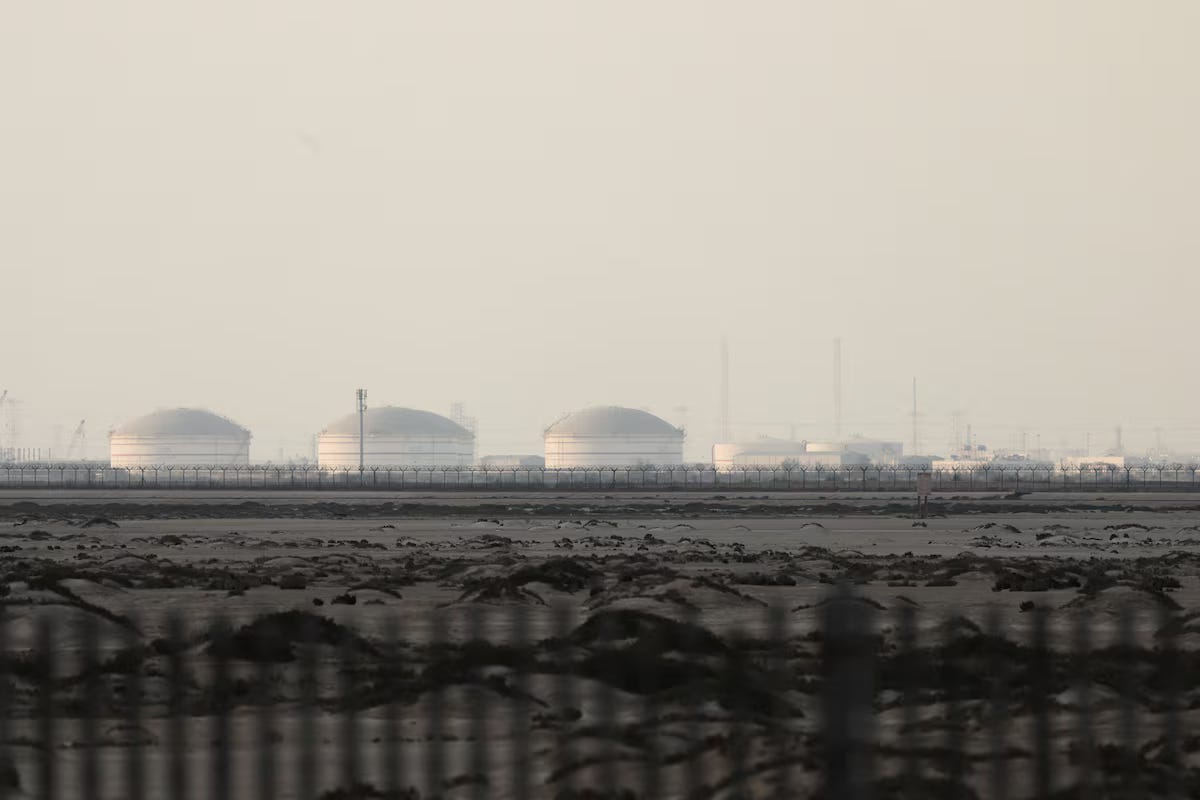
Iranian missile and drone attacks on oil and gas facilities have pushed Qatar to declare force majeure on gas shipments, followed by Kuwait issuing a similar declaration on crude oil sales.
The following report unpacks the meaning of force majeure, traces what has occurred in Qatar and Kuwait, assesses the real impact of these declarations on production, exports, and supply chains, and identifies the countries most affected.
What Does “Force Majeure” Mean?
Force majeure is a contractual clause rooted in contract law and defined as an unforeseen event beyond the control of the parties that renders the fulfillment of contractual obligations impossible.
In the context of long-term energy contracts, invoking force majeure does not terminate or permanently cancel agreements. Rather, it is a legal mechanism that temporarily exempts both the seller and the buyer from financial and legal liability arising from the failure to deliver or receive shipments.
For the clause to be activated, an extraordinary event entirely outside the parties’ control must occur—such as war or the closure of maritime corridors—preventing the physical execution of contractual commitments.
Economically, declaring force majeure protects the seller from severe delay penalties. For the buyer, however, it means an immediate interruption of scheduled supplies without the right to claim compensation.
What Happened in Qatar?
On March 4, 2026, QatarEnergy declared force majeure on gas exports two days after liquefaction facilities in Ras Laffan halted operations following Iranian strikes and increasing difficulty for vessels navigating the Strait of Hormuz.
Qatar responsible for roughly 20 percent of global liquefied natural gas exports relies on the North Field and the liquefaction complexes at Ras Laffan to export about 80.97 million tons annually. All shipments must pass through the strait.
Energy Minister Saad al-Kaabi warned that all Gulf exporters could declare force majeure within days if the war continues. He cautioned that oil prices could reach $150 per barrel and gas prices $40 per million British thermal units, noting that restoring production to normal levels could take weeks or even months—even if hostilities cease.
The shutdown of Ras Laffan brought liquefaction and loading operations to a complete halt due to limited storage capacity around 1.88 million cubic meters, sufficient for roughly four days combined with the suspension of maritime navigation. The force majeure declaration therefore reflected not merely a legal notification but a genuine physical disruption.
Most of Qatar’s customers are in Asia China, Japan, India, South Korea, and Pakistan which together account for more than 80 percent of its exports. The majority of sales occur under long-term contracts (90–95 percent), limiting buyers’ flexibility.
As a result, Asian purchasers were directly affected and scrambled to secure alternative cargoes from the United States and Nigeria, though replacement volumes remain smaller than Qatar’s lost supply.
In Europe, which relies on Qatar for only about 7 percent of its gas imports, the disruption still pushed European spot gas prices (TTF contracts) up more than 30 percent. Asian LNG benchmark prices (JKM) surged 68.5 percent to $25.39 per million British thermal units.
What Happened in Kuwait?
On March 7, Kuwait Petroleum Corporation (KPC) declared force majeure on crude oil sales and began precautionary production cuts due to Iranian threats to maritime navigation and the near-total absence of ships willing to cross the Strait of Hormuz.
The company stated that the reduction is temporary and will be reviewed depending on how the situation develops. While the size of the cuts was not specified, Kuwait’s production stood at around 2.6 million barrels per day in February.
Analytical reports indicate Kuwait has storage capacity sufficient for roughly 18 days. If export capabilities are not restored, production cuts will become unavoidable. Some sources have already reported reductions at certain fields as storage tanks fill up.
Kuwait is not only a major crude exporter it is also the largest exporter of jet fuel to Europe, shipping about 149,000 barrels per day in 2025. It was also the second-largest diesel supplier to Europe at roughly 110,000 barrels per day. Meanwhile, its naphtha and petrochemical exports help supply Asian markets.
Kuwait’s Al-Zour refinery has also boosted exports of low-sulfur fuel to more than 205,000 barrels per day as of January, with roughly 70 percent of shipments headed to Southeast Asia.
For this reason, Kuwait’s force majeure declaration threatens jet fuel and naphtha supplies in both Europe and Asia while tightening heavy fuel markets.
Countries Most Affected
Gas
Asian countries are the most exposed to a disruption in Qatari gas supplies.
China sourced 29 percent of its LNG imports from Qatar in 2025, while India imported 45 percent of its needs from the Gulf state.
Pakistan and Bangladesh rely almost entirely on long-term Qatari contracts, limiting their alternatives.
Europe depends less heavily on Qatar but faces low storage levels. At the beginning of March, German gas storage stood at just 27 percent of capacity, while Dutch fields were only 10 percent full. Any additional supply loss therefore raises prices and strains Europe’s storage capacity.
Oil and Refined Products
Asia imports roughly 60 percent of its crude from the Middle East.
Japan relies on the Gulf for about 90 percent of its imports, while China sources roughly half of its crude from the region.
In Europe, a significant share of jet fuel and diesel comes from Kuwait and the UAE. About 40 percent of jet fuel shipments passing through Hormuz in 2025 were destined for Europe.
The disruption of Kuwaiti exports combined with the closure of Saudi Arabia’s Ras Tanura refinery following a drone attack has pushed Asian jet fuel prices to their highest levels since 2022 and forced shipments from South Korea and Nigeria to be diverted to Europe.
China and India are the countries most vulnerable to a halt in crude oil supplies because they import large volumes from Iraq, Kuwait, and the UAE. Southeast Asian countries that rely on heavy fuel imports will also be affected, while Europe faces shortages of jet fuel and naphtha.
Economic and Market Effects
The halt in gas and oil exports triggered a sharp rise in spot energy prices.
Asian LNG prices (JKM) surged 68.5 percent to $25.39 per million British thermal units.
European gas prices (TTF) rose more than 30 percent.
Global oil prices climbed roughly 12 percent in a week, while diesel and jet fuel margins in Asia reached their highest levels in four years.
In shipping markets, crude tanker rates (TD3 index) doubled to $423,000 per day. LNG shipping rates in the Atlantic climbed to $61,500 per day a 43 percent increase while Pacific rates reached $41,000 per day.
Maritime war-risk insurance premiums jumped more than 1,000 percent, with risk coverage rising from 0.25 percent to about 3 percent of a vessel’s value.
These increases raise the cost of shipping every barrel of oil and every million British thermal units of gas, meaning final prices for consumers electricity, fuel, and fertilizers will inevitably rise.
Asia’s petrochemical sector has already begun to feel the strain. Companies reliant on naphtha have been forced to reduce plant operating rates or declare force majeure as Middle Eastern supplies halt.
South Korea’s YNCC announced reduced operating rates, while producers in India and China postponed shipments.
Meanwhile, some regions—including the United States and Nigeria—have benefited from the price surge as LNG and oil cargoes are redirected to Asia at higher prices. The widening price gap between Asia and Europe has also created arbitrage opportunities for traders seeking to exploit regional price differences.
Alternatives and Their Limits
Most Gulf oil and gas exports depend on the Strait of Hormuz, through which roughly 20 percent of global oil and significant volumes of gas pass. Alternatives are therefore limited.
Saudi Arabia operates the East–West pipeline, which transports crude from eastern fields to the Red Sea port of Yanbu with a capacity of about 5 million barrels per day, temporarily raised to 7 million in 2019. However, the actual loading capacity at Yanbu does not exceed 1.5 million barrels per day.
The UAE operates the Habshan–Fujairah pipeline with a capacity of 1.5 million barrels per day, bypassing Hormuz to the port of Fujairah.
Even combined, these pipelines cannot absorb the exports of Saudi Arabia, the UAE, Kuwait, Qatar, and Iraq. Moreover, the pipelines themselves remain vulnerable to attacks, and Fujairah port has already faced drone strikes.
There are effectively no viable alternative routes for Qatari gas, as LNG cannot be transported through pipelines in place of maritime shipments. This makes any disruption close to total.
The greatest risk in the coming weeks is the continued closure of the Strait of Hormuz, which could force other exporters—such as the UAE and Saudi Arabia—to declare force majeure if storage tanks fill up.