

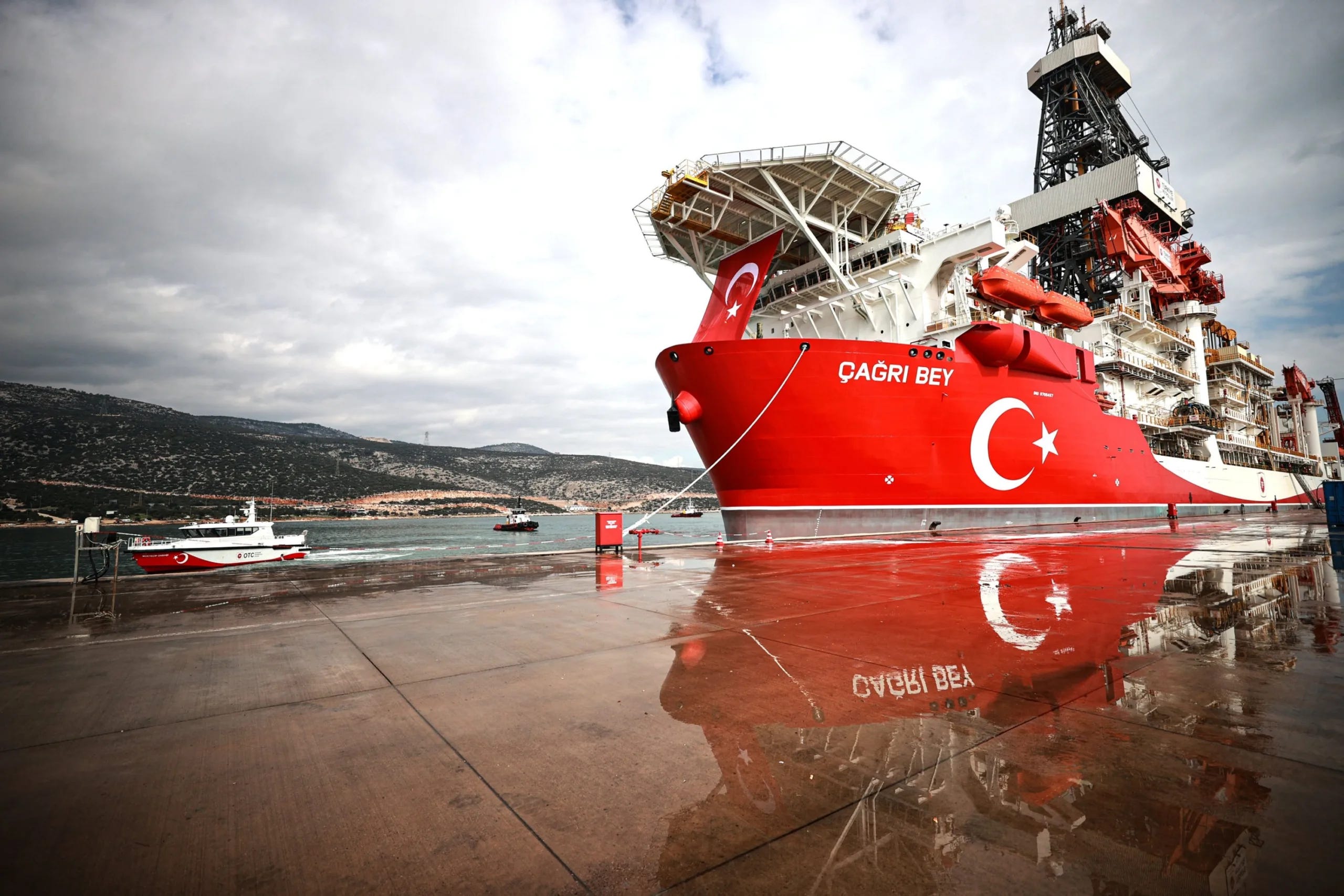
The arrival of Turkey’s drillship Çağrı Bey in Somali territorial waters in April 2026 was not merely a technical step in offshore exploration. It marked a revealing moment in a deeper transformation in the nature of Turkey’s presence in Somalia.
Ankara, which has entrenched its influence over the past decade through humanitarian aid, the construction of a military base, and the training of Somali forces, now appears to be adding a new layer to that influence one defined by offshore energy and deep-sea exploration.
What, then, is the mission of this vessel? What is the scope of its operations? How significant are Somalia’s offshore hydrocarbon resources? And how do both sides stand to benefit from this cooperation?
The Vessel’s Mission and Operational Scope
After a 45-day journey, the vessel reached the Gulf of Aden accompanied by three naval frigates assigned to protect it. It had departed on February 15 from the port of Taşucu in Mersin, navigating via the Cape of Good Hope after being unable to transit the Suez Canal due to the height of its drilling tower.
Its arrival coincided with a ceremonial program in Mogadishu, where the Somali government declared that the operation could transform the country’s economy and strengthen its regional standing.
The Çagri Bey is a seventh-generation deepwater drillship, measuring 228 meters in length, designed to drill wells at depths of up to 12,000 meters and capable of accommodating around 200 personnel.
The drilling project is the outcome of a series of agreements signed between Ankara and Mogadishu in 2024:
On February 8, a “framework agreement for defense and economic cooperation” granted Turkey a role in protecting Somali waters.
On March 7, a government agreement on oil and gas cooperation was signed, covering exploration, evaluation, development, and production in both onshore and offshore blocks.
In July, the Turkish Petroleum Corporation (TPAO) signed a “hydrocarbon exploration and production agreement” with the Somali Petroleum Authority, granting Ankara exclusive rights to explore and produce oil and gas in three offshore blocks.
Subsequently, Ankara dispatched the survey vessel Oruç Reis in October to conduct 3D seismic surveys over an area of 4,465 square kilometers, completing 78 percent of the work before returning in July 2025.
According to Turkey’s Ministry of Energy, Çağrı Bey is set to begin drilling at the “Korad-1” well (also referred to as “Korad” or “Kurad”), located within Block 153 approximately 370 kilometers east of Mogadishu. Water depth at the site reaches around 3,500 meters, with drilling expected to extend to 7,500 meters.
Reports by the African economic agency Ecofin indicate that the well lies in Somalia’s “Central High” zone one of the deepest offshore drilling areas in the world selected based on prior seismic data.
The Somali government has not publicly delineated detailed offshore block boundaries, but the Turkish-Somali agreement grants TPAO operational rights in three offshore blocks, including Block 153, where the first well will be drilled.
Experts agree that Somalia’s offshore hydrocarbon resources remain unproven. To date, no offshore exploratory wells have been drilled to enable a commercial assessment.
Estimates by the Somali government, the U.S. Department of Commerce, and survey companies suggest that offshore basins may contain between 30 and 40 billion barrels of oil and gas equivalent. However, these figures are based on seismic data and geological modeling rather than confirmed reserves.
Some officials speak of confirmed gas reserves of around 6 billion cubic meters, yet no commercial discovery has been made. As such, the Korad-1 well represents a critical test of whether extractable reserves exist and Çağrı Bey will play a decisive role in turning projections into tangible figures.
A Geopolitical Positioning at the Edge of the Red Sea
Where Energy, Security, and Military Presence Converge
The mission of Çağrı Bey cannot be separated from its security context. Over the past decade, Ankara has built its largest overseas military base in Somalia Camp TURKSOM opened in 2017 and spanning four square kilometers, with the aim of training 10,000 Somali soldiers.
Turkey has trained thousands of troops and supported police forces, granting it considerable influence over Somalia’s security apparatus. Turkish companies also operate Mogadishu’s international airport and commercial port under 14-year concession agreements signed in 2020, which include infrastructure rehabilitation in exchange for a share of revenues.
In February 2024, the two countries signed a defense and economic agreement allowing Turkey to provide maritime security support to Somalia, including coast guard training and the protection of territorial waters.
In December 2025, Somalia’s Ministry of Fisheries and Turkey’s military pension fund (OYAK) signed a “strategic cooperation and services agreement,” establishing a joint company—SomTurk—to oversee fishing licenses and regulate activities within the exclusive economic zone, granting Turkey a share of fisheries revenues.
Another maritime security agreement signed in February 2026 provided for the establishment of a joint naval force for ten years to combat piracy and protect Turkish vessels. It also allows Turkish energy ships, including Çağrı Bey, to operate under military protection.
Ties to Maritime Routes and the Gulf of Aden
Somalia’s importance lies in its strategic location at the intersection of the Gulf of Aden and the Indian Ocean, near the Bab el-Mandeb Strait and the Red Sea through which a significant share of global energy trade passes.
Despite the fragility of the Somali state, its long coastline exceeding 3,300 kilometers offers potential for oil and gas, fisheries, and military docking. Ankara thus views Mogadishu as a nexus where energy, security, maritime routes, and political influence converge.
The site where Çağrı Bey will operate lies roughly midway between the Somali coast and Bab el-Mandeb, the strategic chokepoint linking the Red Sea to the Indian Ocean.
This corridor has seen increasing military activity due to Houthi attacks on shipping in the Red Sea and regional competition over ports.
The presence of Turkish warships escorting Çağrı Bey reflects Ankara’s ambition to strengthen its naval footprint in the Indian Ocean and secure its supply lines against piracy and other threats.
The maritime agreement also grants Turkey the right to establish infrastructure in Somali ports and enhance coast guard capabilities, extending Ankara’s “Blue Homeland” doctrine previously focused on the Mediterranean into the Red Sea and beyond.
What Does Each Side Gain?
Turkey
For Ankara, Somalia represents an opportunity to project its “Blue Homeland” strategy into the Indian Ocean. Turkey seeks to diversify its energy sources following gas discoveries in the Black Sea, while its expansion into Africa supports efforts to reduce dependence on energy imports and develop offshore drilling capabilities.
The partnership also provides Turkey with a strategic foothold near Bab el-Mandeb, enhancing its role as an alternative trade corridor to Europe should transit through the Suez Canal be disrupted.
Beyond hydrocarbons, economic gains include access to Somalia’s rich fisheries sector and control over port and airport operations, creating opportunities for Turkish firms in construction, transport, and logistics.
The military base and joint naval force also allow Turkey to train its forces and gain operational experience in open-sea environments, strengthening its standing within NATO and enhancing its leverage in Eastern Mediterranean and Gulf crises.
Turkey benefits from a significant share of revenues during the cost-recovery phase, in addition to port management contracts and fisheries income.
Somalia
For Somalia, a country grappling with weak institutions and limited investment, the agreements offer:
An opportunity to attract capital, technology, and development financing.
The prospect that oil and gas discoveries could transform its rent-based economy and boost state revenues.
A partnership with a capable military power to build a national army and coast guard able to combat piracy and smuggling.
Job creation through oil, fisheries, and port projects, alongside improved infrastructure and reduced dependence on foreign aid.
Somalia also gains infrastructure investment, technology transfer, and a military presence that strengthens deterrence against armed groups.
However, the agreements carry risks. Allowing Turkey to recover up to 90 percent of revenues during initial phases has sparked accusations of mortgaging Somalia’s resources.
Additionally, the presence of Turkish forces near Bab el-Mandeb could lead to friction with rival states or armed groups, increasing the risk of attacks on facilities.
Regionally, this expansion unfolds amid intense competition over African ports involving the UAE, Qatar, and Turkey, as well as broader rivalries in the Red Sea among Saudi Arabia, Egypt, Israel, and Iran.
The oil agreement with Turkey has also provoked anger in Ethiopia, particularly after Addis Ababa signed a deal with the self-declared Republic of Somaliland granting it access to the Gulf of Aden an arrangement Mogadishu viewed as a violation of its sovereignty. Somalia responded by deepening its maritime agreement with Turkey and allowing Turkish forces to protect its waters.
Ultimately, the success of the project hinges on commercial discoveries. If the Korad-1 well fails to confirm substantial reserves, Somalia risks losing investor confidence and becoming entangled in costly commitments with little return.