

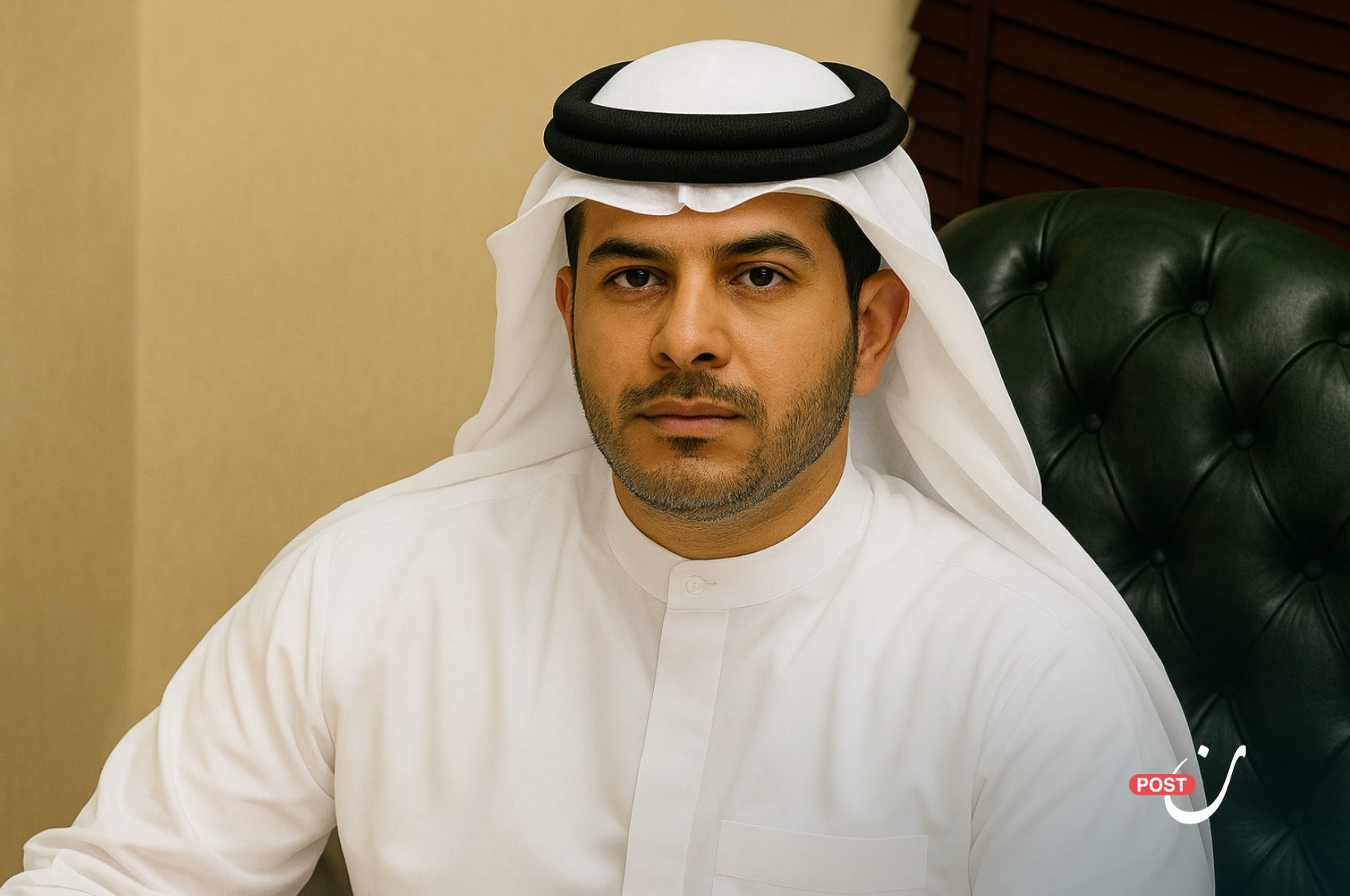
“To my Syrian brothers and sisters… you, more than anyone, understand the meaning of loss, of fear and uncertainty.” With these words, choked with pain and trembling with anxiety, Raghda Kiwan, the wife of detained Emirati dissident Jassem Al-Shamsi, issued a heartfelt appeal to the Syrian government and public.
Speaking with a broken voice, Raghda recounted the moment her husband was arrested before her eyes on November 6, as he was taken away by political security forces in Damascus. Since then, he has vanished without a trace.
The pain of his absence, she said, is not just heartbreaking it is devastating. The fear gnawing at her and their five children grows heavier each day in the absence of any official statement or clarity about his fate or detention conditions.
Raghda warned of serious concerns that Al-Shamsi could be handed over to Abu Dhabi, stressing that the deep opacity surrounding his case opens the door to the worst-case scenario: forced deportation that could endanger his life and expose him to the threat of torture, abuse, or prolonged imprisonment.
She ended her message with a desperate plea: “Syrians… you who know the pain of loss and disappearance… please don’t leave us alone. Raise your voices with us. Your solidarity may be the last line of defense protecting Jassem from a fate feared by everyone who knows and loves him.”
So who is Jassem Al-Shamsi? And why does this Emirati dissident now face the terrifying risk of deportation from Damascus to a homeland where his life and freedom are in grave danger?
The Story
Jassem Rashid Al-Shamsi is a prominent Emirati political dissident who once held a senior position in the UAE Ministry of Finance, rising to the role of Assistant Undersecretary before resigning to pursue political activism in defense of civil liberties and human rights.
He became a vocal critic of the UAE’s human rights violations, a supporter of political prisoners, and a proponent of popular uprisings across the Arab world particularly the Syrian revolution.
After leaving the UAE in 2011, he spent nearly a decade in Turkey, where he served as the director of a research center and remained active through various media and advocacy platforms.
Later, Al-Shamsi moved to Syria with his Syrian wife and children. He entered the country legally after regularizing his documentation, seeking a fresh start away from political persecution.
His troubles with Emirati authorities date back to March 2011, when he was among 133 Emirati academics, judges, lawyers, and activists who signed a petition calling for democratic reforms. The government responded with a wave of arrests.
In January 2013, Al-Shamsi was listed among the 94 individuals accused of establishing a secret organization to overthrow the regime what became known as the “UAE 94” trial before the State Security Court in Abu Dhabi.
In July 2013, the court handed down harsh sentences ranging from seven to fifteen years for 61 defendants, along with eight in absentia including Al-Shamsi. The trial and its opaque procedures were widely criticized by human rights groups and UN experts, who decried the lack of transparency and due process.
The persecution didn’t stop there. In December 2023, UAE authorities filed new terrorism-related charges against 84 prisoners of conscience, in what observers described as a political vendetta. The “UAE 84” list included many of the same figures from the earlier case, with Al-Shamsi among them.
In July 2024, Al-Shamsi was sentenced in absentia to life imprisonment. Then, in January 2025, he was officially added to the UAE’s domestic “terrorist” list, which included 11 individuals and eight organizations.
Al-Shamsi lived in exile in Istanbul until March 2024, when Turkish authorities detained him at Dalaman Airport during a family trip. The arrest was reportedly linked to an Interpol notice.
In a recorded video, he pleaded for help from rights organizations, fearing extradition to the UAE. He was eventually released.
Later that year, he moved with his family to Damascus, where they lived legally for several months. But danger followed him. On November 6, 2025, Syrian security forces arrested him without a warrant or official explanation.
He was taken to an undisclosed location, and all communication ceased. His arrest came just three weeks after he was barred from traveling out of Syria a clear indication of looming risks. His case now sits at the volatile intersection of politics and human rights.
A Case of Enforced Disappearance
According to the Emirates Detainees Advocacy Center, Al-Shamsi’s arrest has become a case of enforced disappearance. Since his detention on November 6, he has had no contact with his family or legal representation.
His wife, Raghda Kiwan, described the harrowing details of his arrest. She was with him in the car on the southern Damascus highway heading to Ain Tarma when a sudden temporary checkpoint appeared.
Armed men in black approached, demanded his ID, and upon seeing his Turkish driver’s license—ordered him out of the vehicle without a warrant or explanation. He was loaded into an unmarked vehicle while one of the officers drove their car behind it.
Raghda followed them to the political security headquarters in the Al-Fayhaa district. There, everyone was ordered out except Jassem. She was prevented from speaking to him or even approaching. “I kept asking: Why? What’s happening? But no one answered,” she recalled.
After searching their car, a plainclothes officer ordered her home. When she refused, he reassured her: “It’s just routine it’ll be over soon.” She replied skeptically, “I hope you’re being honest.”
She later asked a guard if he knew who her husband was. “No, who is he?” he replied. When she explained that Jassem was an Emirati dissident and she feared he might be abducted, the officer responded: “This is a security center. No one gets kidnapped here.” She was then forced to leave. She hasn’t seen or heard from her husband since.
Raghda’s last image of Jassem is burned into her mind: sitting silently in the back seat inside the political security compound, surrounded by officers. “He looked at me silently… a look of someone who doesn’t understand why he’s being taken. Then the door shut. That was the last time I saw him.”
The next morning, she returned to the same headquarters, certain he was inside. After waiting three hours, an official claimed the vehicle she described “never arrived”—contradicting what she had seen with her own eyes. Her fears of a routine investigation turned into certainty: Jassem was being forcibly disappeared.
Her efforts to trace him led nowhere. At the prison directorate in Al-Marjeh Square, an officer sent a formal inquiry but later returned with the same line: “No response.
No information.” At the Ministry of Interior, a Public Relations officer promised to follow up and gave her a referral slip to a colonel. Still, she left empty-handed.
“The repeated denials, despite what I witnessed, confirm this is a case of enforced disappearance,” she said. “We don’t know where he is, what his health condition is, or even if he’s still in political security or moved elsewhere. Since the moment that car door shut… he vanished.”
The toll on the family is immense. “Our children are scared and confused,” she says. “They ask me every day: ‘Where’s Baba?’ And I have no answers.” The uncertainty, she added, “is tearing us apart.”
Their stay in Syria was entirely legal. Jassem was on the verge of obtaining residency. That he could be disappeared under such conditions adds cruelty and confusion to an already devastating ordeal.
The Growing Fear of Extradition
Fears that Jassem Al-Shamsi may be deported to the UAE are mounting, especially since his life sentence was issued in absentia in July 2024 and his name was added to the country’s terrorist list in January 2025.
Raghda Kiwan has stressed to Syrian authorities that her husband ceased all opposition activity after arriving in Damascus. “We entered the country peacefully. Since then, Jassem stopped posting on social media. He avoided all political statements and fully respected Syria’s desire for balanced relations with all Arab states.”
Despite this, disturbing unofficial information suggests there may be intentions to hand him over. “You know the reality of the justice system and prisons in the UAE,” she said. “If Jassem is extradited, he will be a victim.”
She ended her plea with a final call for solidarity: “Please… speak out. Demand clarity about his fate. Your voices may be the only shield standing between him and the unimaginable.”