

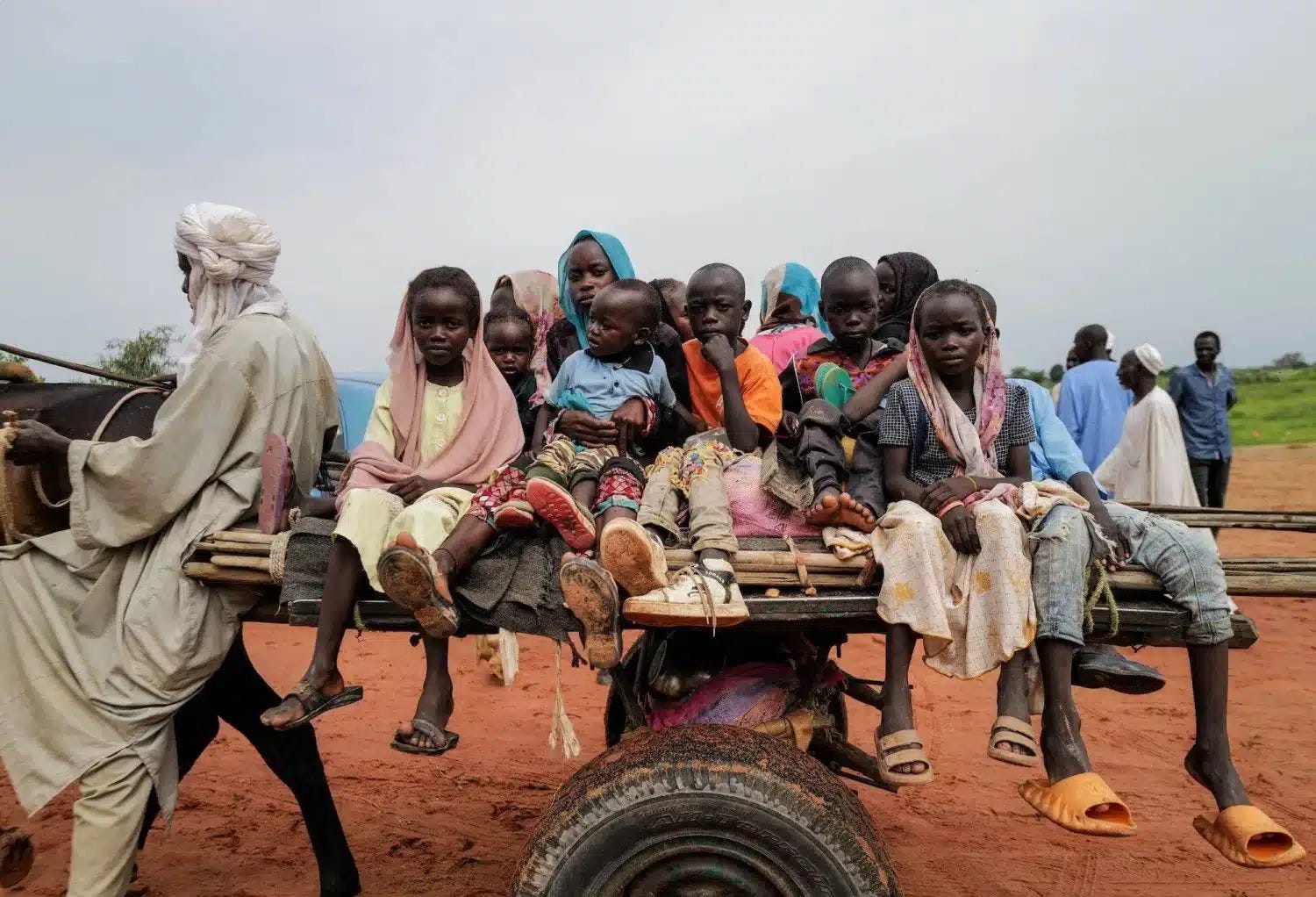
In Sudan, where war, hunger, and displacement intersect, leading humanitarian organizations are scaling back assistance due to severe funding shortages and compounding global crises at a time when millions of Sudanese are relying on aid as their last lifeline for survival.
This shift threatens not only to reduce food support but also to erode the broader humanitarian response capacity, leaving the most vulnerable populations exposed to growing risks with no clear alternatives.
Who is withdrawing from the aid landscape in Sudan due to the war between the army and the Rapid Support Forces (RSF)? What is the cost to food security, healthcare, and displaced populations? Can alternative channels fill the vacuum, or is the crisis heading toward a harsher phase?
Painful Decisions
On December 12, the World Food Programme (WFP) announced it would begin cutting food rations for Sudanese people starting in January 2026, due to a major funding shortfall.
Aid will be limited to 70% of full rations for famine-affected communities and just 50% for those at risk of famine.
Current resources will last only a few months, with a projected 34% funding gap for 2025.
The program needs $700 million to maintain supplies for six months and warns of a collapse before then.
The financial crisis is not limited to WFP. The International Committee of the Red Cross (ICRC) also announced a 17% cut to its 2026 budget compared to 2025, forcing it to scale back emergency support programs in several countries, including Sudan.
A report by ACAPS revealed that the U.S. administration’s decision in January 2025 to freeze foreign aid for 90 days led to the suspension of vital programs in Sudan, as the U.S. accounted for 44% of the country’s humanitarian funding.
As a result, several international and local organizations have been forced to terminate staff contracts and reduce food and healthcare programs in Sudan.
Alarming Figures
The war has created the world’s largest humanitarian crisis, as reflected in the latest UNICEF report:
30.4 million people in Sudan will need urgent assistance in 2025, including 15.6 million children.
Acute malnutrition rates have surpassed the emergency threshold (15%) in most states, reaching over 30% in some areas equivalent to famine conditions.
24.6 million people face severe food insecurity, and nearly 770,000 children are at risk of wasting.
Over 11.6 million people have been displaced internally or across borders, and 17 million children are out of school.
70% of healthcare facilities are non-operational, and 3.4 million children under five are at risk of disease outbreaks.
1.4 million children are living in famine or near-famine areas, including 150,000 in North Darfur suffering from acute malnutrition.
These numbers underscore Sudan’s near-total dependence on international aid to provide food, healthcare, education, and clean water.
The Most Affected Groups
Children, pregnant and lactating women, and internally displaced people are among the most vulnerable.
UNICEF reports that at least 130,000 children are trapped in El Fasher, North Darfur, without access to food or medical care.
Displaced populations in Darfur and Khartoum states face acute food insecurity, a shortage of drinking water, and limited access to healthcare. In Darfur, families are often forced to survive on a single meal per day.
What Lies Ahead?
The WFP has warned that the current cuts may not be the end. Ross Smith, Director of Emergency Preparedness and Response at WFP, described the situation as a “dangerous downward spiral” that could collapse entirely by April 2026 without fresh funding.
The likely scenario is a broader famine if funding shortfalls persist, access to aid remains restricted, and the conflict continues. Food, clean water, and healthcare access would decline, resulting in higher rates of acute hunger and mortality.
Families may be forced to adopt desperate survival strategies, such as skipping meals or selling their remaining assets. Displaced populations in Darfur and Khartoum camps would face escalating health risks due to overcrowding and malnutrition.
If health programs are halted, infectious disease outbreaks would increase, further weakening an already fragile health system. UNICEF notes that massive funding gaps have already reduced access to education and child protection services, leaving children without schooling or psychological care.
Both UNICEF and the WFP warn that an entire generation of children could suffer irreversible harm, and Sudan may face an unprecedented humanitarian catastrophe.
How Much Are Arab Countries Contributing?
Qatar
At the 2024 high-level donors’ conference in Geneva, Qatar pledged $50 million toward Sudan’s Humanitarian Response Plan and the Regional Refugee Response Plan.
A humanitarian airlift delivered 318 tons of food, clothing, and medical supplies worth over $4 million, in addition to evacuating 1,784 people.
In November 2025, the Qatar Fund for Development, in cooperation with Qatar Charity, delivered 3,000 food baskets and 1,650 tents to Dongola in Northern Sudan, setting up a camp that benefited over 50,000 people.
Since the outbreak of the war, Qatar Charity has distributed 5,715 tons of food via 142,880 food baskets, reaching 887,000 beneficiaries.
Qatar’s total aid to Sudan over the past two decades has exceeded $1 billion.
Saudi Arabia
In April 2023, the King Salman Humanitarian Aid and Relief Center pledged $100 million in aid and launched a national donation campaign.
According to UN Financial Tracking Service (FTS) data, Saudi Arabia’s contributions to Sudan under the 2025 response plan amounted to approximately $3.1 million, supporting four projects covering coordination, water, health, and child protection.
In November 2025, the center distributed 1,200 food baskets in Sennar State, benefiting 9,027 people, and 800 baskets in Khartoum State, reaching 5,239 people.
In April 2024, it signed a $1.4 million agreement with WFP to treat malnutrition among 35,000 children and pregnant or lactating women in Sudan and South Sudan.
While Saudi Arabia has contributed over $2.2 billion globally to WFP over the past two decades, the share allocated to Sudan does not match the scale of the current funding crisis.
Kuwait
In November 2025, Kuwait donated $4 million to fund two projects with the United Nations Development Programme (UNDP) aimed at enhancing resilience, access to renewable energy, and agricultural recovery in Sudan.
The first project, worth $6.8 million and jointly funded with Switzerland and UNDP, targets 160,000 people in Kassala, Gedaref, and Red Sea states, supporting climate-resilient agriculture, value chain improvements, and access to water and clean energy.
The second, fully funded by Kuwait with $2 million, provides solar-powered irrigation systems and supports 500,000 farmers in White Nile, Gezira, Kassala, and Red Sea states.
UNDP data shows Kuwait has contributed $18.6 million to development projects in Sudan since 2013.
Additionally, in October 2025, the Kuwait Red Crescent and ICRC signed a $2 million agreement to strengthen health services for vulnerable populations in Sudan highlighting Kuwait’s ongoing humanitarian commitment.
Despite the importance of these contributions, they cannot replace the scale of programs delivered by major international organizations. Qatar’s $50 million pledge, along with food and shelter initiatives by Saudi Arabia and Kuwait, reach tens or hundreds of thousands but the WFP alone requires $700 million to continue operations for six months. Meanwhile, the UN’s 2025 Humanitarian Response Plan exceeds $4.2 billion.