

With the outbreak of the U.S.–Israeli war on Iran, Tehran began launching retaliatory strikes targeting American interests and military deployments across the Gulf. Regional anxiety quickly escalated, and questions multiplied over the logic, scope, and limits of Iran’s targeting strategy.
The debate intensified as some observers pointed to the presence of U.S. forces in Central Asia and the South Caucasus. For many, it appeared that Tehran was deliberately shifting the cost of war onto Gulf states, striking economically and strategically sensitive nodes in order to pressure Washington.
First: America’s Operational Center of Gravity in the Gulf
The geography of the Arabian Gulf represents the primary operational and military center of gravity for the United States in the region. Gulf Cooperation Council states host the core infrastructure of U.S. Central Command (CENTCOM).
Under the pretext of targeting “launch platforms and command centers,” Tehran has expanded the scope of its strikes toward the Gulf, where the most consequential and heavy American military assets are stationed.
Between 40,000 and 50,000 U.S. troops are deployed across the Middle East in roughly 19 sites and military bases.
The largest concentration of these forces, however, remains in the Gulf states, which host the bulk of American personnel and equipment, as illustrated in the accompanying infographic.
Second: The Energy Weapon and Global Economic Pressure
Iran is wagering on triggering a global economic shock by targeting energy infrastructure and threatening maritime navigation an approach aimed at rattling markets and compelling the international community to push for a ceasefire.
Gulf states serve as a lifeline of the global economy, as the world’s principal suppliers of energy resources. By targeting oil and gas infrastructure and attempting to disrupt navigation in the Strait of Hormuz, Iran is exerting maximum economic pressure by threatening the arteries of global energy and trade.
The immediate fallout underscored the rationale behind this Iranian approach. As soon as the attacks began, global energy markets were gripped by panic. Crude oil prices surged by more than 10 percent, with Brent crude jumping above $82 per barrel, while U.S. crude climbed to record levels.
Even more alarming was the meteoric rise in European natural gas futures, which soared by over 40 percent following an announcement by QatarEnergy suspending liquefied natural gas production as a precautionary measure due to security threats and damage to facilities.
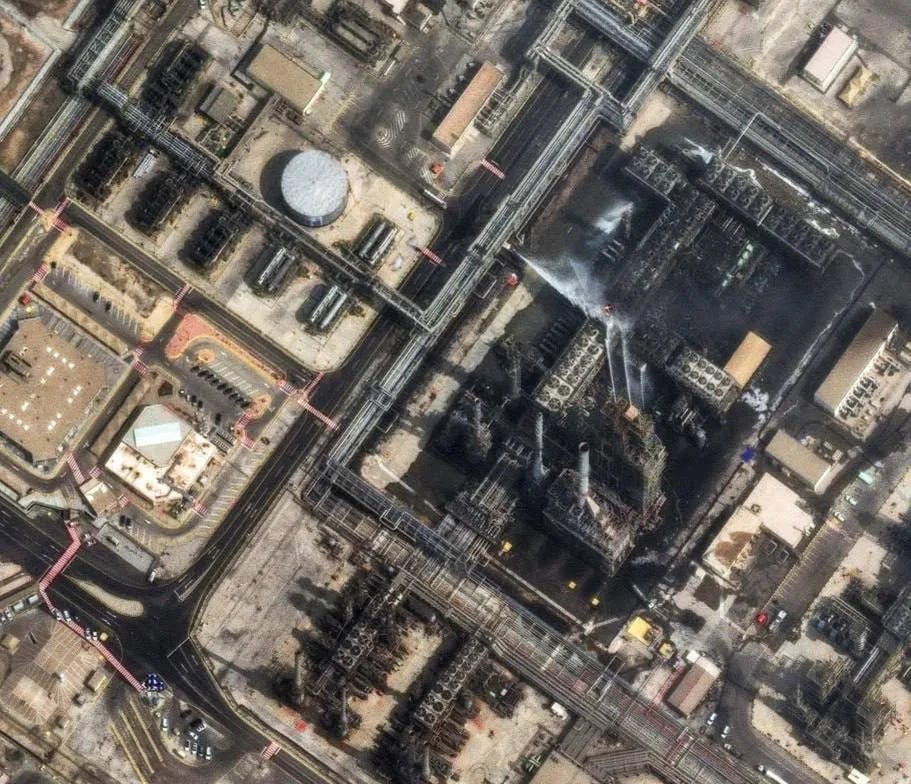
Closing the Strait of Hormuz through which roughly 20 percent of global oil consumption passes and striking critical refining facilities, including the vicinity of the Ras Tanura refinery in Saudi Arabia, sends a clear message: the continuation of war could mean global economic upheaval and a surge in inflation.
Third: Shattering the “Safe Haven” Myth
Iran’s targeting of Gulf states also carries a political and psychological dimension: undermining the image of stability by striking civilian and economic landmarks to amplify fear and erode confidence.
In the years preceding the 2026 war, countries such as the United Arab Emirates, Bahrain, and Qatar invested heavily in branding themselves as financial capitals, secure tourist destinations, and global connectivity hubs.
Yet with the eruption of hostilities, explosions and fires were reported near the iconic Burj Al Arab and the Fairmont The Palm in Dubai. Plumes of smoke rose near the Burj Khalifa and the vital Jebel Ali Port, in addition to strikes targeting international airports in Doha, Kuwait, and Abu Dhabi.
The accompanying infographic highlights the most significant economic sites targeted by Iran across five Gulf states.
By targeting these locations, Tehran seeks to dismantle the psychological and economic image painstakingly constructed over years. Iranian drones and missiles have been deliberately directed at prominent tourist and civilian landmarks to maximize psychological impact and disrupt the perception of security and stability.
Why Avoid the South Caucasus and Central Asia?
1. The Absence of U.S. Bases
The American military presence in the South Caucasus and Central Asia has become largely marginal since the U.S. withdrawal from Afghanistan in 2021 and the subsequent restructuring of forces in the region.
Since then, facilities in Uzbekistan and Kyrgyzstan have been reduced to modest logistical hubs or centers for intelligence gathering and limited security training, amid a strong Russian military footprint and expanding Chinese economic influence.
This Asian geography does not provide the United States with a strategic offensive capability that poses a direct existential threat to Iran requiring large-scale preemptive or retaliatory action.
As such, launching long-range strikes against marginal targets there would not generate the same deterrent return for Tehran as operations in the Gulf, where the immediate impact on energy flows and markets is far greater.
A report by the Center for European Policy Analysis (CEPA) notes that U.S. ambitions in the South Caucasus “do not include a military presence” but are instead focused on economic projects, while Russia remains wary of their commercial implications.
2. Geographic Constraints and Political Calculations
Most Iranian missiles have a maximum range of around 2,000 kilometers. While this theoretically places capitals such as Baku and Tbilisi within reach, the operational conditions are more complex than the shorter-range trajectories toward the Gulf. Missiles would likely need to traverse airspace over Russia, Turkey, or Armenia, raising the risk of interception or the opening of a new front against Tehran.
Moscow regards the South Caucasus and Central Asia as integral to its sphere of influence and strategic depth. In 2023, former Russian Defense Minister Sergei Shoigu warned that Washington was attempting to “restore its military presence in Central Asia” under the guise of counterterrorism and pledged to enhance the readiness of Russian bases in Kyrgyzstan and Tajikistan to counter such efforts.
This underscores Moscow’s sensitivity to any American military activity in the region and suggests that Iranian strikes affecting Russian bases or Caucasus transport corridors could drag Tehran into confrontation with Russia or Turkey.
According to assessments by Russian strategic research centers, Moscow maintains approximately 5,000 troops in Armenia and controls its airspace, making any targeting of such sites a direct challenge to Russia. China, for its part, views Central Asia as the beating heart of its Belt and Road Initiative and a continental economic corridor vital to Beijing’s strategy.
Economically, Iran depends almost entirely on exporting its sanctioned oil to China which purchases roughly 80 percent of Iranian oil exports as a lifeline to circumvent Western sanctions. Expanding the war into Central Asia would therefore directly endanger Chinese commercial and investment interests.
3. Limited “Return” Compared to the Gulf
The American footprint in Central Asia and the Caucasus is primarily economic rather than military, centered on transportation and energy projects such as trans-Turkey gas corridors and Central Asia–Caucasus connectivity routes.
CEPA notes that Washington is developing nuclear and technological cooperation projects with Armenia and Azerbaijan without plans to deploy forces.
Given that the region is not a central hub of global oil trade, striking it would not produce the same global reverberations as targeting the Strait of Hormuz or Dubai International Airport.
For that reason, Iranian decision-makers appear to favor targets capable of shocking markets and raising the cost of U.S. support much as they did when Saudi oil facilities were hit in 2019.