

In a move laden with political implications for the course of the ongoing confrontation, American media outlets reported citing what they described as informed sources that President Donald Trump had held contacts with Kurdish leaders to discuss scenarios related to the possible collapse of the clerical regime in Tehran.
Both Axios, The Wall Street Journal, and CNN reported that Trump conducted two phone calls with the head of the Patriotic Union of Kurdistan, Bafel Talabani, and the leader of the Kurdistan Democratic Party, Masoud Barzani. The discussions reportedly addressed developments in the U.S.–Israeli war against Iran and the possible options for the next stage.
According to the same reports, the contacts came within the framework of “behind-the-scenes movements” said to have continued for months and led by Prime Minister Benjamin Netanyahu as part of what was described as the “Kurdish card.”
Some assessments—according to the two newspapers—suggest that part of the calculation involves the possibility of an internal Kurdish mobilization that could intensify pressure on the Iranian regime and accelerate fractures within its structure.
In the same context, multiple sources said Trump held additional contacts with Kurdish leaders at the beginning of March, and that channels of communication remain open with other local figures who might view a decline in Tehran’s influence as an opportunity to secure political gains.
In a brief statement, White House spokeswoman Karoline Leavitt said that “President Trump spoke with a number of regional partners,” without naming them. Axios later reported that some of those interlocutors were Kurdish leaders.
Attempts to deploy the “Kurdish card” against Tehran are not historically unprecedented. Kurds have long been a factor in the equations of conflict with the system of velayat-e faqih since the 1970s, although their role has varied between political and field-based activity.
Yet the central question today is whether Trump if the accounts reported by Axios, The Wall Street Journal, and CNN are accurate can reactivate this track in a way that weakens or even undermines the regime, especially after strikes that reportedly removed both the first and second tiers of its political and military leadership and damaged its military infrastructure while stripping it of many of its tools of influence.
An Important Context for Understanding the Scene
Beyond the theatrical tone Trump has adopted regarding the ability of a concentrated military strike carried out with Israeli participation to topple the Iranian regime, he appears to recognize at a deeper level that a system so deeply entrenched and resilient, with extensive domestic and regional networks of influence, cannot be brought down by external operations alone or resolved solely through direct military pressure.
From this perspective, Trump’s thinking appears to have evolved toward the belief that the decisive moment—if it comes—must originate from within. Only the Iranian street, in this view, can ultimately determine the outcome.
Accordingly, with the start of military strikes, Trump sought to push in this direction by issuing explicit calls for Iranians to rise up and seize power, adopting a direct inciting tone and tempting Iran’s domestic audience with promises of “American support” as a protective umbrella for liberation from the current regime.
Similar rhetoric has also been echoed by Netanyahu and several figures within the Iranian opposition abroad, most notably Reza Pahlavi, the son of the deposed Shah. Pahlavi has attempted to present himself as a potential alternative should the regime collapse. In parallel with Trump’s calls, he addressed messages to Iranians urging them to move against the authorities in an effort to seize a possible moment of transition.
Trump’s expectations of triggering a “rapid disruption” in the regime’s structure through targeting its political head represented by the Supreme Leader and its military leadership did not unfold as planned. The regime’s response, embodied particularly by the Islamic Revolutionary Guard Corps, appeared closer to treating the moment as an existential battle rather than merely another round in a conventional conflict.
That perception raised the stakes and the cost of confrontation while widening the scope of potential reactions instead of hastening collapse.
Meanwhile, the domestic front demonstrated a degree of cohesion. A segment of public opinion appeared inclined to rally behind the state in the face of what was framed as external aggression. From this perspective, the development reflected a misreading by Trump of the Iranian public mood during moments of foreign threat, when considerations of sovereignty and national identity tend to outweigh internal disputes.
At this juncture, attention shifted toward the “Kurdish card” as a possible last option that might achieve what spontaneous popular mobilization had not. The historical rivalry between some Kurdish forces and the Iranian regime, along with accumulated political, cultural, and security grievances, is presented in this view as leverage that could ignite internal pressure points.
The idea would be to amplify hostility and resentment while encouraging a rapid movement aimed at undermining the regime, with an implicit promise of major gains related to self-determination, expanded political influence, and liberation from the state’s grip and its repressive policies.
A Kurdish Alliance to Overthrow the Regime
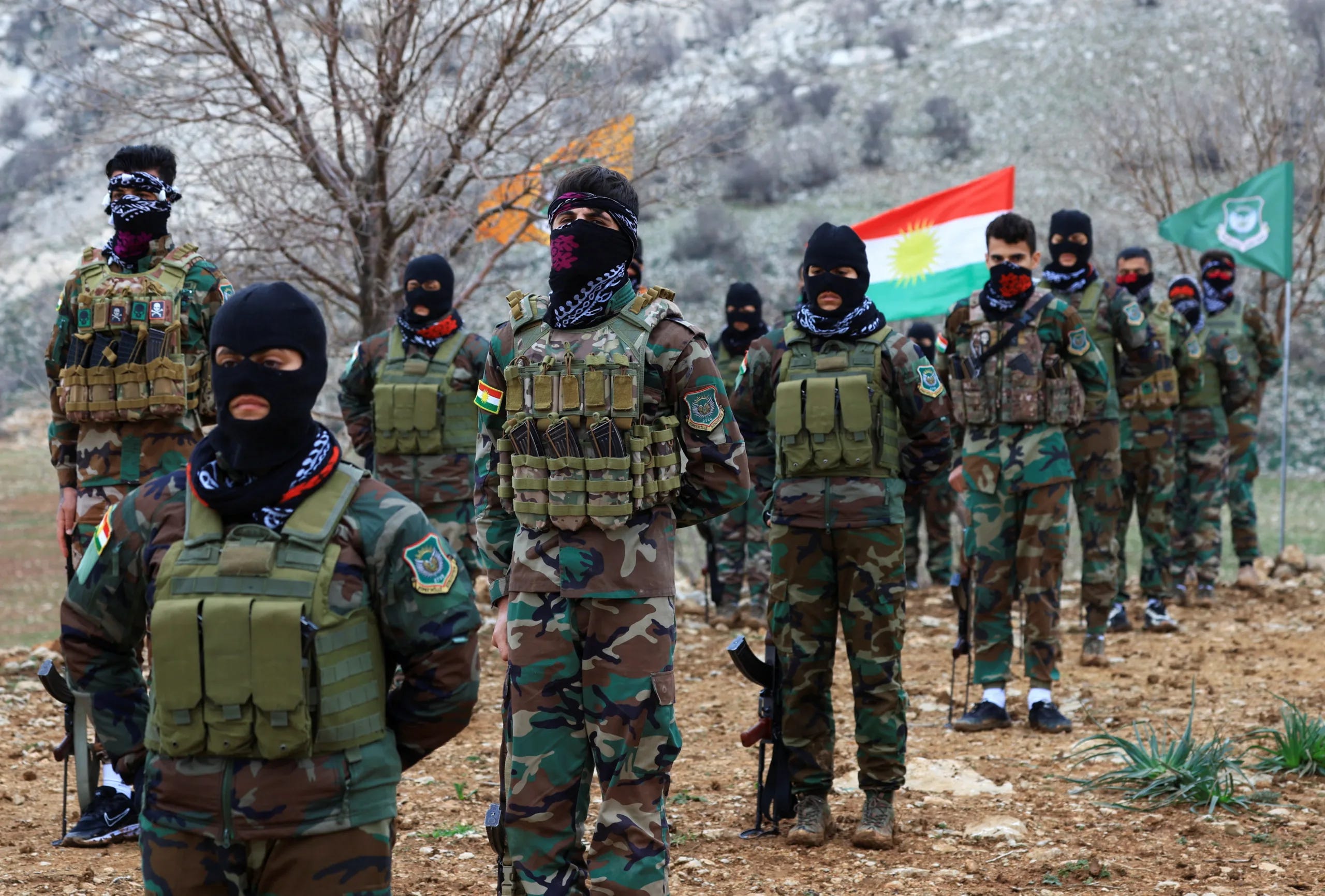
On February 22, at the height of a wave of popular protests inside Iran, five Kurdish parties based in the Kurdistan Region of Iraq announced the formation of a new political alliance pursuing two explicit goals: the overthrow of the Iranian regime and the consolidation of Kurdish self-determination.
The alliance brought together several of the most prominent Iranian Kurdish forces, including the Kurdistan Freedom Party (PAK), the Kurdistan Democratic Party of Iran (PDKI), and the Kurdistan Free Life Party (PJAK).
In a joint statement, the signatories expressed support for anti-government protests in Iran and stressed the need to build a coordinated path combining political struggle with activity on the ground by unifying the efforts of parties and civil society organizations across different regions of the country.
For its part, Tehran treats these organizations—based outside its borders—as “terrorist entities.” This designation has been accompanied by clear security escalation in recent years, including drone strikes targeting sites linked to them in Iraqi Kurdistan. Iran has repeatedly accused the groups of operating within Western and Israeli agendas, a trajectory that has deepened the rupture and entrenched hostility between the two sides over time.
Historically, some of these parties engaged in armed confrontations with Iranian forces in Kurdish-majority areas along the Iran–Iraq border. In recent years, however, the tempo of military activity has declined noticeably, with greater emphasis placed on political activism and pressure campaigns aimed at eroding the regime’s legitimacy from within.
Within this framework, the Kurds appear as the most organized component of the anti-regime camp not only because of the firmness of their political stance but also because, compared with other ethnic groups inside Iran, they possess cross-border organizational networks and armed formations that could theoretically serve as pressure tools capable of harassing the authorities during moments of vulnerability.
Iran’s Kurds: Reality and Capabilities
Kurds constitute one of the largest non-Persian ethnic groups in Iran. Although no official ethnic census exists, widely circulated estimates suggest their number ranges between eight and ten million people roughly 10–12 percent of the population primarily concentrated along the western border with Turkey and Iraq.
Demographically, Kurds are mainly distributed across four provinces: Kurdistan Province, Kermanshah Province, West Azerbaijan Province, and Ilam Province. In addition to this geographic concentration, internal migration has created significant Kurdish communities in North Khorasan Province, Tehran, and several major cities, giving the Kurdish presence an extension beyond its traditional western homeland.
Politically and socially, Kurds carry a long history of tension with the central state. For decades they have accused the Iranian government of political marginalization, underdevelopment in Kurdish regions, restrictions on Kurdish language and culture, and limited representation within governing institutions.
Although the current environment appears less severe than the early years after the revolution, resentment has persisted and resurfaced in varying forms over the past three decades.
From a security perspective, several Kurdish parties maintain armed wings, most notably the PJAK, founded in 2004 and widely considered the most powerful Kurdish militant organization opposed to Tehran today. The group maintains ideological and organizational links with the Kurdistan Workers’ Party (PKK) and is primarily based in mountainous areas along the Iran–Iraq border.
Following it in prominence is the Kurdistan Democratic Party of Iran, whose roots stretch back to the 1940s and which still retains an armed wing, though with reduced effectiveness compared to earlier periods. Left-leaning organizations also operate, most prominently Komala, one of the oldest Iranian Kurdish leftist formations.
Yet despite their symbolic political weight, these groups suffer from clear shortcomings in military capacity both in manpower and equipment when compared with state security institutions, particularly the Revolutionary Guard.
The gap remains vast between a state apparatus possessing solid structures, extensive intelligence and military capabilities, and regional influence, and smaller groups operating in harsh geographic conditions on the margins of the state across mountainous border regions.
A Deep Structural Divide
Weakness within Iran’s Kurdish political scene is not limited to military constraints. It also stems from internal fragmentation, both demographically and politically, making it extremely difficult to unify Kurdish ranks or formulate a collective stance at a highly sensitive moment.
Linguistic divisions are particularly evident within Iranian Kurdish geography. Kurds do not share a single dialect but rather several linguistic streams. Kurds in West Azerbaijan tend toward the Kurmanji dialect, Sorani predominates in Kurdistan Province, while regions such as Kermanshah and Ilam use dialects closer to Lak and Luri.
Although linguistic diversity does not automatically translate into political division, it adds another layer of complexity to any attempt at unified mobilization or centralized Kurdish political discourse.
Sectarian divisions further complicate the picture. A significant portion of Kurds in Kermanshah estimated at roughly one-third of Iran’s Kurdish population are Shiite, whereas most Kurds in other provinces are Sunni. While this disparity does not necessarily produce constant conflict, it introduces additional sensitivities regarding representation, priorities, and relations with both the central state and surrounding regional powers.
Politically, divisions appear even more direct. Kurdish actors differ in their reading of the current Iranian landscape, particularly regarding external intervention or proxy war. Some see foreign military pressure as an opportunity to weaken the regime and open a window for change, while others reject this path and insist that democratic transformation must emerge from domestic popular dynamics rather than from externally imposed projects.
In this context, positions reflecting what has been described as “active neutrality” or a “third path” have emerged. A senior figure in PJAK, Mazloum Haftan, rejected alignment with either the American or Iranian side, arguing that the Kurdish issue has its own nature and that the central objective remains peaceful democratic change within Iran without taking sides in a war that does not serve their political project.
By contrast, the Kurdistan Democratic Party of Iran presents a more flexible approach toward the prospect of war as a potential “political opportunity,” even while refraining from endorsing or justifying attacks. Some of its leaders emphasize that the principal bet remains on the Iranian people particularly the Kurdish population while acknowledging that war could create an environment allowing opposition forces to reenter domestic political arenas.
At the same time, the party underscores that it employs a wide spectrum of struggle tools, from civil activism to more confrontational options when necessary.
Given this complex composition—linguistic, sectarian, and political—the Kurdish movement faces a structural challenge in producing a unified position or leadership capable of making collective decisions in confronting the Iranian regime.
Without a clear shared foundation, the ability to transform demographic weight into cohesive political power remains limited unless strategies emerge that reconcile differences and define a common political denominator.
Trump’s Misreading
Against this backdrop, Trump appears to have misread the Kurdish landscape. In addition to the limited military capabilities of Kurdish parties and their deep internal divisions, there is another crucial factor that may not have been sufficiently considered: the operational environment in which these forces operate.
Kurdish militant activity is largely concentrated along the rugged Iraq–Iran border strip a harsh geographic environment that, with the outbreak of war, has become an exposed battlefield subjected to repeated Iranian preemptive strikes.
The Revolutionary Guard, drawing on long experience in counterinsurgency and significant intelligence capabilities, has effectively turned these mountain ranges into areas of near-constant surveillance and targeting.
Under such conditions, the notion that Kurdish militias could carry out a ground incursion into a state whose defensive doctrine is based on confronting threats “from the zero point” appears closer to a theoretical scenario than a feasible military option at present.
Furthermore, the assassination of the Supreme Leader reshaped the domestic mood in a direction contrary to expectations of fragmentation. It prompted some opposition voices to rally behind the state on nationalist grounds, as Ali Khamenei in the public imagination of some Iranians was transformed into a national symbol of a “martyred leader.” Such dynamics often generate a degree of internal cohesion during wartime, even if temporary.
Accordingly, any American–Israeli attempt to pursue regime change through an inciting discourse based on the “Kurdish card” at this moment may not ignite internal upheaval as expected. Instead, it could produce the opposite effect: popular mobilization that grants the Revolutionary Guard broader legitimacy and allows it to present itself as the last line of defense in an existential struggle, thereby opening the door to greater escalation and the use of harsher and unprecedented tools under the cover of growing public support.
When Could the Equation Change?
In light of this reading, the idea of toppling the clerical regime through the Kurdish card in its current form appears highly complex. It is not impossible in principle, but it remains contingent on major shifts in the course of confrontation that could reshape the balance of power and radically alter calculations.
The first such shift would involve escalating strikes producing comprehensive weakening of the regime militarily, politically, and structurally thereby limiting the ability of its institutions, especially the Revolutionary Guard, to maintain control and manage the crisis. Only then might a window of collapse emerge that internal forces could exploit.
Such a scenario would likely coincide with meaningful external support regional or international for the Iranian opposition, whether broadly or through targeted backing of Kurdish actors. This support might take the form of limited military assistance or political and diplomatic cover granting internal movements a degree of international legitimacy or protection.
If this trajectory materializes, Kurdish movements could resonate more widely with segments of Iranian society, particularly if the regime appears to be nearing its end. In that case, the arena might become ripe for an uprising that, from its perspective, seeks to salvage what remains of the state before it descends into total collapse.
Conversely, if the Iranian regime succeeds in quickly repairing its fractures, reorganizing its security and political centers, and absorbing pressure through resilience or adaptation, the prospect of overthrowing it will remain distant especially in the absence of the aforementioned factors of internal weakening and effective external support.
Indeed, the opposite scenario may prove more likely: that the regime emerges more cohesive. Simply surviving and avoiding collapse under the weight of military operations could itself become a symbolic victory, one that the authorities may later convert into political and security capital.
