

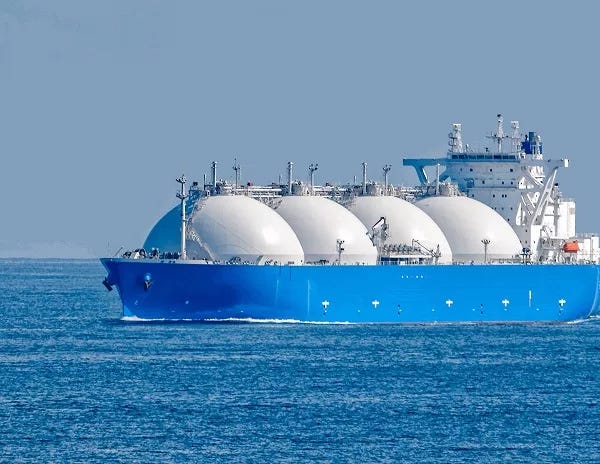
In a move that reflects a sharp understanding of the Middle East’s energy dynamics, U.S. Deputy Secretary of State Christopher Landau announced on Wednesday, November 19, that Egypt has signed a $4 billion agreement with the American energy firm Hartree Partners to import natural gas.
Washington sees the deal as part of a broader strategy to bolster its global economic and trade interests, supporting job creation in the United States while providing low-cost, reliable energy to key partners like Egypt, according to Reuters and Landau’s follow-up post on X the next day.
The announcement comes at a politically sensitive moment. Israel’s gas deal with Cairo is teetering on the edge of collapse due to Tel Aviv’s continued delays in fulfilling its export commitments.
What was once envisioned as a stable economic lifeline has increasingly become a pressure tool wielded by Prime Minister Benjamin Netanyahu’s government particularly during political disputes with Egypt, especially regarding contentious issues such as attempts to impose realities related to the displacement of Palestinians.
The Israeli deal, valued at $35 billion, involves the supply of around 130 billion cubic meters of gas through 2040, with daily volumes reaching up to 1.8 billion cubic feet. However, in recent weeks, the agreement has entered a complicated political and regulatory tunnel within Israel.
As the critical November 30 implementation deadline approaches, mounting technical and bureaucratic obstacles are casting growing uncertainty over its future.
Amid this gridlock, U.S. gas emerges as a potential interim solution, raising important questions: Is this merely a stopgap until the Israeli deal stabilizes, or is it a prelude to a broader shift in the Cairo-Tel Aviv energy equation? Could Egypt leverage this new development to negotiate new terms and insulate itself from the volatility of Israeli political decisions?
What is certain is that the days following November 30 will reveal the extent of maneuvering room and leverage each party holds in an environment where energy, security, and regional politics are now deeply intertwined.
The Faltering Israeli Gas Deal
In August 2025, at the height of Israel’s war of extermination in Gaza and amid escalating calls for political and popular boycotts of the occupation, Tel Aviv announced what it touted as “the largest gas deal in its history” a $35 billion agreement to export approximately 130 billion cubic meters of gas to Egypt by 2040.
The announcement, made by Israeli Energy Minister Eli Cohen, was seen as deliberately provocative, especially as images of devastation in Gaza stirred global outrage. The prospect of such a vast economic partnership ignited public fury across Egypt and the Arab world.
Despite widespread condemnation, Cairo attempted to contain the backlash by emphasizing that the deal was not new but an extension of a 2018 agreement an effort to depoliticize the issue and mitigate criticism.
However, this narrative failed to ease tensions, particularly given the widespread perception that the timing of Israel’s announcement was deliberately calculated to provoke political and media chaos.
Soon after, the situation flipped: Israel itself announced the suspension of the deal, citing disputes over pricing mechanisms and the need to meet domestic demand, insisting that it would not proceed without “protecting its internal market.”
This sudden reversal sparked frustration in Washington and prompted U.S. Energy Secretary Chris Wright to cancel his scheduled visit to Tel Aviv. The Israeli move raised more questions than answers: Was this a negotiation tactic?
A broader political play? Or a calculated effort to trap Egypt in a political and ethical dilemma rather than an economic one?
The suspension was not an isolated incident. It was merely the latest episode in a pattern of ongoing Israeli pressure since the outbreak of the Gaza war. Israel had previously threatened to revisit the deal in response to Egypt’s maneuvers in Sinai, halted exports citing tensions with Iran, and suspended production several times under the guise of security concerns or maintenance needs.
This pattern reflects a clear effort to transform the gas issue from a commercial matter into a political weapon. Israel has repeatedly used it as a tool of leverage to reshape the rules of engagement with Cairo. Egypt, in turn, has been actively seeking alternatives to reduce its dependence on a single, increasingly unreliable energy source.
Israel Puts Egypt in a Bind
Egypt’s pursuit of U.S. gas is not a matter of luxury it’s a strategic necessity. The country faces a growing shortfall between domestic natural gas production and surging demand, forcing it to become a net importer of liquefied natural gas (LNG) since 2024.
Egypt’s daily demand stands at around 6.2 billion cubic feet, while domestic production hovers between 4.1 and 4.2 billion cubic feet leaving a deficit of at least 2 billion cubic feet daily. Although the government aims to raise output to 5 billion cubic feet by year’s end, summer demand often spikes to nearly 7 billion, placing tremendous pressure on the energy system.
This reality has transformed Egypt from a gas exporter to a net importer amid a rapidly growing population, surging consumption, and declining field outputs, particularly at the Zohr field, whose production dropped from a 2019 peak of 3.2 billion to just 1.5 billion cubic feet per day.
According to Bloomberg, LNG exports fell from 7.7 million tons in 2022 to roughly 2.5 million tons of imports last year, signaling a drastic shift in Egypt’s energy profile. With production down 17% in 2024 compared to 2023, Egypt has become increasingly dependent on imports: total imports rose by 51% in the first nine months of the year, while LNG imports surged 169% in just three months.
To stabilize supplies, the government has signed long-term contracts through 2030 with LNG suppliers to cover summer consumption. Chief among them was the deal with Israel which has since been breached prompting Cairo to ink a new agreement with the U.S. Egypt became the second-largest importer of American LNG in August, receiving 57 billion cubic feet (13% of total U.S. exports).
Diversification Above All
Egyptian decision-makers now regard dependence on Israel as a strategic liability both politically and economically akin to gambling in a highly volatile region. The past two years have demonstrated that Israel views energy not as a commercial commitment, but as a political bargaining chip.
This has pushed Cairo to reengineer its gas supply chain, diversify sources, and reduce reliance on any single supplier especially as local production faces mounting challenges.
In this light, Cairo’s turn to U.S. gas reflects a calculated shift. The U.S. offers a more reliable alternative at a time when Egypt became the largest LNG importer in the Middle East in 2025, surpassing Kuwait due to plummeting domestic production and rising demand.
The American deal gives Egypt greater financial flexibility thanks to credit terms extending 6 to 12 months and pricing mechanisms tied to global benchmarks. This buffers Egypt from the kind of price volatility that often wreaks havoc on energy budgets.
Moreover, the deal helps Egypt stabilize its domestic energy market by securing sufficient supplies to meet growing demand, mitigating the risk of blackouts or disruptions in key industrial sectors.
The agreement is not merely transactional it forms part of a broader strategy to position Egypt as a regional energy hub in the Eastern Mediterranean, supported by a flexible infrastructure capable of importing, processing, and re-exporting LNG.
Economically and politically, Egypt’s pivot to U.S. gas strengthens its strategic alignment with Washington. Diversifying gas sources not only shields Cairo from Israeli pressure but also enhances its geopolitical bargaining power with both regional and global actors, aligning energy security with broader economic and national security interests.
America’s Triple-Dividend Pragmatism
From Washington’s perspective, the $4 billion deal may not be massive by energy market standards, but it delivers a triple payoff: economic, strategic, and geopolitical.
Economically, the agreement boosts U.S. LNG exports and cements Egypt’s role as a major market in the Middle East creating new opportunities for American firms while generating jobs and revenue.
Strategically, it expands the U.S. footprint in the region’s energy landscape, reducing Egypt’s dependence on rivals like Russian gas and reinforcing Washington’s role in shaping regional energy networks.
Politically, the deal provides the U.S. with fresh leverage in the Eastern Mediterranean, strengthening its partnership with Egypt through deeper financial and technical cooperation, and bolstering its status as a central player in the EastMed Gas Forum strategically positioned between Israeli, Egyptian, and European interests.
By routing U.S. gas through Egypt’s advanced liquefaction facilities, the U.S. also opens a gateway to European markets offering an alternative to Russian gas.
In doing so, Washington meets two goals: securing European energy supplies and scoring points in its broader geopolitical rivalry with Moscow.
What Lies Ahead for the Egypt-Israel Gas Deal?
Israel is unlikely to fully abandon its gas agreement with Egypt. Beyond its political value shifting Egypt from a gas exporter to an importer the deal holds undeniable economic significance.
Spanning 15 years and worth $35 billion, the agreement brings Tel Aviv roughly $2.3 billion annually, or about 3.8% of its 2024 exports a figure Israel sorely needs amid the budgetary strain caused by the war in Gaza.
Israel’s periodic threats to suspend or renegotiate the deal appear to be tactical maneuvers, part of a pressure campaign tied to Egypt’s position on the Palestinian displacement issue. Egypt, guided by its own political and security calculations, has pushed back.
Still, the most likely scenario is that Israel does not seek to terminate the deal but rather to use it as a temporary bargaining chip to advance political aims.
Enter the U.S. Trump’s administration with its hard-nosed commercial pragmatism has sought to capitalize on Egyptian-Israeli tension by promoting American gas as a temporary alternative.
The $4 billion deal offers tangible gains for U.S. companies and injects fresh liquidity into the energy sector, without compromising Washington’s leverage over either Tel Aviv or Cairo.
At the same time, the U.S. aims to contain Egypt within its strategic orbit and prevent it from drifting toward alternative suppliers like Russia or other Eastern powers. The American move is less about replacing Israel and more about bridging the current impasse cooling tensions, salvaging the original agreement, and keeping Egypt firmly within the Western energy framework.