

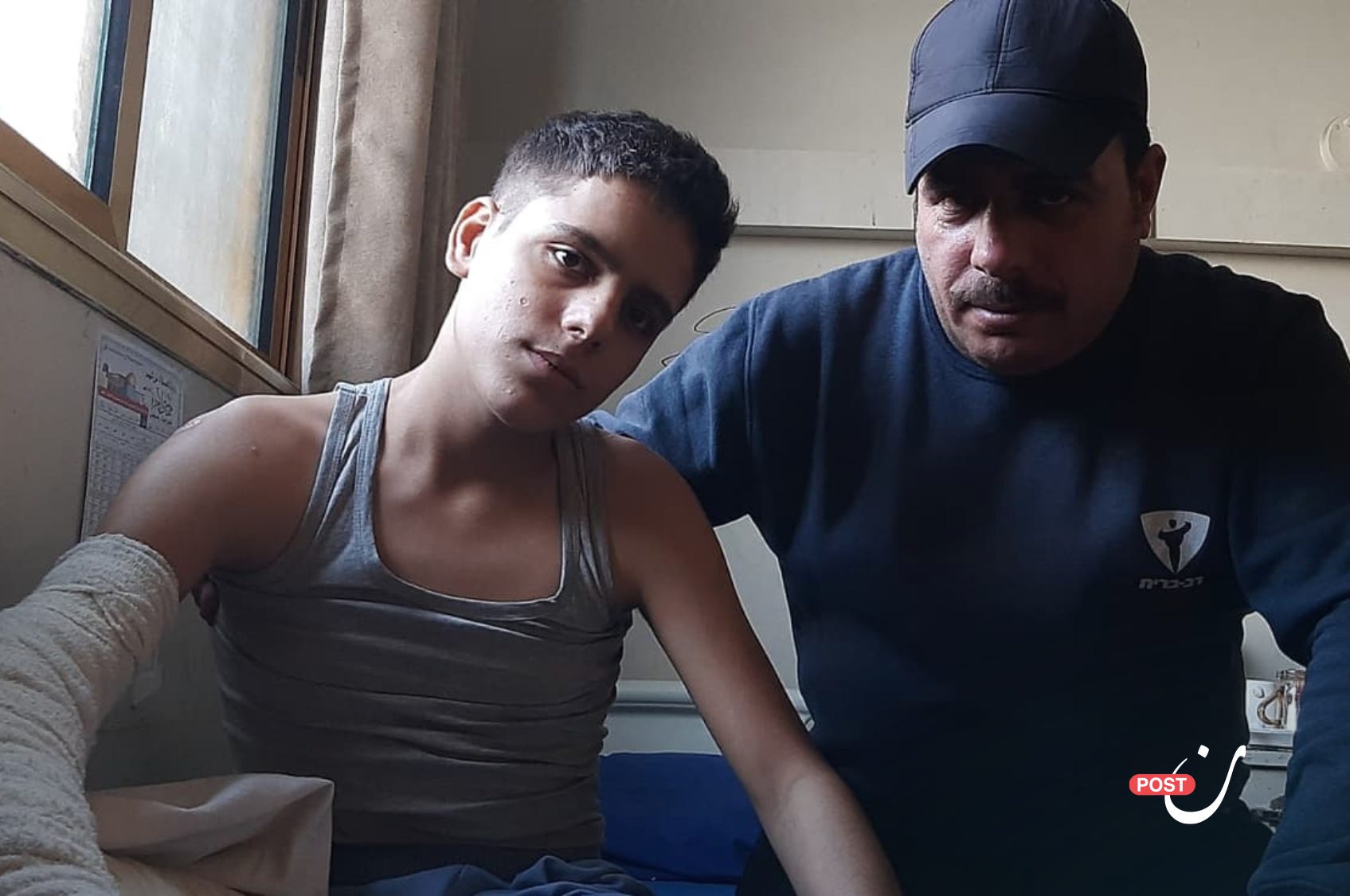
In the operating room of the Arab Ahli Baptist Hospital, 15-year-old Mahmoud al-Bahtini lies on a bed with his left leg amputated. His delicate body is wrapped in white gauze soaked in iodine and blood, while his father gently helps him sit up and wipes a warm tear from his right cheek. As he undergoes his first surgery, Mahmoud’s voice breaks through in a tone of sorrow:
“How am I supposed to start my life without my leg? Who will play soccer with me in the street?”
Mahmoud, now 15, recounts the devastating moment that changed his life. Speaking to Noon Post, he says:
“On November 1st, I stepped out of our house in al-Tuffah neighborhood to the street corner to pick up food from the community kitchen. It was just rice. Since we’ve been through famine, ‘the kitchen’ means food for the whole day. If I didn’t bring it home, my family of eight would go hungry.”
He runs his fingers over the spot where his leg used to be, feeling the wound.
“I didn’t even hear the Israeli drone drop the quadcopter bomb from above. I only felt the pain and saw the blood pouring from my body and leg. I still can’t forget lying on the ground in a tent outside the Baptist Hospital, bleeding, until hours later the doctors noticed me and gave me blood transfusions.”
As time passed, Mahmoud was rushed into surgery. His body writhed in pain and he screamed from the agony but it was too late to save his leg.
“I woke up in bed with a medical IV in my arm, and my body wrapped in white gauze,” he says, blinking.
“I was in so much pain in my upper thigh.” He pauses for a few seconds before continuing:
“I screamed and asked my dad: ‘Where is my leg?’ And he told me, ‘It was amputated above the knee... May God compensate you, Mahmoud.’”
The Weight of War
Mahmoud is one of over 6,000 Palestinians who have lost limbs, with children accounting for nearly 25% of all amputations during Israel’s genocidal war on Gaza. According to the United Nations, Gaza has become home to the largest group of child amputees in modern history.
During our interview, Mahmoud’s father, Saqr al-Bahtini, who is in his 40s, sat beside him, preparing a cup of tea.
“My son has now spent nearly three months confined to a hospital bed, unable to stand or take a single step without my help,” he says.
“Even going to the bathroom requires assistance. I feed him myself because his right arm is still undergoing surgeries it lost part of its muscle and is riddled with shrapnel.”
Mahmoud speaks in a trembling voice, his face heavy with sorrow:
“The occupation killed my older brother. The genocide took my leg. And shrapnel struck every part of my body.”
Wiping away a tear, he adds:
“I just want to play soccer again… to be able to walk on my own. Do you think my leg will grow back when I get older?”
Since October 7, 2023, Gaza has seen a surge in amputation cases caused by Israel’s devastating war, compounded by a severe shortage of medical supplies and prosthetic components due to the ongoing blockade and the closure of border crossings, according to the Palestinian Ministry of Health.
“Mahmoud is a man in a child’s body. He’s my right hand at home,” says Amal Rashid, his stepmother.
“His siblings are very young, no older than four. Mahmoud fetched water, chopped firewood, cooked food, and went to the market to get what we needed.”
With her hand resting on her cheek, Amal adds:
“Mahmoud is the son I never gave birth to. My heart breaks for his stolen childhood and the psychological toll he’s enduring every day since losing the leg he loved to kick a ball with. Soccer was his passion he dreamed of becoming a famous player like Ronaldo or Messi.”
When asked how the family is coping with Mahmoud’s psychological state, she tells Noon Post with a voice full of anguish and helplessness:
“Every day I visit him at the hospital, he always says, ‘Look, Mom... they cut off my leg.’ I try to lift his spirits, to tell him this isn’t the end. That he will continue his education and that we will do everything we can to get him a prosthetic leg. We pray every day for his recovery and for the chance to get him medical treatment abroad.”
The lack of prosthetic limbs and materials needed to produce them has deeply affected wounded Palestinians who now face intense physical pain and psychological trauma with little hope of returning to a normal life.
“Over two years of war on Gaza, the Ministry of Health has recorded more than 170,000 injuries and 6,000 amputations 25% of them among children and 12.5% among women,” says Zahir al-Wuhaidi, Director of the Health Information Center at the Ministry of Health in Gaza.
“More than 18% of injuries require long-term rehabilitation and physiotherapy, and may turn into permanent disabilities without proper care and services.”
He continues:
“There are 30,000 people in need of long-term physical therapy, rehabilitation, and support at a time when Israel’s policies continue to create critical shortages for the wounded in Gaza.”
“Israel is deliberately preventing the entry of medical supplies and prosthetic materials. Gaza once had a municipal prosthetics center and another in Sheikh Hamad Hospital for Rehabilitation and Prosthetics. Both are now out of service because they can’t access the raw materials needed to make prosthetics,” al-Wuhaidi explains.
He concludes his interview with Noon Post with a plea:
“We call on the global community to immediately open the Rafah crossing to evacuate the wounded and sick, and to allow the entry of medications, medical equipment, and prosthetic limbs. We also urge the dispatch of specialized medical teams to support Gaza’s health workers.”
Behind every amputated limb is a willpower determined to silence the pain—and carve out a path toward rebuilding a future.
