

Yemen is currently experiencing one of the most complex periods in its modern history since the outbreak of war. Political, security, and social crises are intersecting in a deeply entangled scene, where it’s difficult to isolate any single component.
The rapid developments in the southern provinces, accompanied by political and military escalation and shifting positions among local and regional actors, have rekindled essential questions about the future of the Yemeni state, the boundaries of competing political projects, and the extent to which other regions can remain neutral in the face of these growing tensions.
At the heart of these questions lie the eastern provinces —Hadhramaut, Al-Mahrah, and Shabwah— areas that have so far remained somewhat insulated from the political turmoil gripping parts of the south. As such, they have become a focal point for various stakeholders and a real test of the state’s ability to manage diversity and maintain stability in an exceedingly fragile environment.
While these provinces have not been immune to rising political rhetoric, they have remained, up to this point, less directly involved in violent confrontations. This can be attributed to their unique social and historical fabric and a community structure that favors civil peace and public service demands over divisive political agendas.
However, this relative calm does not imply the absence of challenges; rather, it suggests a temporary phase that could shift if polarization deepens or if the state fails to offer a distinct model for engaging with these regions.
A Unique Social Fabric Requires a Tailored Approach
In an official assessment of the situation, Deputy Minister of Information Dr. Fayadh Al-Nu’man told Noon Post that the government is closely and responsibly monitoring developments in the southern and eastern provinces. He emphasized that what is unfolding in the south cannot be separated from the broader national context or the consequences of the ongoing war.
Al-Nu’man noted that the eastern provinces represent a different model in dealing with the crisis, where social cohesion and political awareness have helped prevent the conflict from spilling over. Despite attempts to influence these areas through political rhetoric or partisan polarization, Hadhramaut, Al-Mahrah, and Shabwah have so far chosen to focus on service delivery and development, rejecting any descent into conflict that could endanger communal peace.
He argued that this reality necessitates a different political approach one based on partnership rather than dominance, dialogue instead of imposition, and acknowledgment of local specificities within the framework of a unified Yemeni state. Managing diversity, he stressed, does not weaken the state but can become a strength when addressed through equitable and participatory policies.
Al-Nu’man emphasized that preventing the political conflict from spreading to liberated provinces begins with addressing the root causes of the crisis in the south through serious, inclusive dialogue and by empowering local authorities to play a central role in security, service delivery, and development. This, he said, constitutes the first line of defense for stability.
The State’s Most Vital Stability Line
Despite the relative calm in the eastern provinces, this stability remains fragile amid ongoing war and competing political agendas. Recent events in Aden and other parts of the south have reignited debates about the role of these provinces in any future political settlement and their relationship to the broader “southern cause.”
Yemeni Shura Council member Salah Batis believes recent developments have negatively impacted the national scene, nearly undermining the state’s legal center and threatening social cohesion and regional security especially given these provinces’ ties to the security of neighboring countries and international maritime routes in the Arabian Sea, Gulf of Aden, and Bab al-Mandab Strait.
Batis told Noon Post that historically, the eastern provinces have not been part of the confrontational political projects that emerged in the south in recent years. He noted that these regions view themselves as partners in the anticipated federal state, as envisioned in national frameworks and the outcomes of the National Dialogue Conference—not as subordinate or marginal entities.
He warned against attempts to impose political models by force, whether those seen in Aden or Sanaa, arguing that applying such models broadly would only complicate the situation and deepen divisions. While recent events have bolstered the demands of eastern populations, Batis stressed that these demands remain legitimate within the framework of the state. They are based on equitable power and resource sharing not violence or exclusion.
Political Polarization and the Crisis’s Deeper Roots
Developments in the south also reflect a deep-seated political and social crisis, rooted in decades of absent justice and the state’s failure to effectively manage diversity. This has generated a range of demands from expanded local governance to outright self-determination making the southern issue one of Yemen’s most intricate challenges.
Political analyst Hassan Mughlis told Noon Post that the rising rhetoric around independence cannot be understood in isolation from its underlying causes. He explained that separatism was never a standalone goal but rather a direct outcome of accumulated grievances and the central government’s failure to deliver social justice.
Mughlis noted that Yemenis embraced unification in the hope of building a state grounded in equality and guaranteed rights. Yet, the lack of justice both before and after unification has fueled widespread feelings of marginalization. He asserted that geography is not the core issue justice is. And achieving justice could be enough to reverse separatist calls.
He criticized the reduction of the southern issue to certain political entities, arguing that monopolizing representation in such a diverse society only exacerbates division. He called for a comprehensive national dialogue inclusive of all Yemenis and warned of the dangers posed by regionalist discourse to the country’s social fabric.
A New Political Approach and Potential Shifts
For his part, Mohammed Omar Moamen, head of the Political Bureau of the Peaceful Tihami Movement, said recent southern developments have directly influenced the general political mood. He stressed that southern Yemen plays a critical role in both regional and international geopolitical dynamics.
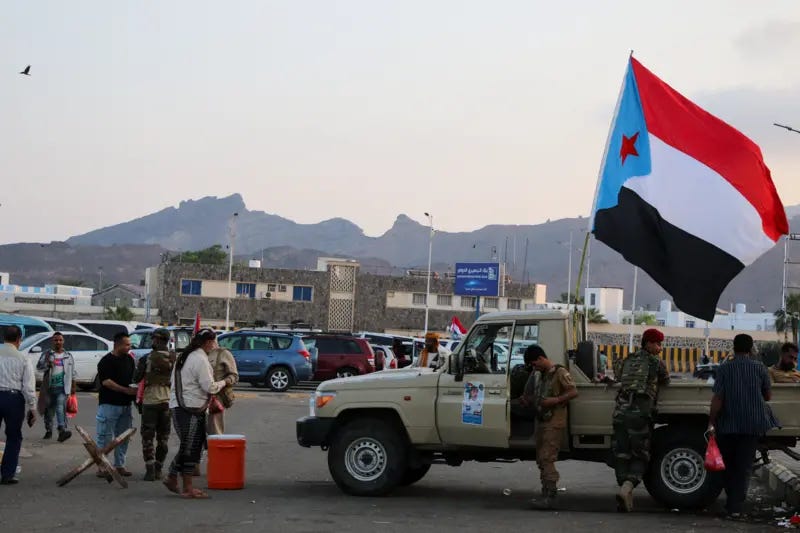
In an interview with Noon Post, Moamen said the events revealed major conflicts of interest within the Arab Coalition sometimes reaching the point of confrontation. He noted that Yemen’s strategic location means that any internal development carries immediate regional repercussions.
Regarding the eastern provinces, Moamen emphasized Hadhramaut’s distinct social, cultural, and economic character. He predicted the coming phase could see the emergence of political rhetoric expressing local aspirations for self-governance, particularly as regional actors shift positions and local stakeholders gain more freedom of movement.
Regional and International Dimensions and the STC’s Position
The significance of the southern and eastern provinces transcends domestic politics due to their strategic location along international shipping lanes, making any instability there a matter of growing regional and global concern. In this context, Southern Transitional Council (STC) spokesperson Anwar Al-Tamimi stated that the Council adheres to a political discourse that rejects monopolizing the southern cause or using it to promote unilateral visions that disregard collective southern aspirations.
Al-Tamimi told Noon Post that the STC’s project is a mass movement reflecting the aspirations of all southerners. He added that key southern strongholds including Hadhramaut and Al-Mahrah have always been the backbone of the southern project. The southern movement’s early sparks were ignited there, and they hosted the largest mobilization events.
He stressed that Hadhramaut and Al-Mahrah are acutely aware of the exploitation they have endured, particularly by wealth-plundering networks and systematic attempts to erase their identity and engineer forced demographic changes. As a result, these regions have become even more committed to the federal southern project as a framework that guarantees rights, resources, and identity.
Al-Tamimi said the STC not only recognizes local particularities but actively promotes them as a counter to any efforts to impose unity by force, political maneuvering, or external pressure. He argued that local identities are not in conflict with the southern project they are a foundational pillar of the envisioned federal southern state.
He added that military and media campaigns against the STC have not weakened it. On the contrary, they have strengthened its popular base, as evidenced by the massive public rallies seen in cities like Mukalla, Socotra, and the southern capital, Aden.
Al-Tamimi concluded by emphasizing that the south is home to genuine political pluralism, unlike other parts of Yemen. He stated clearly that the STC represents the political voice calling for the restoration of a southern state, while welcoming any other political initiative so long as it explicitly acknowledges the right to self-determination. Ultimately, he said, it is up to the southern people to decide.
