

After December 8, 2024, a long chapter of Syria’s modern history came to a close with the toppling of statues and portraits of the Assad family. Slogans that had dominated the public space for decades faded away. As this visual regime collapsed, Syrians seized the opportunity to reclaim their streets and squares.
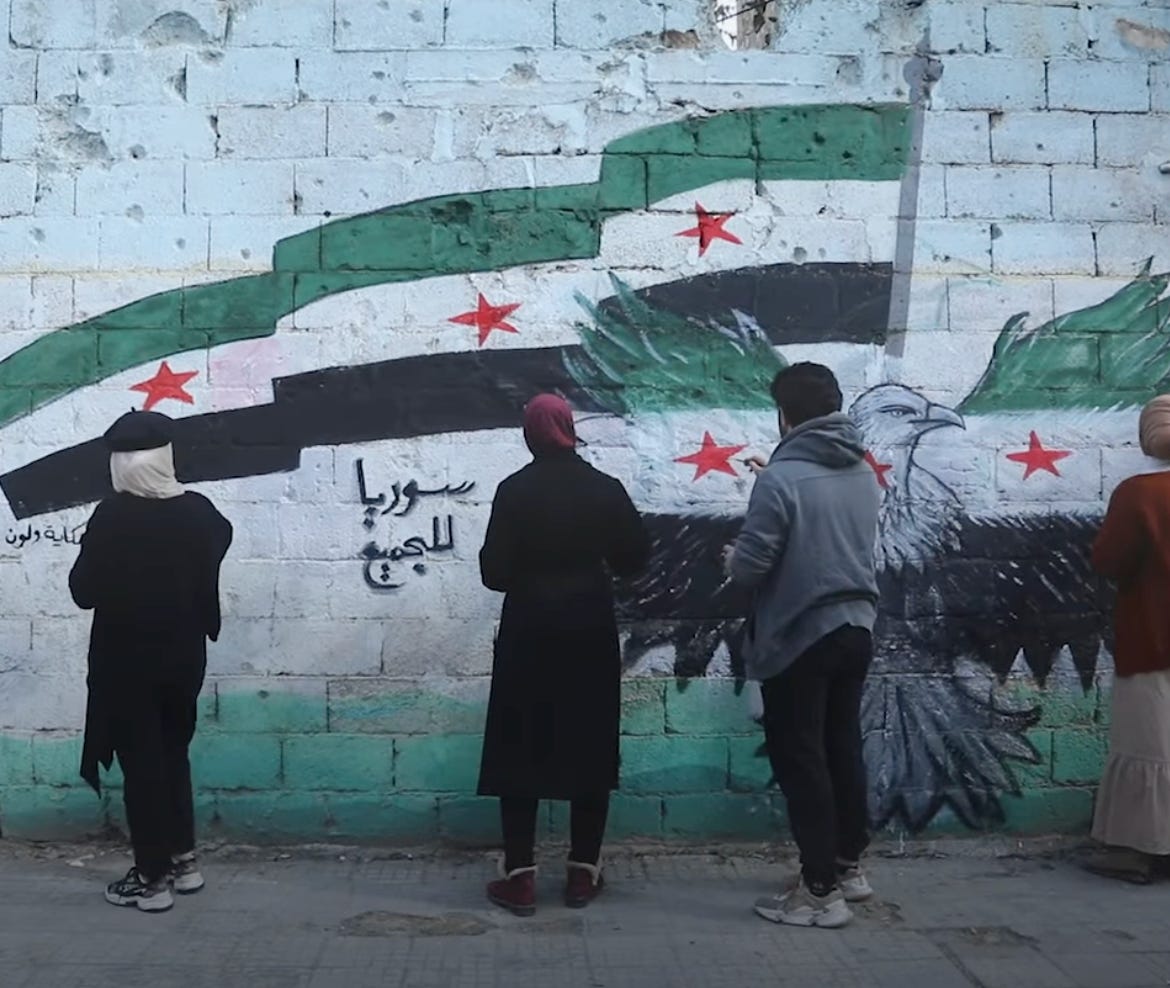
In the first weeks following liberation, Syrian cities underwent a rapid transformation. Streets and institutions bearing the Assad family’s name were renamed. Public squares, city centers, and schools filled with murals of the revolution, portraits of martyrs, and symbols of freedom.
Even the walls that once bore witness to repression were transformed into canvases of popular creativity, blending messages of unity with the scars of sacrifice and hopes for a future built on justice and dignity.
Today, streets, schools, and public spaces resemble living museums, telling the story of a new Syria, shaped by the hands of its people. The public space has become a visual archive of freedom sprouting from every corner, embodying a memory painted in the vibrant colors of revolution.
The once-restricted visual sphere has reclaimed its stolen freedom, becoming an open book where people now write their own history. Walls are no longer instruments of domination but a unifying national language through which a people reclaim their spirit and trace the contours of a new Syria.
This report follows the arc of that transformation from the fall of authoritarian symbols to the rise of a new visual landscape that affirms a Syria redrawn by its citizens, with public space finally reflecting their vision for the future.
The Fall of Tyranny’s Icons
Syrians experienced a defining symbolic moment in their modern history: the fall of the regime’s visual symbols. The toppling of portraits and statues was not an impulsive act of rage but a collective declaration of liberation from decades of domination, and a reclamation of the public sphere.
From the early hours of liberation, people in towns and cities across Syria took part in tearing down Assad family statues, burning images, and removing signs from government buildings, security compounds, schools, hospitals, and roads. Baathist slogans and banners were torn down.
In Homs, hundreds gathered around the statue of Hafez al-Assad long a symbol of repression—and pulled it down with their bare hands in a moment echoing scenes from Daraa and Hama days earlier. Chanting “God is Great,” protesters used simple tools to dismantle the statue. When its head finally fell, the crowd erupted in applause and joyous cheers.
In Daraa, the birthplace of the Syrian revolution, residents raced to destroy the statue of Hafez al-Assad, taking turns pulling the ropes. The scene became a spontaneous celebration. By morning, crowds paraded through the streets dragging the statue’s remnants.
In Aleppo, citizens removed the statue of Bassel al-Assad from his horse in the famous Bassel Roundabout. Cheers and chants filled the air. The regime retaliated swiftly—killing 61 civilians in a brutal act of vengeance.
In Hama, in another highly symbolic scene, residents used a mechanical arm to topple Hafez al-Assad’s statue, then dragged its head through the streets in celebration, firing into the air and chanting.
In Damascus, once buried under layers of regime imagery, a dramatic scene unfolded: people tore down Assad portraits and giant murals that had dominated neighborhood entrances for decades. With knives and bare hands, they dismantled statues and billboards. Crowds gathered under fallen icons some weeping, others recording moments they had never imagined witnessing.
These scenes played out across dozens of Syrian towns and cities. In many places, the destruction of tyrannical symbols became a small festival of freedom tears mingled with laughter in a collective ritual of liberation.
Previously, such images had been part of a calculated architecture of psychological and social control. Over 3,000 statues of Hafez al-Assad stood across the country, alongside portraits at city entrances, university squares, government ministries, hospitals—even in small shops.
These visual representations reinforced the regime’s omnipresence in daily life, turning fear into a social norm that permeated every aspect of existence.
With the collapse of these symbols, an entire visual regime crumbled. Syrians reclaimed their streets and redefined the public sphere as a space reflecting their will and narrative. A new visual archive emerged one that declared the end of a dark era and the birth of a new Syria, painted in the colors of its people.
Cities Regain Their Faces, Public Space Returns to the People
After decades of monopolizing public walls and squares, Assad’s imagery gave way to a restored voice in the public space. Once statues and old symbols fell, Syrians poured into the streets, reshaping their surroundings with new meanings that redefined the spirit of place. What emerged was a diverse visual identity—different in every city, reflective of local memory and history.
The spark began in Damascus suburbs—especially Daraya—before spreading quickly to Aleppo, Hama, Idlib, and Daraa. This visual renaissance was driven by volunteers, university students, local artists, and families of martyrs and the disappeared. It took many forms: murals on the ruins of bombed homes, large artworks at neighborhood entrances, and wall paintings through volunteer initiatives.
These murals centered on memory and commemoration (martyrs, the disappeared), freedom and hope (doves, children, sunlight), and citizenship and identity (justice slogans, messages of solidarity).
Walls became visual records of martyrdom, suffering, and resilience. Painted faces of mothers, children waving the flag of freedom, birds breaking free of cages, and hands building anew appeared alongside powerful slogans: “Dignity – We Dream Together – Hold Your Head High – Syria Is for All.”
In every city, locals reshaped public space. In Latakia, images of the former regime disappeared, replaced by murals supporting popular campaigns like “For Hama’s Sake.” In Hama, school walls once adorned with Baathist slogans now bore phrases celebrating freedom and dignity. In Aleppo, new murals reflected the city’s unique culture and post-liberation identity.
This new visual landscape captured every facet of the Syrian experience—pain, resistance, hope, and identity. The streets became open-air exhibitions reflecting society’s heartbeat. The public space was no longer muted—it was participatory, liberated from decades of authoritarian suffocation.
Faces of Martyrs and Fighters: Icons of National Memory
With the regime gone, local communities began crafting alternative symbols to replace the old icons of tyranny. Chief among these were images of martyrs, which became the foundation of a new collective narrative restoring a stolen memory and reintegrating the fallen into daily life.
The faces of fighters, medics, women, children, and victims of bombardment or enforced disappearance became a unifying visual language of collective sacrifice. Murals across cities honored them with artistic renderings that turned mourning into remembrance and hope.
Crafting a New National Identity
Following the regime’s collapse, public institutions removed all Assad symbols. The transformation began with schools. Assad’s portraits vanished, replaced by revolutionary flags and murals painted by students. Schools became laboratories for constructing a new national identity and public spaces instilling citizenship rather than authoritarian loyalty.
In Hama, local youth and volunteers revitalized school walls with community-led murals. Across cities, streets themselves turned into visual galleries. In Damascus, a major campaign repainted school walls, erasing remnants of the previous era.
Renaming Streets, Squares, and Universities
In the post-regime phase, a sweeping campaign began to rename streets, squares, and universities once dedicated to the Assad family a natural extension of liberating the public space and removing the markers of dictatorship.
Assad Square became Revolution Square. Bassel al-Assad Street was renamed Freedom Martyrs Street. Universities and institutions followed suit: Al-Baath University became Homs University; Tishreen University became Latakia University. The Assad Library became the National Library, and mosques like the Bassel al-Assad Mosque were renamed.
In Damascus, even the iconic “President’s Bridge” was renamed “Freedom Bridge.” In Hama, a major intersection was renamed “Shaheen Roundabout” in honor of the drone that played a key role in the battle against aggression.
In Damascus and elsewhere, youth-led campaigns erased visual remnants of tyranny. The streets began to reflect liberty.
Memory Initiatives: ‘You Are With Us’ as a Model
In this new era, organized initiatives emerged to anchor collective memory and promote justice. Chief among them was “You Are With Us,” a campaign by Justice and Empowerment Organization, which painted murals of 10,000 forcibly disappeared individuals. Artists, students, and families of detainees participated.
The artworks spread across Damascus, Daraa, and Idlib merging art with transitional justice.
This campaign marked an advanced stage of Syria’s visual revolution. It wasn’t just commemorative it was political, social, and artistic. It redefined public space as a collective forum for expression and memory, building awareness rooted in justice and dignity.
In Daraya, southwest of Damascus, one of the most striking examples took shape. Led by artist Bilal Shurba, a group of young artists turned the ruins of a destroyed house into a grand mural honoring families of the disappeared. Painted on a collapsed ceiling, the work stands as one of Daraya’s most significant artistic tributes.
Painting the faces of thousands of the disappeared was a transformative act turning private grief into a visible national memory. It transformed mourning into meaning, public space into a living museum linking past, present, and future, and gave people a deeper sense of belonging and shared responsibility.
The Role of New Symbols in Reimagining Syria
As new symbols spread across schools, streets, and institutions, Syria’s public space began a profound transformation one that reshapes not only appearances but also consciousness and collective imagination.
Murals of freedom, portraits of martyrs, and messages of citizenship reawakened an awareness that a new chapter had begun a rupture from the past. The public space was no longer the regime’s domain but a shared canvas where people draw their future.
These symbols are now central to redefining national belonging. The message is clear: the homeland is not a person to glorify, but values to build and experiences to share.
The new visual landscape also serves as collective therapy, easing the psychological trauma of loss. Martyrs’ portraits have become a public ritual of mourning, giving meaning to sacrifice and transforming private pain into a national cause.
Above all, this space prevents forgetting. The visual markers murals, names, faces keep memory alive. Every painting recalls a tragedy, every name celebrates resistance, every street becomes a living lesson in history a wall against the return of tyranny.
Ultimately, this new visual fabric is a human form of documenting Syria’s great revolution a history written in color, seen by the eye and felt by the heart, forming a shared national imagination for the future.

Incredible documentation of how public space transforms politically. The line about murals being 'collective therapy' after trauma really captures somethin deeper than just removing old symbols. Theres an interesting tensoin here between memorialization (honoring martyrs) and forward movement (building new identity) that most revolutions struggle with. The decentralized, local approach seems like it might help prevent a new visual monopoly from forming.