

Read the Interview in Arabic
The Arab region witnessed major transformations during the past decade, which included or resulted in the redrafting of constitutions in more than one state, the most recent being Syria, which woke up to a stunning dramatic transformation in late 2024.
The relationship between the constitutional text and the political reality in the Arab region has long been one of the most complex dilemmas. While the constitution is supposed to establish a social contract that restricts authority and protects people’s rights, it is instead a tool to entrench authority and prolong tyranny, amendable when necessary within 10 minutes, as happened in Syria in 2000.
With the major political transformations we are witnessing, I find myself interested in the constitution experiences in our region, especially since 11 Arab countries have witnessed, since 2011, the drafting of new constitutions, or made fundamental amendments to existing constitutions, or issued a constitutional declaration or document.
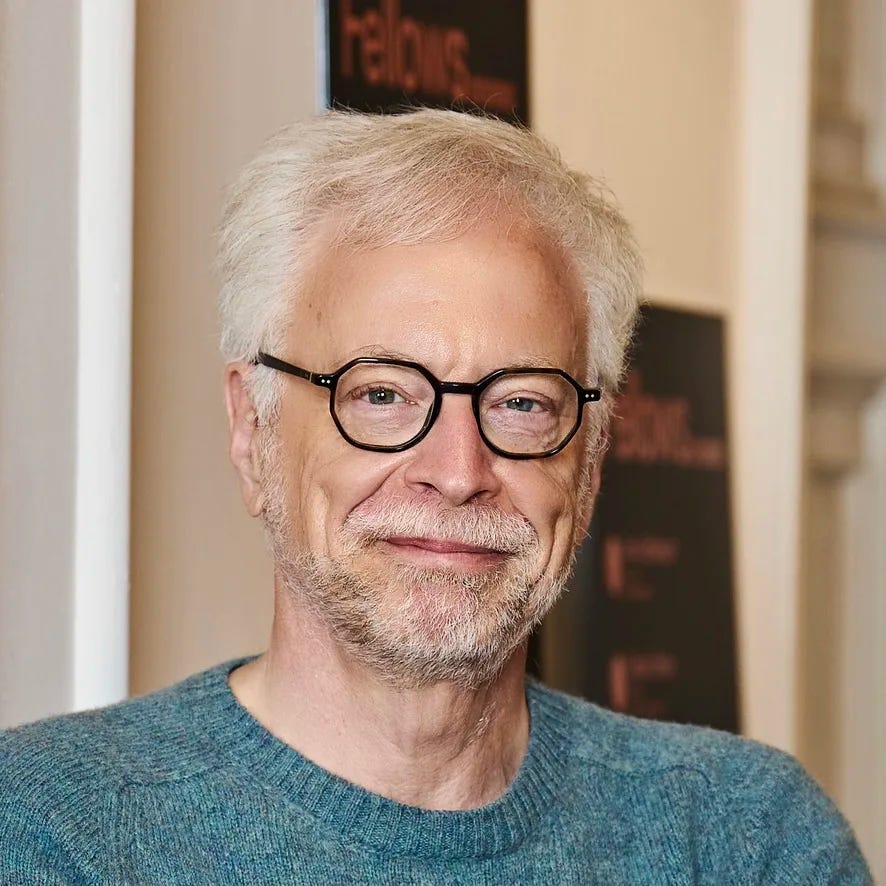
In this interview, we explore the visions of Nathan J. Brown the prominent American researcher, one of the foremost Western authorities on Arab constitutional and political systems, and the author of important works such as Constitutions in a Non-Constitutional World and When Victory Is Not an Option regarding the Arab constitutional faltering, the future of Islamic currents, and the challenges of political transition.
Who is Nathan Brown?
A prominent American scholar of politics and governance in the Arab world, and a professor of political science and international affairs at George Washington University. His research has earned numerous prestigious awards, and he is a nonresident senior fellow in the Middle East Program at the Carnegie Endowment.
Brown (68) received his B.A. in political science from the University of Chicago, and his M.A. and Ph.D. in politics and Near Eastern Studies from Princeton University. He teaches courses on Middle Eastern politics, as well as broader courses on comparative politics and international relations.
His Publications (Newest First):
Autocrats Don’t Always Get What They Want (2024) – with Steven D. Schaaf, Julian Waller, and Samer Anabtawi.
Lumbering State, Restless Society: Egypt in the Modern Era (2021) – with Shimaa Hatab and Amr Adly.
Arguing Islam After the Revival of Arab Politics (2016).
When Victory Is Not an Option: Islamist Movements in Arab Politics (2012).
Between Religion and Politics (2010) – with Amr Hamzawy.
Resuming Arab Palestine (2003).
Constitutions in a Non-Constitutional World: Arab Basic Laws and Prospects for Accountable Government (2001).
The Rule of Law in the Arab World: Courts in Egypt and the Arab States of the Gulf (1997).
Peasant Politics in Modern Egypt (1990).
Allow me to begin this interview with a question I previously posed to Professor Elizabeth Thompson. In her response, she spoke highly of your work on constitutions in the Arab world, which prompted me to ask you the same question: where does the constitutional project in the Arab region usually falter?
One could say they falter in the text: they have loopholes, vague clauses on rights, devices to render meaningless procedures for accountability, and so on. But the differences between authoritarian and democratic constitutional texts are real but often exaggerated. I think where they really falter is in the political context more than the text itself. Without some pluralism within society and within the political sphere it is difficult for any constitution to operate in a fully democratic manner.
In your book Constitutions in a Non-Constitutional World, you argue that authoritarian regimes draft constitutions not to constrain power as is their presumed role but to entrench it. Today, after two decades marked by repeated constitutional amendments across the region, do you believe the function of Arab constitutions has shifted from being merely a “tool for regime survival” to a more direct “instrument of exclusion” against political opponents?
First, I would say that almost all constitutions are written to entrench authority. Democratic ones are no different in that regard; they do constrain authorities in some way, but they also define chains of command, authorize, and clarify, and enable. It is not a coincidence that many constitutions are written in the midst of fiscal or military crisis and are thus designed to support the state.
But what is distinctive in the Arab world is that almost all constitutions have been written by existing regimes seeking to entrench themselves. They are not written by rival political forces seeking to hammer out rules for politics, nor are they written by elites attempting to construct a state (or rescue one in crisis). They are written by existing regimes seeking an adjustment, reinforcement, or new ideological direction.
For a brief moment after 2011 that was different: constitutions were written by rival political forces negotiating (Tunisia), as a result of an indeterminate struggle (Egypt); they were amended (Jordan, Morocco) by existing regimes attempting to bargain with their critics.
But there was meagre fruit from these efforts. The period of constitutionalism uncertainty (and often of optimism) did leave an effect, however. Political movements and actors are far more likely to cast their aspirations in constitutional form than earlier; constitutional language is more frequently heard in the public sphere.
Based on your research, what are the most significant challenges facing constitution-making processes in the Arab world?
As I have suggested the most significant challenge is autocracy itself. As long as authority is monopolized, there can be no constitutional process that delivers anything other than autocracy–and indeed, constitution writing that allowed for true accountability and contestation would be a threat.
But I think there is a second one as well. Even if there were pluralism in fact, acceptance of pluralism has been much less in evidence. Or where it has seemed to appear–for instance in Egypt in 2011–it quickly collapsed under deep mistrust.
How do you assess Article Two in the Egyptian constitution and similar provisions in other Arab constitutions—that declare Islam the religion of the state and Islamic law a principal source of legislation? Do you see this article as having genuine legal impact, or is it largely symbolic or folkloric in nature?
From your scholarly perspective, does this provision merit the level of controversy and political struggle it generates each time constitutional experts sit down to draft a new constitution in the region?
The legal effects of such clauses have been limited. I think there are provisions for religion that can have effects (for instance, those placing family law on a religious basis) but these are not among them. To have real impact, the clauses would have to be (1) more specific, or (2) designate authority to determine which interpretation of sharia is binding. The legal meaning is determined by “who” questions as much as “what” questions.
I do not dismiss such clauses, however, since they attract attention and debate, forming focal points for constitutional argumentation. It is difficult to understand the deeper engagement with constitution drafting over the past two decades without realizing the way religion and constitutional text have become linked.
Have you had the opportunity to review the text and experience of Syria’s new Constitutional Declaration of 2025? If so, how do you assess the document and the broader constitutional moment it represents? And what message would you offer to Syria as it looks ahead to drafting a permanent constitution?
The message of the document is “Syria has a president and he will oversee the transition.” The message that I would offer is “You will pay a price in the long term if you view the constitution as a place to record your dominance rather than as an arena for a deeply divided and traumatized society to find ways to reconstruct their political system.”
In your book “When Victory Is Not an Option”, you argue that Islamist movements participate in politics in order to survive rather than to govern. After a decade of zero-sum conflict, has “survival” itself become an unattainable option? And does this mark the end of the traditional organizational model of the Muslim Brotherhood?
It marks the end of the Brotherhood’s political project, at least for the forseeable future. And by that I mean the idea that the best way to pursue the Brotherhood’s goal is through the political process.
And yes, survival becomes a goal in itself. Some within the movement–one that is now a century old–view their mission as long term and thus preserving the organization becomes an important accomplishment especially in the context of deep repression.
Do you believe that Arab states have ever allowed Islamists to come to power without retaining the right to withdraw that power whenever they choose?
I think the question conflates state and regime–and that is what many regimes do. They see their preservation and tantamount to preserving the state itself. And that makes it difficult to accept any rotation of power, whether with Islamists or others.
Were the experiences of Islamists in government, particularly in Egypt and Tunisia—a failure of “ideology,” or a failure of “governance” and bureaucratic management? And are there lessons here that you believe are especially relevant for Syria today?
In a sense, given the history of these societies, the political configuration, and the challenges, success would have been a bit of a surprise. There were miscalculations to be sure, but I do not think they were the monopoly of Islamists.
The situation in Syria is so different–it is a society recovering from over a decade of horrific violence and dislocation; and one in which political differences have become militarized. That is such a different setting that I would look elsewhere for lessons–to societies emerging from similar civil conflicts.
Why do processes of political transition in the Arab world appear more fragile and protracted compared to other regions, such as Latin America or Eastern Europe? What, in your view, lies at the heart of this persistent difficulty?
I do not think they are more fragile and protracted. The problem may be with the word “tranistion” itself–it implies a clear beginning and end. Politics did not start at a specific point and it will never end. What appeared to be a neatly defined transition in some settings (say, Russia in the late 1980s and early 1990s) looks very different today.
10. Do terms such as “democratic transition” still retain analytical value when applied to the Arab region, or is there a need to develop a new political vocabulary to more accurately describe what is unfolding?
I think if we only understand politics as a move to or away from democracy we miss most of what is going on. We have a rich vocabulary about politics that should not be reduced to the single dimension of degree of democracy.
How can Syrian civil society today and perhaps this also applies to civil society in Egypt, Tunisia, and elsewhere—expand its margins of freedom and strengthen its representation without coming into direct confrontation with the authorities?
Of course it will come into confrontation; the goal might be to manage such confrontation and work out political rules to protect some measure of debate. There is no magical path to such an outcome, but any “civil society” that does not have deep roots in the society is likely to be easily contained.
Do you think the nature of “civil society” in the region has fundamentally changed? For example, have we moved from a phase centered on “rights-based demands” to one dominated by “strategies of survival”?
I think the biggest change may be the way in which informality has become more powerful as formal politics has been so sharply patrolled. There may be little space for labor or political party organization in some countries, but there are more sophisticated debates outside of those channels, whether on social media or in personal conversations. This is an impression, not a finding, but I simply find that few regimes control their subjects’ minds even if they control all the legal tools.
Allow me to conclude with this final question as well: as a Western scholar, how do you deal with the charge of “Orientalism,” or of imposing Western theories on a complex Arab reality? How do you ensure that you are truly “listening” to the region rather than “lecturing” it? And do you believe there are questions that Arab scholars do not ask often enough about their own states?
I’ve never been charged with “Orientalism” and the burden of proof would be on the accuser if such a charge were levied. I am not concerned with preempting it.
What I do try to do is precisely what you suggest: listen. And that means two things: listen to the people I am studying and listening to those who study them (my scholarly colleagues) regardless of their language, nationality, or discipline.
I publish the writings I do not to lecture but to engage–I am happy when I get a serious response from my colleagues; I am even happier when I get a serious response from those I study (whether it is Kuwaiti Islamists or Egyptian judges).
I think the distinction between Arab scholars “studying themselves” and Western scholars “lecturing them” is one that is not false but it has greatly diminished over the course of my career. Intellectuals are increasingly open to building global rather than national communities. And they are bold in their questions.
Unfortunately there are now two political factors at work that may undermine that very positive trend: restrictions on social science research in the Arab world; and restrictions on travel especially by the current American leadership.
This interview forms part of a continuing series spotlighting Western scholars whose research addresses the Arab region or explores Arab–Western relations. The project aims to critically examine how Western academic and intellectual frameworks conceptualize the region. Previous conversations in the series included researcher Daniel Zoughbie and Professor Elizabeth Thompson.
